Debate is raging across the world—not just the Anglosphere—over diamond nomenclature. For those interested in gemological geopolitics, the war of words is now echoing through the Kremlin.
On Wednesday, Vladimir Putin became the latest, and arguably the most powerful, head of state to officially weigh in on what lab-grown diamonds may be called. The debate over diamond terminology, it seems, is just as pedantic in Moscow as it is in Vicenza or New York.
The exact terms, according to Russian law and trade parlance, vary from English. In Russian, brilliants are faceted diamonds, whilst almaz refers more generally to the rough diamond itself. No longer can brilliant be associated with a man-made diamond.
On Oct. 28, the opening day of the Russia–Africa summit and economic forum in Moscow, the Russian president said he sides with his finance minister on whether man-made diamonds deserve the same name as mined ones, according to state news agency RIA Novosti.
“My opinion is closer to what our minister said: After all, what is created by nature is what forms the basis of this industry,” Putin said in Russian.
Lab-grown producers, said Putin, made their case to him directly.
“They tell me: Our products are no different from natural diamonds, they are no worse in appearance or quality, so they should cost the same,” he said. “Nevertheless, decisions are being made here that prohibit calling artificial diamonds diamonds in the literal sense of the word. After all, they are man-made.”
Putin added, though, that only specialists can really tell the difference between a man-made diamond or a natural one, or what they’re worth, according to RIA Novosti.
His deputy government chairman and finance minister, Anton Siluanov, was more blunt about it. At an exhibition on the forum’s sidelines, he said natural and lab-grown diamonds are diverging in both value and demand, and that the variance between the two grows stronger each year. “And so it will continue further, because in the final count, artificial diamonds will be turning into good costume jewelry,” Siluanov said, as reported by Finance Mail.
Glasnost and gloss: Kremlin’s case against lab-grown stones
In Russia, where diamond mining company Alrosa holds a near-monopoly, different arbiters are at play: The line was drawn not by a lab or a trade body—with boisterous and litigious public debate—but by the government.
Under Government Resolution No. 657, in force since Sept. 1, lab-grown stones must be sold as faceted synthetic diamonds (ogranyonny sinteticheskiy almaz), tagged synthetic, and weighed in grams rather than carats, as JCK reported in July. Sellers may not use the Russian term brilliant, its derivatives; color and clarity grades; or words such as precious, real, genuine, natural, mined, or eco-friendly, on tags, websites, advertising, or certificates, according to legal database Garant.
Deputy finance minister Alexei Moiseev cast the rule as consumer protection. “Precious articles are a significant purchase, which is often connected with a gift, a family history, and long-term value. Therefore, the consumer must see correct and reliable information about the origin of the stone,” he said in a Kremlin statement.
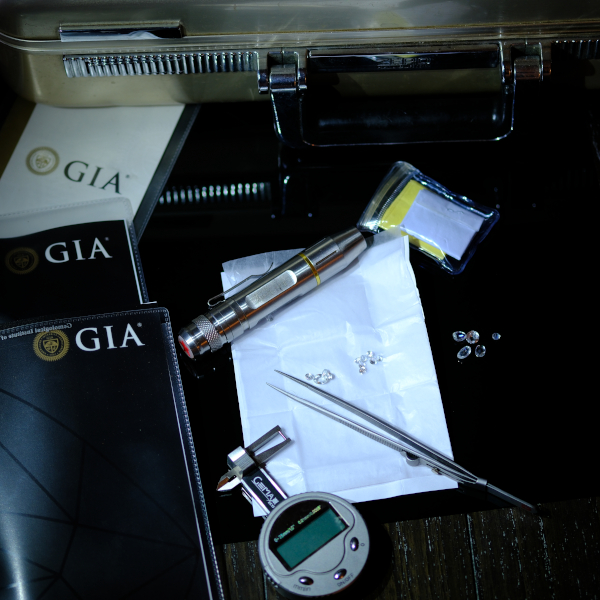
Alrosa told Russian newspaper Kommersant the approach matched international practice—and pointed to, of all places, GIA.
The rule landed as lab-grown was surging in Russian stores. In the first quarter, jewelry chains reported lab-grown’s share of their sales had risen 2.9 times year over year, to 25%. Retailers pushed back, proposing grown or synthetic brilliant. They lost, but won a concession to sell stock already in circulation under their old and preferential labeling regime.
State-controlled Alrosa reportedly produces roughly 90% of Russia’s diamonds and posted a net loss of 9.54 billion rubles in the first half, against a 40.6 billion ruble profit a year earlier. It has been under U.S. sanctions since 2022, and G7 nations have barred Russian diamonds since 2024. Prior to the Russia-Ukraine war—when distribution statistics from Russia were perhaps more believable in the eyes of the collective West—Russia was widely known to have supplied roughly a third of the world’s natural diamonds.
From Russia, with synthetics
Relations between Russian and American gem experts weren’t always so fraught. In 1993, two years after the Soviet collapse, GIA researchers and scientists from Lomonosov State University in Moscow jointly described Russian-grown diamonds in Gems & Gemology as synthetic diamonds. GIA kept that word on its reports until 2019, and from 2020, lab-grown diamonds were benefiting from the full 4Cs of natural diamond grading reports—until last year, when GIA pulled back.
In Moscow, state gem labs were describing lab-grown diamonds in the same series of attributes used as natural diamonds as recently as 2023—citing one 16.04-ct. stone as “D/VS1”—before the government stepped in.
The carat and the stick
Since then, as the price of lab-grown diamonds continues to collapse, the war of words has reached the scale itself. In diamond-producing countries such as Botswana and Russia, whole units of measurement are now in the crosshairs of government policy when it comes to diamond verbiage.
Nations that dig diamonds out of the ground don’t want people to use carats (0.2 grams) when labeling man-made diamonds. The Kremlin already demands lab-grown stones to be weighed in grams. Last year, Botswana’s government announced plans to follow suit.
In America, a similar battle is headed to Washington, where the FTC is expected to reopen its Jewelry Guides in 2027 or 2028. Many lobbying groups are standing on both sides of this simmering debate.
Those in favor of filing lab-grown diamonds under synthetic when the FTC revisits its Guides include, among others, the Diamond Manufacturers & Importers Association of America and the American Gem Trade Association.
Others are signaling they will defend the term. The Plumb Club has joined forces with the Jewelers Vigilance Committee to help shape the review.
“Growing” opposition
Lab-grown producers, meanwhile, are lawyering up. After CIBJO’s board voted in September to make synthetic the sole descriptor in its Diamond Blue Book, the lab-grown advocacy group Diamond Producers Council (DPC) called the move “biased and deceptive.”
It also recently sent a legal notice to the jewelry industry, domestically and globally, warning that it reserves the right to “pursue legal remedies against jewelers, trade organizations, and other market participants that use the term synthetic in a manner that misleads one or more consumers into believing that lab-grown diamonds are fake, imitation diamonds, or are not diamonds.”
DPC warns that its lawyers are ready to fight back, not only in the United States, but in other jurisdictions too.
This leaves Moscow in a weird agreement with the collective West’s natural-diamond lobby. The word the Kremlin has written into retail law is the one AGTA, DMIA, and Africa’s producers want Washington to adopt—and the one Russian and American gemologists put their names to in 1993.
Only the producing states, though, have gone after the scale itself: Russia by government decree, Botswana and its African peers so far only by proposal. The lab-grown camp has reached for the courts instead, and it has the science on its side of at least one argument. (The FTC concluded nearly a decade ago that lab-grown stones share essentially the same optical, physical, and chemical properties as mined ones.)
Even GIA, which has changed course on lab-grown three times since 2019, spent five years grading them on the same 4Cs as natural diamonds before pulling back.
Each side, in other words, is grasping for whatever leverage it has: Governments that dig diamonds write rules and bend metrology, and consortia that sell lab-grown diamonds hire lawyers.
Whether Washington moves any closer to the Kremlin’s decree, or Gaborone’s scale, may become clearer in 2028—if, as JCK has noted—the FTC’s revision proceeds on schedule at all. Until then, as Putin himself admitted, only specialists can tell the stones apart.
The words, and the weights, are another matter. (With files and translation from Aaron Soloviev)
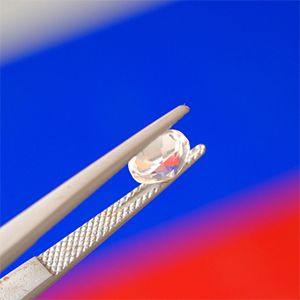
Top: A diamond reflecting light off Russia’s flag (photos: Sam Cooley)
- Subscribe to the JCK News Daily
- Subscribe to the JCK Special Report
- Follow JCK on Instagram: @jckmagazine
- Follow JCK on X: @jckmagazine
- Follow JCK on Facebook: @jckmagazine