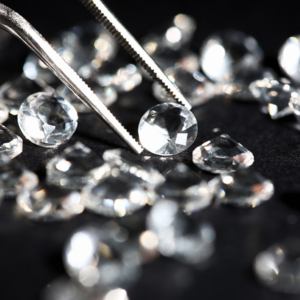
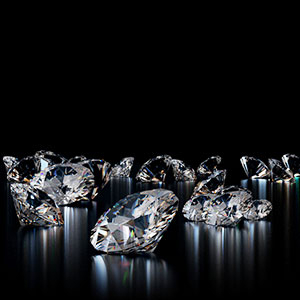
The Russian Federation has joined Belgium and France in mandating that lab-grown diamonds be called synthetic—and some are now hoping the U.S. Federal Trade Commission (FTC) might establish a similar policy.
Russia’s new rules on lab-growns are particularly restrictive, forbidding the use of standard diamond grades for synthetics and insisting they be measured in grams, not carats. It also forbids marketers from using standard jewelry-selling terminology.
“The regulation explicitly restricts the use of ‘бриллиант’ for artificial-origin stones,” Nastya Ivlieva, the Russian-speaking founder of Lostin.Studio, tells JCK. “In Russian, there are two different words [for diamond]: ‘алмаз’ refers to diamond as a material, the mineral. ‘Бриллиант’ refers to a cut gemstone used in jewelry trade.”
“The rule does not explicitly ban the use of ‘алмаз’ when it is properly marked as synthetic.… [It] is about restricting the trade term brilliant.”
That means that when selling a lab-grown diamond in Russia, it would have to be described as a polished rough synthetic.
The news was praised by Russian diamond miner Alrosa, and some in the natural business hope that more countries will follow Russia’s lead.
Russia’s move came shortly after the African Diamond Producers Association (ADPA) met in Sierra Leone and called for stricter regulations on lab diamond nomenclature.
The ADPA says it plans to lobby governments throughout the world for similar changes—with a particular focus on the United States, the world’s largest diamond market.
At JCK Las Vegas this spring, Bogolo Joy Kenewendo, Botswana’s minister of minerals and energy, said that her country is “putting forward position papers” to the FTC calling “for the term diamond to be reserved for natural diamonds and for synthetics to be called synthetic.”
The FTC is scheduled to review its Jewelry Guides in 2028. However, it’s possible that revision may be delayed, given that the agency has not yet completed its planned overhaul of its Green Guides, originally slated for 2022.
Even if the FTC does review the Jewelry Guides, some warned it is highly unlikely it will mandate the term synthetic, since it has allowed terms such as lab-grown and created for decades.
“What happened in Russia will not fly here,” says Tom Chatham, chairman of Chatham Created Gems, whose father, Carroll, waged a long legal fight to describe his gemstones as created. “That is why we have the Federal Trade Commission, to protect consumers from entities that want to eliminate competition.
“Chatham didn’t win in 1962 because we out-lawyered the Feds. We won because Chatham created emerald, not fake emerald, and to require synthetic would be unfair to the consumer because they equate that word with fake.”
The FTC seems to agree with that last point. In its 2018 review of the Jewelry Guides, the agency took a dim view of the term synthetic, and removed it from its list of recommended descriptors for lab-grown diamonds. (Its current favored terms are laboratory-created, laboratory-grown, and [company]-created. All lab-grown diamonds must be sold with a “clear and conspicuous” modifier that alerts consumers to the nature of the product.)
FTC lawyers said its was making that change because “many consumers mistakenly believe synthetic means an artificial product such as cubic zirconia, which lacks a diamond’s optical, physical, and chemical properties.”
And while the agency declined to ban use of the word—which is regularly used by scientists to describe created gem materials–regulators also warned that marketers should not use it to imply that lab-grown diamonds are not “actual diamonds.”
Even so, synthetic has now become the term of choice for many in the natural diamond business, and De Beers CEO Al Cook has taken to using a hybrid term, synthetic lab-grown diamonds.
(Photo: Getty Images)
- Subscribe to the JCK News Daily
- Subscribe to the JCK Special Report
- Follow JCK on Instagram: @jckmagazine
- Follow JCK on X: @jckmagazine
- Follow JCK on Facebook: @jckmagazine