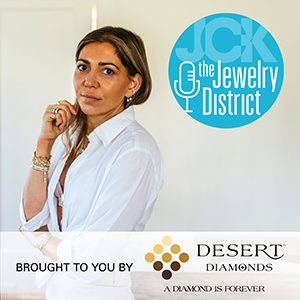
Victoria Gomelsky and Rob Bates talk to Jade Trau, founder of her eponymous brand. She shares her experience growing up as a fifth-generation diamantaire who traveled the world sourcing diamonds for her grandfather’s business, and how her perspective shifted after the birth of her twins. She explains how she formed her own point of view in jewelry design and the moment in her career when she actually started to see herself as a designer. Get her reaction to gold prices, lab-grown diamonds, and stick around to the end to see her beautiful heirloom piece made with a fancy gray diamond and hear the story behind it.
Watch Now
Title sponsor: De Beers (adiamondisforever.com)
Show Notes
04:20 Jade’s background
08:30 Impressions of the diamond business
11:25 On becoming a designer
15:55 How she responded to the gold prices
19:35 Thoughts on lab-grown diamonds
21:20 Visiting a Botswana mine
26:00 Story of her fancy gray diamond heirloom
Episode Credits
Hosts: Rob Bates and Victoria Gomelsky
Producer and engineer: Natalie Chomet
Editor: Riley McCaskill
Plugs: @jckmagazine; adiamondisforever.com
Episode Transcript
This transcript has been abridged and edited for clarity.
Victoria:
Hey, everyone. Welcome to The Jewelry District…How goes it?
Rob:
Hi, it goes well. Good to see you. It’s already fall. I don’t know how that happened.
Victoria:
Yes, it is fall! Next week when people are listening to this, I will be in Milan attending the Patek Philippe Grand Exhibition.
Then I’ll stop in Paris for one night on the way home and there’ll be a lot of jewelry events there. So, I will come home bearing lots of good information about fall trends and any other buzz I hear because there’ll be a lot of American jewelers there, as well as Europeans who are showing alongside Paris Fashion Week.
I’ll follow up the next time we talk. In the meantime, we’ve got a lovely guest: the wonderful beautiful designer Jade Trau. Jade, it’s so nice to finally get you on.
Jade:
Thank you. It’s so nice to be here.
Victoria:
Especially with fall here, I’m always keen to hear about your take on trends. We’ll get there.
You have a beautiful space. Are you in your New York office?
Jade:
I’m working from home today. It is where I do most of my designing because I need total quiet. Anything is distracting.
Victoria:
I get that. When I’m writing, I really need quiet. But it’s interesting for a designer. I’m sure some people would find music inspirational, but not you, it sounds.
Jade:
It depends on where I’m at. I’m very busy designing a brand-new collection to celebrate my 15th anniversary next year. It’s distracting in and of itself because it’s so new. I can do whatever I want. And that’s so distracting that if you add music to that, then start thinking, “What do you think their process was? How do you think the song was written? What do you think she was wearing? Where’s her studio?” So I need to disassociate.
Victoria:
You mentioned 15 years, so let’s go back. What year did you start?
Jade:
2012 because the collection is for next year.
Victoria:
Okay, 2012. Let’s go back well before then. Tell us about where you grew up.
Jade:
I grew up in New York City. I call myself a townie, but my town is Manhattan. I was born at Lenox Hill Hospital two miles away from where I’ve ever lived other than my one-year stint in Miami. I really never left. I went to the same school from nursery until I graduated high school and then went to NYU. So I was on the island.
I never knew that people commuted in a car. I commute by going up in the air. At NYU, I studied marketing before the internet, which was a valuable degree. In my freshman year in college, I had already started working for my grandfather. At the time, my grandfather was a De Beers sightholder. It was right before everything started to change—before De Beers brought their consulting group in and they started doing supplier of choice and everything else.
My timing was that I saw old-school diamond business, then I saw the transition and everything that happened subsequently.
I had my babies in 2007, which was a big moment for me because suddenly, it wasn’t just that I was my job, but I was leaving these kids so that I could go do this job. So, career fulfillment meant something different to me at that moment. I started thinking, “How am I adding value? What am I doing to change the pipeline?”
We manufactured the 2.5 to 4 cts. It was mostly round goods and some fancy shapes—what we called round-edged fancies, marquises, pear-shapes, ovals, emerald-cuts. If we manufactured one 2-carater from our box, that was a big deal. But it was mostly from 30 points up to about a carat 80.
I’d come into the office one day, and my grandfather would say, “We got an order from Costco,” or “We got an order from Tiffany’s. I need you to go to Antwerp tonight, and I need you to buy 100 one-carat IVS2s, or as many as you can buy.” And I’d get on a plane. And it was fun when I was 27. But once I had these two babies at home, I didn’t want to do that. It was just buy low, sell high. That’s all I did.
At that point, I started to see what was on the market. And of course, all these heritage houses all have their own point of view in that they have beautiful collections and wonderful designs. But the classics always looked fairly similar. The studs looked the same, the tennis bracelet looked the same, the rivière necklace looked the same. There was a bit of a formula, and you would only change the dial about 5%. But from afar and to someone who’s not that discretionary, they all look the same.
I started to think to myself, If I use all of my knowledge from diamond buying and manufacturing and learning how to measure in a scope and not on a Sarin machine, what can I do to change and add value? I thought there should be a new way to talk about classic diamond jewelry. That’s how I started. And it’s been a long road.
Rob:
What was your impressions of the diamond business, especially in the old-school days?
Jade:
Well, when I went to Antwerp, I would go with a man as a broker. A little bit of it was the language barrier, but mostly everybody spoke English. I think people didn’t give me any credibility because I was a woman. I don’t know that I felt it so much. At the time, I think I was happy to have someone with me to navigate from one office to the other.
But in retrospect, I remember that I was completely not considered. My opinion didn’t matter. My “this is what I think this should cost” didn’t matter. And it was only after I had been going for a couple of years when I started saying, “I don’t need you to come to this office with me. I know how to do this on my own. And if they don’t want to work with me directly, they shouldn’t work with me.”
But it was very interesting. It was blinders on your eyes, very binary. People were also extremely proprietary—so private, which I still think exists on a level that I don’t love, which is why I like participating in podcasts and panels. I’m very open about not just my journey, but the mistakes I’ve made and everything that I do to continue to grow this business every year.
But it’s the more things change, the more things stay the same. I don’t know that things have changed that much. Nobody makes me sign a contract. I still just sign a memo when I leave with a pile of diamonds. I still say, “I’ve sold that,” and then an invoice comes and they just cross their fingers that a check is coming 30 days later. References are still done the same way. “Hey, can you tell me about this jewelry store? Can I sell to them? Are they good?” You know, there’s no formality.
Victoria:
I love that. So you’re a fifth-generation diamantaire, right? That’s a long history of diamond people in your family. Did you always know you were going to do this?
Jade:
There was a brief stint where I thought I was going to be an attorney, but I’m obviously extremely creative. My grandfather was in the diamond business and my father was a lawyer. In my sixth-grade yearbook, they had a section for future careers and it said jewelry designer for me. I don’t think I was into jewelry then, so I don’t know where that came from.
Victoria:
You had a vision.
Jade:
I always liked little things. I was always interested in miniatures for whatever reason, very intricate drawings—Agnes Martin is my favorite artist. I like things that are very specific.
Rob:
When you decided to become a designer and launch your own brand and put your name on it, what was that thought process like?
Jade:
For at least five years, I called myself a diamond dealer that makes jewelry because I had this thing, “How can I just anoint myself and say, and now you’re a jewelry designer, Jade?” My mom said, “Jade, some of the greatest artists in the world have no formal training and they have no problem calling themselves an artist. You’re a jewelry designer, you design jewelry.”
But I think for me, once I started to have a little bit of a DNA. I think that’s such a big part of when your brand crosses the precipice and you can say, “I have a point of view.” When people started saying to me, “I can spot a Jade Trau piece from across the room.”
Once I had a point of view, I started to feel like I had something and that this was worth really fighting for. It also took me a little while to realize how damn hard you have to work to make a small business work.
Sponsor message:
What proves natural diamonds are rare? Desert diamonds. Because just like the people we love, no two Desert diamonds are alike. They shine in sunlit whites, golden-hour champagnes, sunrise blushes…colors that are unique, special…rare. Just like the people they’re meant for. This holiday, introduce your clients to natural Desert diamonds, now in iconic pieces. A Diamond Is Forever. Visit ADiamondIsForever.com to learn more.
Victoria:
How would you describe that point of view today, and how has it changed? It’s been 15 years. I’ve known your jewelry for a long time, and it definitely has a point of view. But I don’t know if it’s always had that.
Jade:
I’m proud to say that I have pieces from my first collection that are still bestsellers in my line. So, there is a through line that the collection has always had—this idea that it’s a riff on classic.
But really my thing is, nobody should have buyer’s remorse over the piece they buy from me because they bought the piece that was too trendy. In 20 years from now you should still wear this and you should be like, “Yes, my favorite necklace. I love this necklace.”
And also, that there’s nothing generational. It’s not like that’s too young for me. Yes, we get older. Sometimes we’d like to wear bigger, bolder pieces, but that’s just preference. That’s not because it’s too juvenile of a style or it’s too stylish or styled. So in that way, I think that there’s always been a through line.
But now I think that there are some basic elements that I’ve identified that I play with. The functions of the jewelry are what I use as my design elements—the prongs, the bezels, the negative space, the weight of the chain. I’m not trying to say to myself, “Let me reinvent the wheel,” which you can’t do in jewelry anyway. I’m not trying to say, “What cool alternate material can I add into this to make it feel really fresh?” It’s still diamonds, 18k gold, and platinum, and made in New York with Italian-made chain.
So, in a way it makes it easier because I don’t have to look this wide. But in another way, it makes it a lot more challenging because I don’t get to say, “Well, now I’m going to do a whole collection with green emeralds.”
Victoria:
With the price of gold where it is, has committing to 18k been hard or have you just been leaning in?
Jade:
I was just leaning in. There was nothing I could do about it. I leaned into more diamonds. I made a lot of diamond-heavy pieces. It got me thinking about perceived value. I have this bracelet that I wear all the time. I remember when it first came out, I think it was $8,000 or $9,000. And now it’s almost double that.
And I look at it and I say to myself, “Is this a $10,000 bracelet? Is that a $16,000 bracelet?” And then your mind starts to play tricks on you. I say all the time, this is the only luxury goods industry where people are looking at the price of the parts to decipher whether it has value.
I recognize that in China and in other places in the world gram weights are listed. The way people purchase is different. So that’s part of it. But nobody’s saying, “What was the labor on making these Prada boots and how much leather? And is it really worth $1,500?” I’m not sure.
The other side of it is maybe it also made people realize that it is an investment. It’s portable wealth on some level. And maybe you’re not getting the full value of what you paid at retail, but it has intrinsic value that is undeniable.
Rob:
For whatever reason, it’s been a big year for jewelry and all the luxury houses have done well. Any reason that you think that’s happening?
Jade:
I don’t want to make this into a political podcast because nobody wants to hear that. But I think that the division of wealth is increasing. I think that my clients—our industry’s clients, for the most part—are not necessarily feeling the bite of inflation or rising gas prices. There’s been some stability now with gold. I think we know where it’s at now. It’s not like it was in January.
Last year was the first time that I had to do two price increases in a year. I’ve been very committed to doing one a year. Not only do I not I feel like it’s unfair to my clients, but it’s a lot of work.
We have 400-plus SKUs in our collection. I don’t do across-the-board price raises. I go through each one, and I think about perceived value and is there enough margin there? Am I just going to take a little bit of a loss because that’s what feels right? So that clients feel some stability.
Also, and I’m totally speculating, but I think the housing market’s in a weird place. People are not necessarily spending like during Covid. People were moving and they were buying houses in the ’burbs. They had to furnish those houses, renovate the houses. So now there doesn’t seem to be as much movement. So, maybe there’s more space to spend their discretionary income on things like jewelry and travel, and less on new fixtures for their kitchen. I don’t know.
Rob:
What are your thoughts on lab-grown diamonds, and do you use them? Could you ever conceive of using them?
Jade:
I’ve had my standard line, which is, lab-grown is for your sunglasses and your jeans. Although recently someone said they’re for your dog collars and your leashes. I kind of like that. I’m going to switch it up.
I think that they’re a tech product. It’s cool that we can grow a diamond now. I hope that we’ll be able to use it for better purposes than jewelry, like more functional, heat conductors and whatnot.
For me, especially with the price of gold and especially with making my pieces in the U.S., it doesn’t make sense that I would take really valuable material and then match it with really worthless material. The juxtaposition doesn’t work for me. So, I’m not working with them.
Also, I’ve watched what happened. The lab-grown came into the market and prices were tethered to natural prices. Then it slowly and then very quickly plummeted in price. As we were just saying about investing in a piece and then finding out later—what happened to all the people who bought all that lab-grown at 65% less than the natural version? So I stick to what I know and what I know is natural.
Rob:
I noticed that in Vegas you hosted the Botswana Minister of Mines. Can you tell us how you got involved with her and what that experience was like?
Jade:
First of all, she’s so wonderful, bright, well-spoken, beautiful, and impressive and is also a mom of four children. So it was my pleasure and honor to have the conversation, which I worked with Couture to do for their talks.
They thought it would be a good fit because I have an understanding of the diamond business as much as I do the jewelry side of things. I think it was a good marriage of knowing both sides of things.
Last night I was at an event where I learned that the population of Botswana is only 2.5 million people. So every time I do things like this, I learn so much. And if you’re not learning, what’s the point? I wanted to have the conversation because I knew I would come out of it that much more educated.
I think it’s a serious challenge what they’re going through and between lab-grown, diamond prices, and them wanting to take ownership and the changing hands of De Beers, and where it’s going to go. They have a big task ahead of them.
This idea of single-origin mining and how all of these countries are going to deal with it, I think it’s really important. If I could do single-origin diamonds, I would do it in a minute. I think it’s important. I think it matters to my clients that my jewelry is made in New York and that my chain is made in Italy. So why wouldn’t it matter to my clients if I could say all of my diamonds come from Botswana? But at this stage, you still can’t do that.
But it’s lovely to be connected to that side of the industry too, because it makes the pipeline feel really short and it makes me feel like I understand the implications of what I’m making from the top all the way down.
Victoria:
Have you been to Botswana?
Jade:
Yes. I’m going to take a little bit of responsibility for this. I will just say that one of the former executives of De Beers also gave me credit for it.
De Beers was having a cocktail hour. It was in 2019 at Couture. They had a tea with the first lady of Botswana during the day, and they invited some designers. And the first question she asked is, “How many of you have been to Africa?” And only one person raised her hand.
So later that day, I went to this De Beers cocktail hour, and this gentleman said, “How did it go?” I said, “You want to get designers to work with natural diamonds and to work with diamonds, but then only one person raised their hand. If you want to get them involved and you want to keep them tethered, take them there.” I said I wanted to go. I want to see what the mines look like. I want to understand it. How can I talk about how it’s ethical mining when you’re not letting me see it from my own eyes?
And truly, within two weeks of coming back from Vegas, I got a phone call from someone at De Beers saying they were planning a trip with a group of designers, and they invited me to come. A few months later, very fortuitously in November of 2019, a whole group of designers went with De Beers to Gaborone, and to see the mines, and then up to the Okavango to safari for a couple of days.
I think that maybe some of the other designers felt that the trip to the mines was a little bit more obligatory because they haven’t been reading Rapaport magazine and getting Gems & Gemology magazine since they were 18 years old, but for me—I thought it was exceptional to see. It felt like I was going to see a wonder of the world. Everyone says that once you go to Africa, you just want to go back. And I feel that way for sure. But even more so, I want to see different diamond mines. One wasn’t enough for me.
Victoria:
In terms of your collection and the diamonds, there’s not a lot of color. Do you do colored diamonds? And there’s a special story about an heirloom piece that your grandfather had, right? So maybe that could be a cool way to hear about color.
Jade:
I love brown diamonds. I was never that into shades of yellow, but maybe it’s because you like what looks good on you. I’ve always loved shades of brown. I wear brown. Brown boots are my Achilles heel, and if I see a nice pair, I must own them. And brown suede bags, but then I destroy them.
So I’ve always loved brown diamonds, but I did find that my clients weren’t necessarily as in love with them as I was, which was frustrating. I still love diamond buying and I still do it all the time. I would say I spend a few days a month on 47th Street buying or on the phone with vendors.
At the beginning, I would buy some brown diamonds and then I would just sit and sit. And now people have started to love them the way I love them. It’s a pleasure because it’s changed my world and it makes me feel like I’m buying a whole new product, you know? I love how the saturation of color is so different based on the shape, based on the size, learning the terminology, seeing the difference between orangey-brown and brownish-orange. It’s a little new for me.
The ring that I wear on my pointer finger, it’s a 1 carat marquise.
Victoria:
Wow. I love it.
Jade:
It’s a natural fancy gray, no other color in it, which is on the rarer side I now know. And my grandfather, in all the years of manufacturing a box and being a sightholder, he had a pile of colored diamonds, maybe seven stones. There’s like a 23-point fancy light pink, it looks like a white round stone. Many of them don’t look like anything.
But this one, I remember looking at it because it was on these old parcel papers. Years ago when he was alive, I said, “I love this one.” I always loved it when I was a teenager. And he said, “It’s yours.” And then I never did anything with it. I just put it back in the safe.
And when I was turning 40, I thought, “You know what, I’m going to make myself something with this. It’s time.” And I took the crunchy old cert out to see what it was from. And it was certed on August 1980, which is the year I was born. And doing the math of what the life cycle of a box is, I thought that was probably a box he bought in April. He probably bought this diamond the month that I was born.
Rob:
April is diamonds.
Jade:
It sure is. Thank God. I’m very lucky that my birthstone is my stone, because otherwise I might have had a whole different business, you know?
Victoria:
It was obviously fate. How beautiful.
Jade:
I think so. And really, it means something to me. All the pieces that I wear really do mean something to me. I’m very deliberate about what I add to my collection. And I think everybody should be. I say all the time, I don’t care what I’m buying. It doesn’t matter whether it’s a white T-shirt or something that you’re buying at the supermarket that you may or may not cook and will end up part of the enormous food waste in this country.
Certainly when you put a piece of jewelry on, you should put it on and you should say to yourself, “It feels unfair that I don’t get to own this and that I have to take it off.” You should have a visceral feeling of, “This is mine and it must be mine and I will work to make it mine,” you know?
Victoria:
Like the power of positive thinking and willing things into existence. Hopefully other people can take that and manifest the gorgeous jewels.
Thank you and I look forward to the next time we see you in person.
Any views expressed in this podcast do not reflect the opinion of JCK, its management, or its advertisers.
- Subscribe to the JCK News Daily
- Subscribe to the JCK Special Report
- Follow JCK on Instagram: @jckmagazine
- Follow JCK on X: @jckmagazine
- Follow JCK on Facebook: @jckmagazine