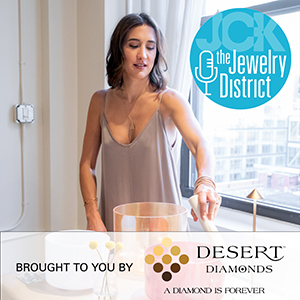
Hosts Victoria Gomelsky and Rob Bates talk to Gabrielle Saunders, founder of Ruveil, a jewelry brand that allows people to “wear what they hear.” She explains how her jewelry design is informed by her background working in jewelry houses such as Alexis Bittar and Harry Winston, studying gemology at GIA, and becoming a sound meditation facilitator. Bridging the seemingly disparate worlds of wellness and fine jewelry, Gabrielle’s brand taps into a growing market and creates a personal connection between each piece and its wearer.
Watch Now
Title sponsor: De Beers (adiamondisforever.com)
Show Notes
03:30 Gabrielle’s background
11:00 Founding Ruveil and the ethos behind it
13:40 On sound baths and their effects
19:35 Gabrielle’s personal connection to sound baths and how she came to lead them
23:15 Behind the Cymatics collection
24:45 Introducing the collection to jewelers and consumers
29:40 A tiny sample of a sound bath
Episode Credits
Hosts: Rob Bates and Victoria Gomelsky
Producer and engineer: Natalie Chomet
Editor: Riley McCaskill
Plugs: @jckmagazine; adiamondisforever.com
Episode Transcript
This transcript has been abridged and edited for clarity.
Victoria:
Hey, everyone. Welcome to The Jewelry District…I’d love to tee up our guest. Her name is Gabrielle Saunders, and she is the founder of a jewelry brand called Ruveil.
We met at the Tucson Gem shows. I had lunch with some members of the Gem X social club. I really enjoyed the founders and the topics they cover on the Gemflix series, which they instituted during the pandemic. And Gabby was a member, so we’ve been in touch ever since.
We wanted to have Gabby on because she has a cool brand and line. The way she describes it is her jewelry allows you to wear what you hear, which is an intriguing concept. It has to do with sound, sound meditations, and the crossover into the wellness space.
You have this approach to fine jewelry that I think will resonate—no pun intended—with a lot of people.
It’s a little different than the kinds of designers we typically have on. We’re mostly talking about people who use fine materials like you do, but they’re not as tapped into wellness.
But before we get to your collection and how you incorporate your appreciation for sound meditation and the quality of sound, tell us about your background: where you’re from, what your training was, and how you got into jewelry.
Gabrielle:
I grew up in the Princeton area, New Jersey, and for as long as I can remember, I was making jewelry. As a little girl, I was on the sidelines of my big brother’s baseball and soccer games beading and teaching myself these different ways to make jewelry. It was something that I loved.
As the years went on, that passion and curiosity never went away. Eventually my parents thought, “There’s something here. She’s very into this,” and it’s not something that I’m willing to stray from. So they encouraged me to apply to some pre-college programs when I was in high school.
I studied pre-college at RISD, FIT, Tyler School of Art. That’s when I knew that’s what I wanted to do. Sitting in the studio with those other artists, being surrounded by so much creativity and knowing that there was an entire world built around this, it blew my mind.
I decided to pursue it in undergrad. I went to Pratt Institute, studied jewelry design, and then later went on to study at GIA and earn my graduate gemologist degree, graduate pearls, anything I could do. I wanted to learn.
It’s funny because it’s not a family business. A lot of people in the industry get into it because they have somebody along the bloodline that had their own business or was a jeweler. This is something I was born with. I don’t know why. There was never anything else. I never considered any other career, for better or for worse. It’s always been a part of who I am.
Victoria:
And then you went on to have some different work experience. The thing that strikes me when I look at your LinkedIn is that the brands you worked in are across the jewelry spectrum in terms of their materials and their vibe. Tell us a little bit about what you learned from those experiences.
Gabrielle:
Those experiences, especially early in my career, shaped how I see design and create. My first job out of college was literally the day after graduation. I studied at Alexis Bittar back in the heyday when the studio was in Dumbo. Alexis himself was in the studio. It was a really bustling, creative place to be.
I worked closely with the design team to go over their designs and CADs to make sure that their vision was communicated through the CAD and then through to production.
Seeing designs through to production was inspiring. It taught me a lot about having a unique story and that artistry behind the design. Alexis never strayed away from being bold and doing things that weren’t being done, like the Lucite that he was using. These materials that hadn’t been seen before.
From there, I went on to work at Lulu Frost for a long time. I did production, then became her assistant designer. That was a very vintage brand. I learned a lot about jewelry history through that brand, because we were using all these different materials from throughout the century. I had the opportunity to practice my bench-making skills by hand-assembling a lot of her pieces. Then I moved to the design team, which is much more technical. That was a beautiful experience that brought in the education aspect: jewelry as an art form.
Then came Harry Winston. That was one of the highlights of my career, to be surrounded by that level of excellence. The craftsmanship and going into a design knowing that this is likely going to be a family heirloom, demanded a different level of my performance and my way of thinking.
Victoria:
Did you think that you would stay in that high, branded space? When did you leave? Then can you bridge us to founding Ruveil?
Gabrielle:
That was in 2020. It was an exciting time. I was at Harry Winston. I was learning and growing so much. At the same time, lab-grown diamonds were starting to hit the scene. It was an interesting moment in the jewelry industry because it seemed like this taboo thing. That’s when Ada Diamonds approached me.
They were in the process of opening headquarters in New York and asked me to be the New York lead. That would mean hiring the team, running that showroom, running everything from design to production—wearing all of the hats.
I felt like I couldn’t say no to this opportunity to explore the side of the industry that was coming full force: the lab-grown diamond industry. It came with a force—we all know that. But also to have the experience of running a business. I had the production and design background. I was in the process of earning my gemology degree. So behind the scenes nights and weekends I was studying.
This felt like the natural next step, where I needed that experience to be a founder. I always knew I wanted to start my own company, but I knew that I needed this experience to ultimately get to where I envisioned myself to be, which is where I am today.
Rob:
Do you work with both lab-grown and natural diamonds now?
Gabrielle:
In my collections, I only do natural. However, for custom work, I absolutely offer lab-grown diamonds if that’s something that somebody’s interested in. I feel like there’s room for both in the industry. There is a client for both. And in my opinion, people deserve to be informed, not judged for what they want to wear and what gemstone they want to incorporate into their piece of jewelry. So that’s how I approach my work.
Victoria:
So come 2020, it’s the pandemic. We’re all sorting through lockdowns. And you decide finally to found Ruveil. Tell us about the ethos of the brand and what you envisioned when you founded it. I’m excited to hear about this bridge into holistic wellness.
Gabrielle:
The pandemic hits and I think we all felt upside-down to say the least. Why not start a company in the middle of a pandemic? But I did. I mean, thank God I took that leap. Initially it was a lot of custom work. There was a huge opportunity as people were going through their old jewelry, so doing heirloom redesign is how it all started.
Then I started with my Candlelight collection, which is near and dear to my heart, because it’s one of the first full collections that I came out with. It was essentially playing meditation music while candles were dripping wax, or during important events that I wanted to capture the essence of the moment. So, the wax recorded that energy. I would direct cast that into sterling silver and form it into a cuff or earrings or whatever the case may be. Then, in my tiny New York City kitchen, I would apply the keum-boo, which is the 24 karat leaf on it. For me, that gold reflected the flame of the candle.
I still, to this day, make those pieces. Each one is one of a kind because the candles burned one time during that moment. It’s about recording a moment that’s so fleeting, in a different way. So that’s how it started. Then it just started trickling from there in terms of my ideas.
I’ve always been in the wellness space. I’ve always enjoyed meditation and yoga. I’ve never instructed those things, but I’ve always enjoyed that part of my personality. And it just snowballed.
Sponsor message:
This podcast is brought to you by De Beers. It’s not every day a bridal offering reflects love the way Desert Diamonds do. Both are completely natural. Both take time to form. And no two are ever alike. That’s what makes these rings mean so much more. From sunlit whites to golden-hour champagnes and sunrise blushes, colors as natural as love itself. This year introduce your bridal clients to Desert Diamonds. A diamond is forever. Visit adiamondisforever.com to learn more.
Victoria:
Since we’re talking about wellness, I recently participated in a sound bath that was really powerful. It was a couple of hours, and it was very moving and emotional. The chimes and bowls—the music was otherworldly.
Rob:
Yes. Can you tell me what a sound bath is?
Victoria:
Well, Gabby, I’d rather you explain, and then tell us how you got interested in sound, because this is in parallel to jewelry, right?
Gabrielle:
It is. That was the turning point when I got into sound meditation. I use my instruments, which are crystal alchemy bowls made of 99.9% quartz crystal. They’re also infused with different precious gemstones and metals, which I love because it ties back to jewelry and my gemology background.
I have eight or nine of these bowls. I curate them not only based on the notes—because they all have to be within a certain tuning of each other—but also based on their gemological properties. I talk about that at the beginning of my sessions, because I think it’s important to understand not only the frequency that you’re hearing and feeling at a cellular level, but also the metaphysical properties of these gemstones and the different chakras they are associated with.
Basically, a sound bath or a sound meditation is being bathed, so to speak, in different sounds and frequencies. It could be the crystal bowls, brass Tibetan bowls, chimes, drums, or gongs, which are really powerful. Essentially, it’s a moment for you to find stillness, but it gives you something to focus on. So,you’re not sitting in quiet meditation, which can be hard because your monkey brain’s going.
It gives you something to follow throughout. And you can allow your brain to wander and come back to it again. It’s a beautiful way to practice that meditation, especially for somebody who has a hard time in the silence of it. I invite you to come to one of my sessions, Rob and Victoria.
Victoria:
I’d love to. How often are you leading these?
Gabrielle:
A lot, all over the place. Tonight, I’m coming into the city for a sound meditation in SoHo. Then Williamsburg on Saturday at the Moxy Hotel. I will be out in Canyon Ranch in November, Wildflower Farms in December. And I do it locally in my community as well. I do a lot of volunteer work and I do a lot around here for different yoga and Pilates studios. And I do them virtually.
Rob:
When you do these sound meditations, is it for people who are interested in your jewelry? How does the jewelry tie into that?
Gabrielle:
It depends. For example, when I go to Canyon Ranch, I like to host activations. I’ll talk about the science behind sound meditation, what’s happening to your body at a cellular level, while you’re experiencing these frequencies and tones. Then I like to give a sample of the Faraday waves. Faraday waves are like, if you put water in a bowl and you play it, the vibrations will create a beautiful, sacred geometry pattern. You can see it with your eyes. It is magic.
That’s a really beautiful way to demonstrate what’s happening to your body during a sound meditation and also ties into the Cymatics collection, because that’s essentially the inspiration for it.
These beautiful patterns that the frequencies create, they’re around us all the time. We can’t see them, but they’re there. I do all these things, take some questions, and the jewelry is there so people are able to tie in what they’re learning with the pieces. Then I allow the group to sit or lay for an hour of sound meditation. So, they get the full experience, intellectually, emotionally, scientifically, on a cellular level, and a way that you can wear it. It covers every sense that you could imagine.
Victoria:
Having just been to one, I can say it is a powerful experience. Rob, I do encourage you to try one of these. I think you might find that it’s much more poignant and powerful than you would expect.
It doesn’t require much. At worst, you’re a little bored, but at best, you emerge feeling like something emotional has moved inside you, and it probably quite literally has moved, right?
Rob:
What would be the emotional thing that moves?
Victoria:
It could spur a memory of somebody you love. Often, it brings up something. Maybe you don’t even know how to articulate it. You don’t know why you’re suddenly crying.
Gabrielle:
That’s exactly right. And that’s why it’s important for somebody who facilitates these sessions to be trauma-informed and be able to safely hold these spaces for people to have these experiences, because I was one of them. That’s how I got into sound.
To answer your question, Rob, it stirs up energy in your body. You can feel different sensations. People can feel tingling sensations or heaviness in their chest. I always encourage people to go deeper, “Well, why do you feel that way?” It’s a time to reflect.
That’s not to say that’s going to be your experience every time. Sometimes you might fall asleep because that’s what your body needs. You might enjoy the sensations and it’s just a relaxing experience. It’s not always an emotional shift that occurs. But that’s how I got into it. I’m an open book.
I think it’s important to tell this story so that others can relate and maybe not feel so alone. After I had my son, I went through severe postpartum depression and anxiety. It was debilitating. It was like a cloud came over and I just couldn’t shake it.
I received a gift card to a wellness center on the Upper East Side that I adore called Sage + Sound. I remember when I received it, I thought, “Oh my God. This stressed me out even more. You gave me a task.”
Eventually I got to the point where my husband was like, “You need to get out of here. I don’t care what you do, but you need to do something.”
So, I went to the wellness center. It was a Friday night, 7 o’clock sound meditation, and I laid there hysterically crying. And I didn’t understand why. I’d been at sound meditations before, and I loved them. It was always a beautiful moment, but this was profound. And afterward, I felt so much better. I felt restored. I felt this emotional release that was so beautiful. Then I just kept going back.
Every Friday night, that was my ritual. That was my time for myself. Then I started to get curious. “Why am I feeling this way? Why, after every time I go to these sound experiences, do I either have a huge release or feel a huge shift?” So, I leaned into that curiosity.
Jackie, the instructor, was probably wondering, “Who’s this crazy lady in the front row every Friday night crying?” We became friends. She started doing a teaching cohort and asked me to join. And I was like, “No way. I have a newborn. I’m not here to hold space. I can’t even take care of myself right now.”
Another year went by, and she asked me to join her next teaching cohort. And I was like, “All right, fine, I’ll join, but I’m not joining to be trained. I’m joining just because I really love sound and I’m curious.”
And this was while I was working on my Cymatics collection. I thought it’d be cool to have a deeper knowledge about what’s really going on. So I did this four-month cohort and
I was hooked. I never expected to hold space, but then a friend said, “I’m doing this workshop, and we do sound for part of it.” I just started taking off from there.
Rob:
And then how did you kind of connect that to jewelry?
Victoria:
And tell us about Cymatics. I’ve seen some of the pieces, but we’d love to hear how the collection was born.
Gabrielle:
It was born after a few profound experiences through sound. I got curious. I started asking questions about the musical tones. I remember asking Jackie about the bowls: What are they made of, what notes are these, why am I feeling strong sensations?
I started doing all this research about the science behind sound and sound healing. That’s when I came across cymatics, which is essentially the study of the visible geometry of sound. So if you were to play sound in water or through sand, it would vibrate and create these beautiful patterns.
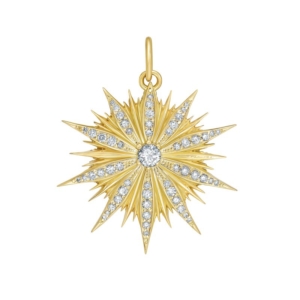
I studied these specific frequencies and their cymatics patterns and then translated them into precious materials, solidified that vibration, that frequency, so that you can wear it and it’s not so fleeting. It’s close to your body and can serve as a reminder of what that frequency brings you, or what that experience was and what it represents to you.
Victoria:
Did you have a hard time introducing this collection? If you’re at a sound bath and you’ve got participants coming up, it’s an easy sell or at least an easy explanation. But when you’re promoting the jewelry and trying to explain this, how does that work? A lot of people aren’t familiar with this experience. Do you then shift and say, “Listen, these are beautiful patterns and it’s a fine piece of jewelry in 14k or 18k and natural diamonds?”
Gabrielle:
I don’t simplify it because each piece is made with such intention and thought. It has found the right people, the right wearer, the right collaboration. What I do when I share my collection is offer a free sound meditation along with said pitch so that you can understand what I’m talking about.
It is hard to communicate this via email, to say, “You need to experience this. Whether you like the collection or not, at least let me introduce you to sound meditation.” But that’s how I’ve been approaching it. It’s becoming something that people are seeking out. It’s been a little bit easier than I expected.
Rob:
Are most of the people that you sell to and you deal with in this community into sound meditation?
Gabrielle:
People who are into sound meditation, and also wellness retreats, wellness resorts, is where I tend to sit.
Victoria:
Huge industry. I don’t have numbers handy, but wellness has exploded, and I’m sure the pandemic amplified that—yet another sound term. Do you sell online and at these events?
Gabrielle:
Yes, it’s mostly trunk shows, or these activations as I call them, because it is an experience, not really a trunk show. So that’s mainly how I’m selling, in addition to my website. And I’m on Olivela, which is exciting. I was in their store in Nantucket last summer. And then I’ll be popping up at these wellness retreats through this year. And then who knows what’s next?
Victoria:
It’s amazing. What is the retail price range of the collection?
Gabrielle:
I recently came out with some pieces that are in vermeil and sterling silver, to adapt to what’s happening with gold. Those pieces start from about $700 to introduce them to a different market and allow other people to appreciate the pieces. And then it goes up to a little over $10,000. So there’s a wide range.
Victoria:
And is it mostly women self-purchasing? Who is your target?
Gabrielle:
Yes, it’s mostly women self-purchasing, trying to mark a moment in their journey, whether that’s a loss or a win or an experience they had when they were at this retreat that they want to remember: their time there, that transformation, that sound meditation they had, or maybe just that version of themself at that moment. It’s been women self-purchasing and I love that.
Victoria:
Yes, you’re edging into this space that feels like it’s growing and growing. I write about travel a little bit and the whole wellness travel category as a niche in the wider world of travel is enormous. You know, people traveling to improve their health, improve their mind-body connection, all these things. I think to a lot of jewelers, this could seem new age-y or woo-woo and they might feel a little put off. Do you ever encounter that? And how do you respond?
Gabrielle:
Yeah, you know, I’ve always said I’m the woo friend, but sound is far from woo-woo. Sound is used in ultrasounds and sonograms. We have accepted that sound is used to peer inside the human body for medical reasons. We’ve accepted that crystals are used in GPS devices, in watches, in all these things. So I think there’s something to it.
I would never force a belief system on anybody. And I believe that we all can take what resonates in this life and leave the rest. But I think there’s something to be said about what we don’t quite understand yet. And there is a lot of science behind both of these things, behind the energy of crystals and sound healing.
Victoria:
This is a real off-the-cuff request, but could we hear what a bowl sounds like?
Gabrielle:
Yes. All right.
Victoria:
Look at this beautiful bowl. What is this made of?
Gabrielle:
It’s quartz infused with ruby. Ruby is a heart opener. It’s associated with the heart of the home. So I keep ruby in my kitchen because the kitchen is the heart of the home.
When this bowl is played during meditation, you might feel sensations in your heart center.
Victoria:
It’s beautiful.
Rob:
And during a sound bath, you would play this for how long?
Gabrielle:
A full hour, but it’s a bunch of different bowls that are at different frequencies, different notes. It’s a musical journey, not just one tone over and over again. I have a chime that I use, and there’s a lot of layering of tones.
Rob:
Is it original music or something that’s kind of standard?
Gabrielle:
Every time it’s different. I’m not reading music. I’m following music theory in terms of harmonies and those tones that are resonant. Each time it’s completely different, so you never know what you’re going to get.
Rob:
Good vibrations, man.
Gabrielle:
Good vibrations—literally.
Any views expressed in this podcast do not reflect the opinion of JCK, its management, or its advertisers.
- Subscribe to the JCK News Daily
- Subscribe to the JCK Special Report
- Follow JCK on Instagram: @jckmagazine
- Follow JCK on X: @jckmagazine
- Follow JCK on Facebook: @jckmagazine