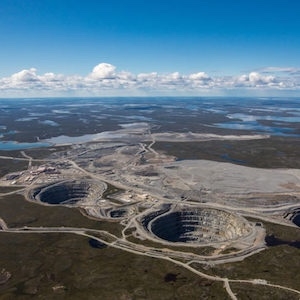
After 27 years as one of the industry’s most prestigious and productive mines, the Ekati mine in Canada’s Northwest Territories (NWT) is shutting down, according to court filings.
Last week, the local government said it saw no way forward for Arctic Canadian Diamond Company, the Burgundy Diamond Mines subsidiary that purchased Ekati in 2023.
While Ekati had some good quarters under Burgundy, the last few years of decreased diamond demand proved the last straw for a mine that already had its share of financial challenges.
In May, the company filed for insolvency protection under Canada’s Companies’ Creditors Arrangement Act. Its petition blamed the filing on U.S. tariffs, a depressed diamond market, and fuel price increases due to the Iran war. Yet it insisted that Ekati was still a “viable business” and expressed hope that another buyer would take it over.
However, the court-appointed monitor said it contacted “140 potentially interested parties” to buy the mine and received no viable bids. After the company’s debtor-in-possession lender declined to provide more funding, the government decided the mine’s days were done and appointed PricewaterhouseCoopers as receiver to oversee its closing.
Ekati’s end leaves only one mine remaining in Canada—a country that was once the world’s third largest diamond producer with four active mines. In April, the country’s second largest mine, Diavik, closed after 23 years of production. That leaves only the De Beers–owned Gahcho Kué, but that mine’s future is also shaky, with minority partner Mountain Province recently getting delisted from the Toronto Stock Exchange. De Beers has also canceled a planned expansion at the mine, which means it will close in 2028—and possibly earlier.
All of which marks a sad end for Canada’s diamond mining industry, and particularly for Ekati, the area’s pioneering deposit.
Its discovery was legendary. In the late 1980s, geologist Charles Fipke became convinced there were diamonds in the NWT and spent nearly eight years in the frozen wilderness looking for telltale indicator minerals. When he finally found a viable mine, he sold part of his company, Dia Met Minerals, to mining giant BHP, for some $687 million.
But while Ekati’s first decade was hugely successful, it soon had to cope with an ever-changing series of owners.
In 2012, BHP decided to exit the diamond industry and sold Ekati to Harry Winston Diamond Corp., which at the time owned 40% of Diavik as well as the famed retailer. Eventually, the company decided its core competency was mining. It sold Winston to Swatch Group and changed its name to Dominion.
In 2016, Dominion was targeted by activist investors, who persuaded its board to put the mine on the market. Washington Corp. purchased the company in 2017, but the sale left it saddled with $550 million in debt. When COVID brought the industry to a halt in 2020, Ekati made its first trip to insolvency court. A group of bondholders took over the mine for the next two years, eventually selling it to Burgundy. But now, having cycled through five owners and two bankruptcies, there’s no new savior on the horizon.
Ekati was a major employer in the area, and many locals worried about what its closure would mean for the local economy.
NWT minister Caitlin Cleveland said in a statement, “This is a difficult day for the Northwest Territories. The challenges facing Ekati and the diamond sector are not new, but that does not make this moment any less serious for the workers, families, businesses, Indigenous governments, and communities affected by today’s decision.…
“Ekati helped shape the Northwest Territories for a generation. Now our responsibility is to build on that foundation and create new opportunities for the future.”
Top: The Ekati mine (photo courtesy of Burgundy Diamond Mines)
- Subscribe to the JCK News Daily
- Subscribe to the JCK Special Report
- Follow JCK on Instagram: @jckmagazine
- Follow JCK on X: @jckmagazine
- Follow JCK on Facebook: @jckmagazine