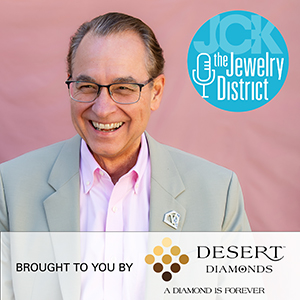
Doug Meadows, founder of David Douglas Diamonds & Jewelry is curious by nature. Many of the valuable lessons he’s learned about running a business in this industry has come from asking other store owners questions. Where some would be too timid, Doug notices the things a retailer does well and asks to do a store visit. The knowledge he’s compiled as a result has only helped his business and relationships. Today, the tables have turned, because podcast hosts Victoria Gomelsky and Rob Bates are the ones asking the questions! Watch as Doug generously shares his experiences, travels, and lessons he’s learned along the way.
Watch Now
Title sponsor: De Beers (adiamondisforever.com)
Show Notes
03:30 Doug’s beginnings in the jewelry industry
09:00 Lessons at Kaminski Jewelers
13:00 Starting out on his own
16:00 Learnings from store visits
20:00 Getting into the diamond business
24:00 International trips and the salability of fair-trade diamonds
Episode Credits
Hosts: Rob Bates and Victoria Gomelsky
Producer and engineer: Natalie Chomet
Editor: Riley McCaskill
Plugs: @jckmagazine; adiamondisforever.com
Episode Transcript
This transcript has been abridged and edited for clarity.
Victoria:
Hey, everyone. Welcome to The Jewelry District.… I met our guest when he was on a panel I moderated at JCK Las Vegas this year, and I was really taken by his comments. He had some great insights.
I asked him to do an interview for one of the Special Reports I write for JCK on natural diamonds. Our guest is Doug Meadows, founder of David Douglas Diamonds & Jewelry in Marietta, Georgia.
It’s great to have you. We had this conversation, and while the piece I wrote up ran in our June Natural Diamond Special Report, you also told me about how you got started in the jewelry industry and built your business from the ground up. You had so many great tips and anecdotes that I thought our audience would love to hear them.
To start, tell us about where you’re from and how you got into jewelry.
Doug:
Well, I live in Marietta, Georgia. I’m originally from Detroit, Michigan. My grandfather had a trade shop there since 1926, and my dad and uncle took that over in the late ’50s, early ’60s. I apprenticed in the ’70s up there. Then I branched out and worked with one of my brothers in a retail store in a major mall. And I got introduced to the retail side of the industry. I’ve always called myself a third-generation jeweler, but a first-generation retailer.
I got into a fun partnership with a buddy and we accidentally bought a jewelry store in one of the malls. It was just out of survival that we did it. We begged, borrowed, and stole from all our friends and family. And it worked for about two years. Then we successfully ran that into bankruptcy.
Victoria:
By this point you had moved to Atlanta in the ’80s, correct?
Doug:
Yes. Then in the mid-’80s, after me and my old partner finally called it quits, I was trying to find a job. My brother and I came up with the idea of him moving down here. We created our David Douglas: We took Dave’s first name and my first name, put them together, and got David Douglas Diamonds. We did that for a couple of years until our competition approached us and wanted us to join them. So, we went in with them for the next 17 years.
While we were there, we bought a pawn shop in the next town. We bought a jewelry store in another town. We bought a car wash behind the store we were in.
Fast forwarding now: My brother and I split up the business. He kept one store in Woodstock and I kept the Marietta store. He had his daughter and son-in-law take over his company. I’m currently working with my son, preparing for someday in the future. But I’m in no hurry to have him take over the company.
Victoria:
I’m struck by how many different things you tried. You started out as a trade jeweler, not as a retailer—to your point about being a first-generation retailer. Was that transition difficult?
Doug:
It was very difficult because I didn’t understand profit and loss. I knew how to make money with my hands, but I didn’t understand how to run a business at all. Thankfully, I had people that helped, supported, taught, and trained me. I just started looking for help and asking everybody I could to teach me how to run a business.
Victoria:
When did you find your footing as a retailer in Georgia?
Doug:
If I had stayed in one place long enough, I think I’d be doing a lot better than I am today. I started out in Cumberland Mall. We were there for a couple of years and after losing our lease and having to move into Vinings, it was a bad relationship between my partner and me. We just slipped into bankruptcy.
Then getting together with my brother, we started out in a store for a few years and then had an opportunity to go do a lease department inside of another retailer. I talk about being a third-generation jeweler, but a first-generation retailer. I was kind of slow to get to that point. I always hit my safety zone of being a trade shop, even though it was in a retail setting, trying to figure out how to get out of that relationship.
We finally got out of it and then we were forced into a retail jewelry store in a shopping center. My brother and I liked to think we were entrepreneurs, but we probably overbought and overstretched ourselves all the time. I had five kids, he had eight kids, so you’re trying to keep them all fed. But they were great free labor too, coming up.
Victoria:
Five years old, cleaning the cases.
Doug:
Gotta teach them those life skills.
Victoria:
For sure. When we talked in June, you’d mentioned an experience that you had with a jeweler that sounded pretty wild, Kaminski Jewelers.
What was that like? Because you talked about some lessons you learned there, even though the environment felt a bit chaotic. Tell us about that experience.
Doug:
The best way to describe Kaminski Jewelers is a circus. Ed and Carol were very flamboyant. Ed did TV commercials dressed in a tutu. He had a slogan: “If you wantski good priceski come in and see Kaminski.” He was all price, price, price. Big price tags on all the jewelry. He had chain rolls just laid out on a sheet of plywood. He had plywood floors. It was just an old house.
But one of the things that he taught me is to take care of your customer. Even though he sold cheap junk, if they had trouble with it, he’d get it fixed. He’d get them taken care of.
But the other thing they taught me—they trusted everybody. And sadly, people took advantage of them. They had a bookkeeper that stopped paying their sales tax and pocketing in the cash, and they ended up having litigations over that.
They were both characters. I mean, he had a big shotgun and a baseball bat by his desk. It was just a totally different experience. But it was a volume store. We had so much service work to do there. I had probably 10 different jewelers at that time. And all we were doing were recasting customers’ old gold. We had a ton of waxes back in the day.
He would let us sell anything we wanted to other than diamonds. So colored stones were wide open, watches were wide open. So we began to get introduced to retail. I loved the way he was just so flamboyant. I mean, he had the guts to just go do it.
Victoria:
After Kaminski, is this when you invested in your very own retail space? When was that?
Doug:
The early 2000s because we were with Kaminski’s for 17 years. It got to a point where I was just trying to figure out how to get out of there. I figured, if I left and opened up across the street, I would be a dirtbag.
So they asked me to leave. I came back from a trip to Fiji and they pulled me into their office and said, “We want you and Dave to leave.” I think they thought I was going to be really upset and I was jumping up and down with joy on the inside because that season in my life was done.
One of the things I started thinking was, “My brother and I had been there for 15, 16 years. Is there an opportunity to buy this business from them at some point in time?” That’s part of the reason I bought the car wash right next to the jewelry store. But, after having some conversations with them, we realized that was a dead end. That’s when it was time for me to go do something else.
Rob:
Was the “something else” the store that you have now?
Doug:
When they told me I had to leave, then I didn’t feel bad about opening up across the street from them. I literally opened a jewelry store across the street from them in Marietta.
I had that location for about 6 years. During that time, we still had the jewelry store and the pawn shop in Woodstock. We’d sold the car wash. Then my brother had the wisdom to say, “You know, it was never fun dealing with cousins and uncles when we were growing up in the business. Let’s not put our kids through this.” He said, “I’ll keep the Woodstock store and you can keep the Marietta store.” And I said okay.
It was hard to do because I really enjoyed working with my brother, but it was a lot of wisdom to make that separation while things weren’t too crazy. I finished out a few more years in that same location and I’ve been at my current location since 2010—16 years now.
Victoria:
How would you describe your clientele? Do you have a lot of self-purchasers or do you primarily sell a lot of diamonds?
Doug:
Over the years I decided that I needed to focus in on something. When we worked at Kaminski’s, his motto for us was, “We fix anything except broken hearts and Timex watches.” My brother and I wanted to be able to never say no to anybody and do it all. As I got a little older and I got a little more wisdom, I learned that you have to specialize a little bit and have a focus because I wasn’t focused at all. I was all over the place.
I decided that I wanted to pick bridal, anniversary gifts, and the self-purchasing woman. Part of that came from IJO [Independent Jewelers Organization]. I had joined IJO about 20 years ago and absorbed all their trainings and classes that they had to offer. They have great education and great help to grow your business. Once I made that focus, once you spend enough time and space on the product, that’s what you’ll get known for and that’s what you grow into.
Sponsor message:
This podcast is brought to you by De Beers. It’s not every day a bridal offering reflects love the way Desert Diamonds do. Both are completely natural. Both take time to form. And no two are ever alike. That’s what makes these rings mean so much more. From sunlit whites to golden-hour champagnes and sunrise blushes, colors as natural as love itself. This year introduce your bridal clients to Desert Diamonds. A diamond is forever. Visit adiamondisforever.com to learn more.
Victoria:
Especially as you were getting your footing in the early 2000s, you had gone to JCK Las Vegas, and you ended up meeting a bunch of people. You told me a little bit about how you were bold enough to ask these other retailers if you could do store visits.
Can you tell us about that? Because I think a lot of people are shy about that kind of stuff. But for you, it seems like it’s really helped. Tell us about how you got up the chutzpah to reach out to other retailers.
Doug:
I don’t know why I’ve been so bold about that. I’m just curious by nature. I remember when I was a teenager and I went to visit one of my cousins and asked “How much do you make?” It wasn’t a judgmental question, but it’s almost taboo. Like you can’t ask those kinds of questions, you know? I’ve been one of those kids that would just ask you a question straight out.
I would tear things apart as a kid just to see how it worked. So when it comes to business, I guess I just looked at it the same way. “Okay, you’re doing really well. You’re doing something I’m not doing. Can I learn that in a day or two, or is it going to take a lifetime to learn it?” But I figured it doesn’t hurt to ask.
There was a gentleman with a store up in Ottawa, Canada, Brent Harden, and I just asked him, “Can I come up for a store visit?” And he goes, “Sure.”
Brent has one of the biggest hearts in the industry that I’ve ever met. He is so giving and knowledgeable. He just wants to see everybody do well. He took me in, put me up, and we had a great time. He taught me a ton of stuff.
By the time I left, he had helped me develop a little workbook with my 16 steps to success that I still cherish today. And as I look back on all the different topics, I’m blown away that they’re now a part of my DNA. They just ooze out of me. But I got that guidance from Brent.
Rob:
What were some of the steps to success? Anything that you still go over?
Doug:
Yeah, one of the first ones is, you need to have some goals, you know, both for your personal life and for your business and break it down into two, five, 10 years. He said, “You want to have a dream store vision? What do you really want your store to look like in five years?” And then start backing it out and figuring out what steps to take to get there.
Also looking at the fundamental things like store sales, your expenses, your profitability, your gross margin, and then taking care of your staff. He called it a partner benefits plan. How are you going to take care of your staff? How are you going to pay them insurance? Things like that. Coming up with an organizational chart.
I think that was the first time I’d ever heard that phrase. I mean, this happened with things that are so basic when it comes to business, but I didn’t get any education. My dad didn’t teach me any of this kind of stuff. He taught me how to make jewelry and fix jewelry. He didn’t teach me how to run a business, or even how to handle money.
Brent had a beautiful selling system that I adored, which I took a bunch of pictures of. The list goes on. He hit every highlight that a business needs to be successful.
Victoria:
Tell us about how your diamond business has evolved and what it is like today.
Doug:
One of the things Brent gave me was a diamond business plan: what sizes to have, how many, and how to grow into that. I had a few other jeweler friends that schooled me on how to get a long-term memo of some diamonds in your store. I became good friends with a diamond dealer in town and partnered with him. He gave me a long-term memo. Anytime I needed anything, he would get it for me.
My dream was to be able to sell diamonds. And every time I broke into that next threshold—whether it was by size or by price—it’d always get my adrenaline going. And watching the faces of the women that received these things, it became very emotional. Then I started learning about the stories behind all these things. And that’s when I really made that shift to, “This isn’t just cold metal and hard rocks. We’re commemorating something, we’re celebrating something. It’s a story and it’s generational.”
When lab-grown diamonds first came out, I remember getting my first one from Stuller just to look at it. I got it in a memo, looked at it, and I was scared to death. I thought, Oh my goodness, this is the end of our industry, but then we just assumed everybody would come in asking for it.
So we treated it like that redhead stepchild and put it underneath the counter and had a few things to show them if they did ask, but they never asked. Then we slowly brought it out because I was seeing some of my other friends having some good success with it.
Then we came up with this idea of the lab-grown diamond challenge: We set up four solitaires: a lab-grown, a natural, a CZ, and a moissanite. This whole time, both sides are almost fighting each other. “We’re eco-friendly!” “We’re this!” “We’re that!” And after going around the world and visiting all these different places, I realized, there’s a cost to all of this—no matter whether it’s real or fake, or whatever you want to call it.
I just wanted to give people a choice. That was my big thing: Can I give you enough information without boring you to death so you could make a choice and decide what you want? And so that’s what I did. That’s the different direction we had.
But now, a few years later, people are coming in telling you they want a lab-grown diamond, so our diamond sales have shifted as far as engagement rings and loose diamonds, with 80% of it lab-grown and about 20% natural. The fashion is still natural diamonds. We’re not jumping that far. We’ll do core stuff like diamond studs or line bracelets, but it almost isn’t worth it to use lab-grown on fashion jewelry.
Victoria:
You come to the diamond business from an interesting perspective because you’ve traveled quite a bit. Was Antwerp your first big diamond trip about a decade ago?
Doug:
Yes. At IJO, they do these Antwerp trips. I was scared to death, but I just went for it.
Rob:
Beautiful city.
Doug:
Oh my goodness, I love it. I love going there. Then I got invited to Mumbai for a diamond event. I thought, Why are they asking me? I’m not a big buyer, but fine, if you want to pay my way and put me up and take care of me and wine and dine me! But what I really enjoyed was all the other buyers that I met there.
And one thing I enjoyed about Antwerp was the selection. If I want a 1- or 2-carat round, I’m not just looking at two or three of them. I’m looking at hundreds.
Victoria:
And what about in India?
Doug:
When I went to Mumbai, I didn’t buy much. I had a customer who wanted some 5-carat total weight diamond studs, so I went down to the bourse and handpicked a couple of matching stones for that.
But that opened an opportunity to go to Jaipur for the gem show event. Then I got a personal invitation from a manufacturer in Jaipur to come spend a week with him and his family. I’m like, “You don’t even know me. We just met 30 minutes ago and you’re inviting me to your house!” I took him up on the offer and spent a week with him, and I got engrossed in the culture. I got to try every kind of food you can imagine. He took me to different parts of India that I never would have been able to go see without somebody like that.
Then I toured the big diamond companies, both natural and lab-grown. It’s been interesting to see the lab-grown diamond growing process. It’s been interesting to see the natural diamond and jewelry manufacturing processes. We went to SEEPZ [Special Economic Zone of India] and visited one of the manufacturers there. And I was there for like five minutes watching these jewelers work and they’ve already taught me 10 new tricks—they’re good.
Rob:
You went on Martin Rapaport’s trip to Sierra Leone just a few months ago. Can you tell us a little bit about your experience?
Doug:
I’ve always been intrigued with fair-trade gemstones. All the stuff Eric Braunwart at Columbia Gem House has put into fair-trade has really intrigued me. It was a great opportunity to go to Sierra Leone to be able to see the process—where do these things come from?
It was like The Wizard of Oz where you got to see behind the curtain and some of it you enjoyed seeing and other things you wish you didn’t know. But it’s life, and I felt very safe doing the trip. There were no repercussions from it. I make friends too easily. So, now my driver that was driving us from Sierra Leone is a WhatsApp chat friend now. We constantly text back and forth.
Rob:
You said you saw the whole De Beers setup, the Gem Fair. Martin Rapaport had been talking about selling the diamonds as fair-trade, as development diamonds. Given how they’re mined in Sierra Leone in particular, do you think that’s a sellable story to your customers?
Doug:
I think they’re doing a decent job with it, because then it falls into their Tracr diamond program, where you can trace it back to that region. Just like with anything, scams can be done or unscrupulous acts can happen. But they’re trying to do the best they can on both sides of the fence. They’re trying to help the villages, miners, and the economy, the community. And they still have to make a profit doing it.
Rob:
But do you think it’s like sellable on a retail level for consumers?
Doug:
Yes and no. There’s a small percentage of consumers who care about that much detail. I’ve tried selling fair-trade gemstones, Canadian diamonds. All the different things that you can do to share the story with them, they just kind of glaze over for the most part. Occasionally they really get engaged and excited and it helps them finish out the purchase.
But when that kid first comes in, he’s got a problem: He’s in love, and he needs a diamond to go home with. He’s got a lot of cash in his pocket, so that’s all he’s thinking about at the moment. He’s clueless about what’s going on in the world.
Victoria:
Thank you so much, Doug. There are so many rich takeaways from what you’ve done and how you’ve built your business. Congratulations.
Any views expressed in this podcast do not reflect the opinion of JCK, its management, or its advertisers.
- Subscribe to the JCK News Daily
- Subscribe to the JCK Special Report
- Follow JCK on Instagram: @jckmagazine
- Follow JCK on X: @jckmagazine
- Follow JCK on Facebook: @jckmagazine