Doug Meadows, cofounder of David Douglas Diamonds & Jewelry, a fourth-generation jewelry business in Marietta, Ga., sells a number of lab-grown stones, but at heart, he considers himself a diamond purist.
“We have what we call our lab-grown diamond challenge,” Meadows tells JCK. “We have a group of four solitaires about 1.5 ct. in size each. One is natural, one is lab-grown, one is moissanite, and one is CZ. And we ask our customers, ‘Can you see a difference? Can you tell which one is natural?’ In one breath, I’m promoting lab-grown, but in my heart, I’m wanting to sell them a natural.”
Meadows’ commitment to telling the natural diamond story deepened in March, when he participated in the Peace Diamond Trade Mission to Sierra Leone led by Ezi Rapaport, Martin Rapaport’s son.
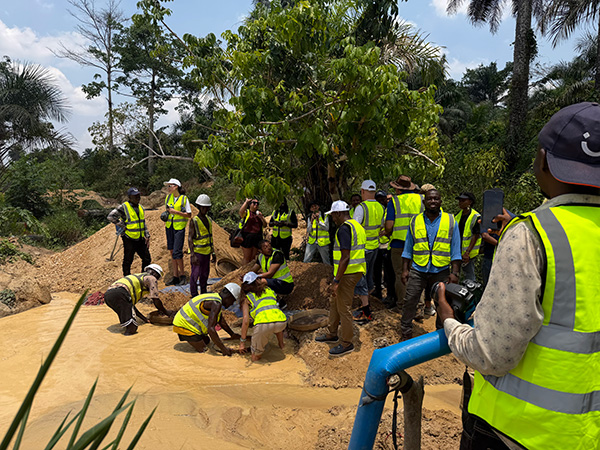
The trip wasn’t Meadows’ first time in Africa; in the past, he’d traveled to Tanzania, where he visited a tanzanite mine, and Uganda, where he is helping to build a vocational school. But he’d long desired to visit a diamond mine.
Then, last fall, an email from Rapaport about the Sierra Leone trip caught his eye. “I couldn’t make the fall trip, so I went in the spring,” he says. “I hounded them until they invited me.”
Meadows was the only brick-and-mortar retailer in the eclectic group assembled by Rapaport. “There was a diamond cutter from Phoenix, someone from a social media company in London doing a story about natural diamonds, an environmentalist, Tracey Ellison (@thediamondgirl), and Big Manny 1 from London—he does science experiments for kids,” he says. “While we were out in the field, the BBC showed up. And they had a guy from the embassy doing economic development.”
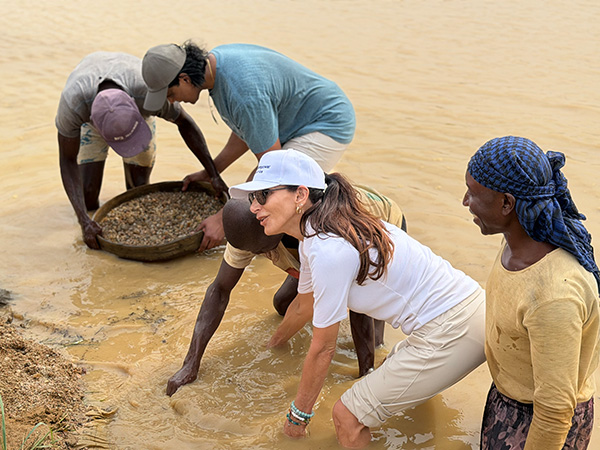
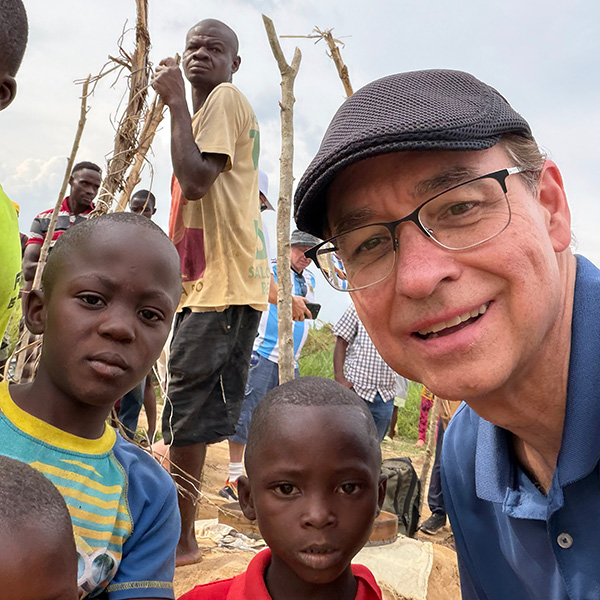
The five-day trip began with a visit to the artisanal diamond mines in the country’s Kono District. “We’re going through these little villages on rough roads and you’re just passing these houses,” Meadows recalls. “What caught my attention was that there were a lot of homes that had been partially built but then work seemed to have stopped. Later, I learned these guys will find diamonds and will build what they can and stop until they find another diamond and can afford to build more.”
The sight of unfinished homes awaiting their owner’s next diamond find offered Meadows a glimpse of the trip’s mission. “One of the things Rapaport tries to do is show you the good that natural diamonds are doing,” he says. “One area we went to is where they found a 709 ct. rough diamond, which they auctioned to the Graff family for $6.5 million. They named it the Peace Diamond.”
The next stop for the Rapaport group was the De Beers office in Kono. “I was impressed with what they’re doing up there,” he says. “They’re teaching the miners how to mine. They do a square plot, they’ll go through the mining, then cover it up and plant crops on it—they’re trying to make it 100% sustainable. That was encouraging to see.”
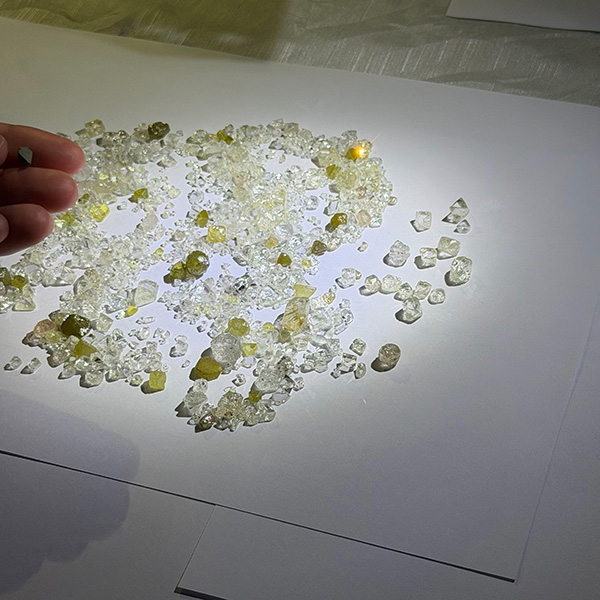
Rapaport has structured the trip, which concluded with a couple days in the capital city of Freetown, to be purely educational. Meadows and the other participants were not allowed to buy any of the rough diamonds they saw due to import/export restrictions, including those imposed by the Kimberley Process, an intergovernmental certification scheme established in 2003 to prevent the trade in conflict diamonds.
After the diamond portion of the trip was over, Meadows joined some of his fellow participants on the Sierra Leone coast, for a few days of beach relaxation. “We started brainstorming and one of the ambitions we came back with—the five of us who stayed over for the extended part—was to create a cutting factory there in Freetown where we could get rough coming in, get it cut, and bring it across from there. But there are a lot of challenges.”
For now, Meadows is still trying to determine the best way to capitalize on his experience, during which he met people with firsthand knowledge of the atrocities of the conflict diamonds era.
“When the Blood Diamond movie came out in 2006, my solution was Canadian goods,” Meadows says. “We worked on that program for quite a while.”
Today, more than two decades after the crisis arose, he responds to queries about the provenance of natural diamonds differently. “I call them ‘beyond blood diamonds’ now,” Meadows says. “Between the Kimberley Process, De Beers’ Tracr program, which provides traceability of where the diamonds are coming from, and meeting the miners, I know that things have changed.”
All the while, he continues to support natural diamonds at the counter. “One of the things we have sensed is that the natural diamonds we do sell are obviously going to a little more affluent and educated customer and they’re not shying away from a 2.5 ct. natural,” Meadows says. “The other thing is that a lot of these kids that have bought that lab-grown diamonds—for their 10th wedding anniversary, are they going to want to upgrade to a natural? I sure hope so.”
Top: Doug Meadows surrounded by local kids in Sierra Leone (photos courtesy of Doug Meadows)
- Subscribe to the JCK News Daily
- Subscribe to the JCK Special Report
- Follow JCK on Instagram: @jckmagazine
- Follow JCK on X: @jckmagazine
- Follow JCK on Facebook: @jckmagazine