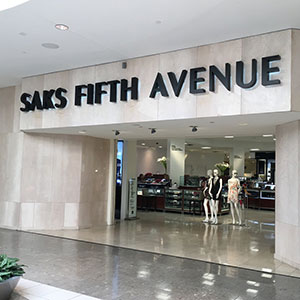
Saks Global emerged from bankruptcy late Friday with a new name—Exemplar Luxury Group—and plans for a new era in multibrand luxury retail.
Exemplar Luxury Group, or ELG, is made up of Saks Fifth Avenue, Neiman Marcus, and Bergdorf Goodman, the retail chains formerly united under Saks Global, which had filed for Chapter 11 in January.
“With a substantially strengthened balance sheet, including a nearly 75% debt reduction, sufficient liquidity, and the full backing of its capital partners and other key stakeholders, ELG is focused on driving long-term, profitable growth and leading multibrand luxury retail in the U.S.,” the company said in its statement about the restructuring.
“As the gateway to the U.S. luxury customer, we are uniting coveted brands with unrivaled customer experiences to drive growth for Exemplar Luxury Group and the broader luxury ecosystem,” said Geoffroy van Raemdonck, who became CEO of Saks Global during the bankruptcy, in the statement. “We are deeply grateful to our customers, brand partners, capital partners, and colleagues, whose loyalty and support have made this possible.”
ELG cited three factors that should “support long-term growth and profitability”: its differentiation from competitors, an “optimized” number of stores, and its e-commerce platforms.
The group now operates 49 brick-and-mortar locations—33 for Neiman Marcus, 15 for Saks Fifth Avenue, and one Bergdorf Goodman store—whereas Saks Global had around 170 locations before bankruptcy. Two of the current stores are slated to close, according to a New York Times interview with van Raemdonck.
“It is a new day for ELG, and we are focused on executing our business plan with discipline and investing in the experiences that matter most to our customers,” van Raemdonck said in the corporate statement. “Neiman Marcus, Saks Fifth Avenue, and Bergdorf Goodman have long set the standard for luxury retail in the U.S., and we are committed to building upon that legacy.”
Saks Global’s Chapter 11 filing came just over a year after its $2.7 billion acquisition of Neiman Marcus (which has had the same ownership as Bergdorf’s since the ’70s). An increased debt load and revenue decline followed, and as a result Saks Global slowed its payments to vendors, who then stopped sending it goods.
Saks Global vendors included Chanel, David Yurman, LVMH and Kering brands, and Shy Creations. JCK reached out to some of these companies in light of the reorganization but did not receive comments before press time.
One retail consultant contacted by JCK questioned Exemplar Luxury Group’s goals, as they seem to sidestep underlying commercial challenges. “The turnaround plan appears highly aggressive—perhaps overly optimistic given today’s luxury retail environment. Success will ultimately depend on execution, not financial restructuring,” says Glenn McMahon, who was a senior executive for several high-end fashion brands and is now managing partner of MAC McMahon Advisory Consulting.
“The biggest unanswered question is, will the customer come back? The major assumption is that customers who abandoned Saks, Neiman Marcus, and the broader organization during the uncertainty will simply return. Winning back consumer trust is far more difficult than restructuring a balance sheet,” McMahon tells JCK.
“Has Exemplar Luxury Group permanently lost a meaningful portion of its luxury customer to competitors like Nordstrom, Bloomingdale’s, and direct-to-consumer boutiques? If that customer has changed shopping habits for good, this recovery will be significantly more challenging than the business plan suggests.”
McMahon gives van Raemdonck credit for making progress rebuilding relationships with many European luxury houses—a critical first step after the vendor disruption that preceded bankruptcy.
“But restoring supplier confidence is only a first step. Which luxury brands are willing to expand under leased concession or shop-in-shop models? That decision will have a direct impact on both sales productivity and merchandise margins,” McMahon says.
Another industry consultant, Lyn Falk, president of Milwaukee-based Retailworks, says the former Saks Global is wise to put effort into key store elements that consumers care about.
“Saks’ move to restructure reflects the fact that store design and experiential retail have become as important, if not more important, than inventory itself,” Falk tells JCK. “Retail spaces are being designed to be emotionally intentional, tell captivating stories, and bring long-term success to a brand. Beautiful and engaging spaces increase perceived value, trust, and willingness to spend.”
Other professionals who follow the retail business wonder, like McMahon, if ELG brands have already lost shoppers to other stores. The fashion marketer known as Fabricateurialist also noted that a focus on luxury consumers could be shortsighted.
“ELG may have bigger ambitions, but a company that nobody wants to sell to, customers have been trained to buy on sale from, and locations that offer a lackluster in-store experience—who is ELG for? Why does it (still) exist? Who wants to shop there instead of hypercurated luxury retail groups like Mitchell’s?” wrote Fabricateurialist on Substack.
Saks Global had more than $3.4 billion in debt when it filed for Chapter 11. Upon entering bankruptcy protection, it received $1.75 billion from bond holders and lenders to maintain operations.
Two investment firms that helped Saks/ELG get through the reorganization, Pentwater Capital Management and Bracebridge Capital, hold two seats each on ELG’s new board. The other members of the seven-person board are van Raemdonck, former Ulta Beauty CEO Dave Kimbell, and former LVMH executive committee member Philippe Schaus.
(Photo courtesy of Saks Fifth Avenue)
- Subscribe to the JCK News Daily
- Subscribe to the JCK Special Report
- Follow JCK on Instagram: @jckmagazine
- Follow JCK on X: @jckmagazine
- Follow JCK on Facebook: @jckmagazine