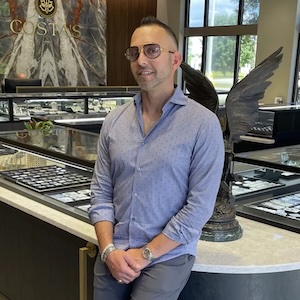
From the start, Yianni Roupas (pictured) thought something was off when the 84-year-old woman entered his store, Costa’s Fine Jewelry and Coins in Waukesha, Wis.
She was looking to buy $30,000 in gold—but wasn’t interested in any item in particular. She couldn’t explain why she wanted the gold, and didn’t seem to care what he had in stock. Plus, she seemed “jittery.”
“I like to do my due diligence and ask questions when people come in,” Roupas tells JCK. “I ask, ‘Why are you doing this? Are you doing it for yourself?'”
The woman eventually picked out six gold coins and handed Roupas a check for $30,000. He told her he needed to wait five to seven days until it cleared before he delivered the items.
“That’s standard for me,” he says. “It’s not like she seemed like a criminal. But it did seem strange she wanted to write a big check then and there.”
That wasn’t the only red flag. A few hours before the woman came in, Roupas received a call from a man claiming to be a local resident, yet the number was from out of state, and the caller mispronounced “Waukesha.” He asked Roupas if his store had $30,000 in gold. When Roupas said that it did, the man asked for a bank wire number. Roupas replied he didn’t give out that info over the phone.
At a staff meeting that day, just about everyone agreed there was something fishy going on.
“We put two and two together,” he says. “I made an executive decision: I’ll call the local police department and explain what I feel was wrong here.”
The next day, a policeman stopped by the store and tried to reach the woman. She declined to talk to him. The officer then went to her house and discovered she had been lured into an increasingly common gold scam that targets the elderly.
“We know these things are going on,” Roupas says. “One of my good friends is a top guy with a bank, and he sees this stuff happening every day: elderly people taking money from their account and putting it in gold.
“The scammers use fear tactics,” he says. “They say they are from the government, or the bank, and are going to shut [the victims’] account down, and they need to immediately put all their money into gold. They convince them their phone is hacked. They say, ‘Don’t tell anyone, don’t call the police.’ All things a real bank wouldn’t do.”
A few days later, the woman came back to the store with the officer holding her on his arm, and thanked Roupas. She told him she was also about to give the scammer $17,000 in cash.
“That was her entire life savings,” Roupas says. “I would have felt terrible if this sale had gone through and she lost every last dollar.”
Scott Guginsky, executive vice president of the Jewelers’ Security Alliance (JSA), says Roupas did the right thing.
“The JSA commends this jeweler for stopping an elderly person from being the victim of a crime,” he adds. “It’s not a normal practice for an elderly person to buy that much gold. They should have to explain why they’re buying it.”
In another recent case, Ben Soldaat, owner of Grand Rapids Coins in Rockford, Mich., notified police when a woman came in, asking for $700,000 in gold items.
“I got the feeling she was really being pushed to come up with a substantial amount of gold fast, and not for the reason that she initially mentioned,” Soldaat told a local news station.
The woman later revealed that she’d received repeated calls from “Eric,” who represented himself as a federal agent, and told her that her Social Security number was being used to finance terrorism. He said she needed to convert her money into gold and hand it to him for safekeeping. Police decided to have an undercover agent deliver him a bag full of “gold”—which turned out to be chocolate coins.
The alleged “Eric,” later identified as Yug Chauhan, has since been charged with multiple felonies.
Guginsky notes that jewelers who notify police about these scams aren’t just helping the victims; they’re protecting themselves.
“You don’t want to put yourself in the middle of a criminal prosecution or investigation,” he says. “And you don’t want to bring criminal elements into your business. You are opening yourself up to bad actors.”
(Photo courtesy of Costa’s Fine Jewelry and Coins)
- Subscribe to the JCK News Daily
- Subscribe to the JCK Special Report
- Follow JCK on Instagram: @jckmagazine
- Follow JCK on X: @jckmagazine
- Follow JCK on Facebook: @jckmagazine