Victoria Gomelsky and Rob Bates talk about what Victoria has been up to in her travels, from an artful Hermès event and JIS Fall in Miami Beach to the NouvelleBox showroom opening in Paris and the Patek Philippe Grand Exhibition in Milan. Meanwhile, Rob has been steeped in the mixed-up world of the diamond industry, attending the recent De Beers–Botswana events in New York, tracking the history behind the key players in the pending De Beers sale, and examining the effect of mine closures and falling supply. The hosts cap their conversation with a look at what a holiday gift might run you at the jewelry counter and some trends to expect.
Listen Now
Title sponsor: De Beers (adiamondisforever.com)
Show Notes
01:30 Hermès watch event in Miami Beach
07:20 De Beers events in New York and what we know about the sale
13:00 What sets Gareth Penny apart from other past CEOs?
16:20 Effect of mine closures and diamond supply
22:00 The Diamond Collective’s new name
24:30 Patek Philippe Grand Exhibition in Milan
27:00 Jewelry gifting for the holidays
Episode Credits
Hosts: Rob Bates and Victoria Gomelsky
Producer and engineer: Natalie Chomet
Editor: Riley McCaskill
Plugs: @jckmagazine; adiamondisforever.com
Episode Transcript
This transcript has been abridged and edited for clarity.
Victoria:
Hey, everyone. Welcome to The Jewelry District… I’m in a very fancy hotel called Faena in Miami Beach. It’s very beautiful. I’m in this glorious hotel room with a beautiful view of the beach, so no complaints.
Rob:
Well, you could be complaining that you’re in the hotel room…
Victoria:
That’s true. I should be down walking the beach. I do love a good Miami Beach excursion.
Rob:
I’ve traveled to a bunch of cities and in the United States at least, I think Miami is one of my favorites. It’s a beautiful, fun city.
Victoria:
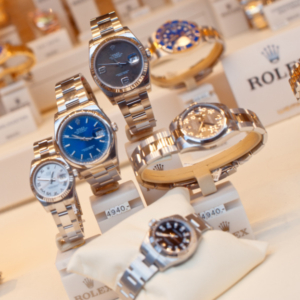
It’s very vibrant. And the reason I’m here is, and I flew in for an event with Hermès. They’re introducing two new variations of their H08 model, which is a sporty, more masculine piece.
They did something very interesting today. Watchmakers have events introducing the press to their newest collection. This one was at the Rubell Museum, which is over near the Wynwood district. It’s a family’s collection of contemporary art they’ve been collecting over decades. They met the likes of Keith Haring and Basquiat when they were relative unknowns back in the ’80s in New York. So, they have many originals from both those artists and others from around the world.
We got a tour. And then we had a make-your-own-art session hosted by another artist that is close with Hermès named José Parlá, who does Jackson Pollock–like work. We literally got to put on aprons and take paints and glue for collage work, and everybody made their own little canvas.
Next, there was a presentation on Hermès and some of the backstory behind their watchmaking, and then we got to see the watch.
Rob:
I’m a little disappointed that this is not a video podcast because I want to see what you created.
Victoria:
It was a fun experience. The takeaway is, you get to put down your phone and pick up a paintbrush. It’s super-playful.
And I think that’s part of what Hermès wants to communicate with a lot of its watches. There’s a real sense of whimsy and play. In the more artisan pieces, they use a lot of different techniques like painting, enamel marquetry, and little automatons on the watches. Those watches are very high-end and very expensive, but they don’t take themselves that seriously.
They famously had a watch where there was a horse—which is very on brand for Hermès. It’s a big equestrian brand. And the horse was sticking its tongue out. It was very silly and fun. And you don’t always expect that from a very high-end luxury house.
So what they did for us as press was give us this experience that was very fun. Then we ate lunch in the gallery, surrounded by all these beautiful works of art. That was pretty special. And then I’m sticking around in Miami for the JIS show. By the time people are hearing this, the show will have passed. It’s a huge buying event for the season and for the new year with tons of different kinds of jewelers, lots of fine jewelers, and also people doing more affordable pieces in vermeil and silver costume. It’s at the Miami Beach Convention Center.
I was there in March for the spring show. Hopefully on our next catch-up, I’ll have a little more to share.
It’s a busy month. How are you, Rob?
Rob:
I’ve been very good. I’ve had a busy month too. I’ve been to a lot of different events, which I’ll talk about in a bit. It was good. It was my birthday.
Victoria:
Oh, yes, happy birthday!
Rob:
Thank you. It’s because it’s my Diamond Jubilee, and it was just Botswana’s Diamond Jubilee. So Botswana had two parties in a row, one to celebrate De Beers and National Geographic re-upping their deal to look after the Okavango Delta and Botswana.
The second one was to celebrate Botswana’s Diamond Jubilee. The president of Botswana and the minister of mines were there.
Prince Harry was at the first event, which was weird because everybody thought he was supposed to be in London. But he has this longstanding tie to the Okavango Delta. He flew back from London just for the night, just for this event. And Venus Williams was there too. So it was very glitzy.
It was celebrating this partnership between De Beers and National Geographic. There were a lot of Botswana government people there and I learned some interesting things.
There’s still a lot of talk about what’s going on with the De Beers sale and there was just a story the day of our recording that Botswana, which has long said it deserves a majority of De Beers, is now willing to settle for 25%.
Botswana, Angola, and Namibia will probably control about 45% of De Beers, which is what some of the private investors wanted. Private investors didn’t necessarily want a bunch of governments having a majority stake. They wanted to keep the company in private hands.
Gareth Penny was at both events. He is the former CEO of De Beers. And he’s heading one of the consortia looking to buy De Beers. He’s generally considered the leading candidate. It was wild because he’s the former De Beers CEO. And on the second night, he was sitting right next to Al Cook, he current De Beers CEO. Gareth doesn’t have an official title yet, but I think the way a lot of people were treating him was as if he is now the CEO of De Beers.
I learned about some members of this consortium. Some people that haven’t been made private, including some American names, a manufacturer, a retailer, and at least one big luxury name out of Europe. And that’s in addition to three sightholder names. So it’s going to be this very big consortium.
I’m not exactly sure how you’re going to kind of herd all those cats as far as running a company. But we’ll hopefully know soon. The fact that this sale keeps going on and on has, in a way, hurt market confidence. Once people realize that De Beers is in certain hands, then I think that will help the market quite a bit.
One of the issues is that it has to get a lot of regulatory clearances, because De Beers operates in so many countries and you’re dealing with companies from all over the world. So even when they announce the sale, then it may take another year to get the regulatory clearance before it can finally operate on its own. It’s already been at least two years and it looks like it’s going to drag on a lot more.
It’s sad in that the price we’re hearing for De Beers is about $1 billion. This was a company that was worth $11, $12 billion, and it’s been marked down. Now, its last valuation was $2 billion, and these people could pick it up for about $1 billion.
But on the other hand, it’s supposed to be very capital-intensive to run because it costs a lot of money to run a diamond mine. There are a lot of questions about how this is going to work, but I think people want to get to the stage where they’re asking the questions rather than just waiting for it to happen.
Sponsor message:
What proves natural diamonds are rare? Desert diamonds. Because just like the people we love, no two Desert diamonds are alike. They shine in sunlit whites, golden-hour champagnes, sunrise blushes…colors that are unique, special…rare. Just like the people they’re meant for. This holiday, introduce your clients to natural Desert diamonds, now in iconic pieces. A Diamond Is Forever. Visit ADiamondIsForever.com to learn more.
Victoria:
Here’s a question. I was looking back: When I first started writing about jewelry, I did a few years of diamond coverage when I was at National Jeweler. This was well before DTC moved their operations to Gaborone in Botswana, back when 17 Charterhouse Street was this legendary address for De Beers. I went there and interviewed Gareth. But there’s been several CEOs over the years. In your mind, what makes Gareth stand out? We had Bruce Cleaver, Philippe Mellier, Al Cook…
Rob:
They’ve all had their strengths and weaknesses. Gareth certainly had some controversy during his time over Supplier of Choice and some of the other decisions he made. During the financial crisis in 2008, I think he led it pretty well. When all of a sudden the world’s going to hell, he did a good job of keeping the ship afloat. He’s an interesting guy in that he’s a link to the old De Beers.
Julian Ogilvie Thompson was the CEO, or chairman as they called it, when I first started. He was this very imposing, intimidating person. He ran De Beers, Anglo American, and a third company, Minorco. Gareth Penny is his godson. So, he’s connected to the old De Beers.
I think one of the challenges he faces, should he get control of the company, is to understand how the company has changed, how the environment has changed, and that some of the things that the old De Beers could do are not necessarily possible in this new environment. He’s extremely bright guy and I’m sure he’ll catch on very quickly. But he’s kind of a conduit to the old De Beers.
After he left De Beers, he ran a big hedge fund that invests in Africa. He’s had wide variety of experience in the financial sector.
JCK used to do this thing, the person of the year. In 2003, we chose Gareth Penny because Supplier of Choice had this dramatic effect on the market. I remember we got some letters saying “How could you choose him? He’s done all this stuff.” His time was a little polarizing. He had to make a lot of very tough choices. Unfortunately, he may have to make a lot of tough choices again.
Even though there are signs of a diamond upturn, mines keep closing. We just heard that Petra put the historic Cullinan Mine up for sale. It was generally considered a profitable mine, it’s more than 100 years old, and so many famous diamonds have come from it.
Petra previously put the Finsch Mine up for sale and found no takers. So it’s certainly possible that those mines will close.
De Beers has a mine in Canada called Gahcho Kué and a junior partner called Mountain Province. Mountain Province has had all sorts of financial problems and debts. And it decided to basically give its share to De Beers earlier this month. That mine will probably close next year, so there are still a lot of problems in the market.
Victoria:
Listening to all this and reflecting on when I was reporting on this beat, it’s always had these complicated, winding stories. Back in the early 2000s, of course, it was the conflict diamonds crisis, Supplier of Choice and what that meant. And being a sightholder was just the end-all be-all for a diamond manufacturer. To lose a sight was somehow this huge controversy. And it feels like we don’t really talk about it as much anymore. I don’t even remember the last time I used the word sightholder. It feels like being a primary customer of De Beers doesn’t quite mean the same thing in this new world.
Rob:
I think that’s right.
Victoria:
It’s just a reminder that, even though we’re in the thick of some complicated issues around diamonds, we’ve always had complicated issues. Maybe the simplest time was when there was just the cartel and its supply and what campaign they were getting ready for the season. That was simpler in a way, because there were fewer characters on the scene. It was really just De Beers and you could interact with them in certain ways. They certainly weren’t coming to the States and having events and chit-chatting at the cocktail party like they are now. It’s a reminder to put everything in context.
Rob:
There was a book I read that said the diamond industry basically goes through crises every five years or six years. Certainly, in the last 20 years, there was a crisis during COVID, there was one in 2018, and another one in 2014, and the financial crisis before that.
Yes, the diamond industry periodically goes through crises and then reformulates itself. This crisis is by just about all accounts very different, partly because it’s facing a serious competitor, which is lab-grown diamonds, and that’s taking serious market share. Also because it has really affected the mining end.
Usually, the mining side just does its own thing. But at this point, we’ve seen a number of mines close and the prices have fallen and it’s quite likely that production will fall under 100 million carats this year and then maybe lower. Some people are even saying overall diamond production might fall as much as 50% because so many mines are closing.
Nearly all the mines in Canada are going to close. That was once a huge business, employed thousands of people, was a huge infrastructure over there. That’s all gone. A lot of the industrial mines in South Africa are on the endangered list.
So, even though we’re seeing an improvement, supply is going to go way down. To be clear, when these mines close, it’s a terrible humanitarian tragedy. We’re talking about thousands of people losing their jobs, and South Africa has 40% unemployment. So, they really have nowhere to go. Canada’s Northwest Territories was very dependent on the diamond industry. People say, “well, they should have diversified.” And yes, everybody should diversify, right? But most people only have one job, right? And most countries only have one or two main industries. And if one of them goes, you’re in trouble. Like if the entertainment industry ever left L.A., it would be in big trouble.
Victoria:
It’s leaving L.A., so yes, it is.
Rob:
Yes, and it is in big trouble, right? If Silicon Valley left San Francisco. I guess my point is, first of all, the mines closing might be good for the industry long term, though we should not lose sight of the human factor in this. It’s terrible for all these people to lose their jobs.
I remember during the Great Recession, there was one day when 75,000 people lost their jobs. I remember thinking, “Wow, that’s crazy. 75,000 Americans losing their jobs.”
But we’re dealing with a smaller diamond market going forward because it’s lost some market share. And for that reason, supply will be less. I should also add that, the diamond industry has been doing things. For a long time, everyone said it has to promote its product. So, it set up the Natural Diamond Council. Well, it was originally set up the Diamond Producers Association, then it became the Natural Diamond Council, and now, it has changed its name to the Diamond Collective.
One of the reasons they did that was they felt that because—legally, at least—the term diamond can only refer to a natural diamond, they didn’t need the natural qualifier. I personally think the industry should own the term natural. I think it’s a great term to own. I think it says exactly what they want to say.
The idea behind collective is that it’s not this council—this formal thing where people sit in chairs around a circular table. It’s the whole industry working together to increase demand. So I like the collective part.
So there’s a lot going on in the industry. As you mentioned, it’s never dull and there are always some issues, but it does seem to have turned the corner somewhat, but very slowly, which in a way is good because the way the industry tends to work is that when things go well, spirits start to soar and then people start to buy. Then they buy so much, it ends up being unsustainable because the demand isn’t necessarily there. Everybody’s cautious, which is good.
We’re waiting to see how the holiday comes out and if natural diamonds can regain at least some of the market share that they’ve lost, or they don’t necessarily need to gain market share. They just need sales to improve. What we’ve seen mostly from the statistics is that while unit sales are down, average prices are up. So again, demand is being concentrated on those bigger, better goods, but that’s still a tough problem for the mines since the bulk of their production is lower-quality stuff.
Victoria:
Never a dull moment in this niche of the fine jewelry universe. I see the market less through the constituent elements that make up the jewelry universe than from the finished end of the market. I go to a lot events, like this watch event here. Recently I did a very quick trip to Europe. I went to Milan for the Patek Philippe Grand Exhibition, one of their biannual global exhibitions where they pull an incredible amount of resources together and stage what is essentially an introduction to the wide world of Patek Philippe and to the specific country that’s hosting it.
They started in 2012 in Dubai. They went on to Munich and London. My first grand exhibition was in Singapore in 2019. There was New York, Tokyo, and now Milan. The beauty of these is, they marshal their rare handcrafts teams into service. They must start working years in advance. They do these incredible dome clocks and artisan pieces—wristwatches with gorgeous enamel work. And it’s always in homage to the host country.
There was a lot of incredible artisan work celebrating Italy, scenes of lemons and little Fiats riding around.
From there, I went on to Paris because it so happened that my ticket stopped in Paris anyway. A lot of jewelers were there. In fact, I must have had close to 10 jewelry meetings in the span of two days.
NouvelleBox, which is a showroom based in London run by Darren Hildrow. They partnered with the Luxury show in Vegas earlier this year and had their own salon. In Paris twice a year, NouvelleBox hosts designers that come in and take part. It’s a place for buyers to come in. A lot of these are jewelers, but many are fashion retailers who sell jewelry. They tend to focus on the higher-end designer offerings, so I saw quite a bit of that.
The gold price, even though it’s not at its peak—its peak was back in January at around $5,600 an ounce—it’s back down to about $4,100, $4,200. So the volatility is its own kind of nightmare. I met two jewelers who had widgets on their phones, so every time they looked at their phone, they had the gold price, which goes to show what a role it plays in the way designers look at the world.
I was researching a story for the New York Times gift section. It’s about the kind of jewelry that people can now afford to buy as a gift. Of course, you can imagine that’s changed radically over a decade. Used to be that $500 to $1,000 could get you a nice gold pendant, maybe a chain even. You know, nothing crazy, but certainly something substantial that felt weighty and valuable.
Well, what can you get now? Not only do you have to adjust your expectations in terms of price. Whereas maybe $2,500 or $3,000 was the top of the gifting category. Now, a gift is maybe $6,500 or $7,000. And instead of getting a nice big pendant with a chain, you’re getting a charm: A tiny charm with diamonds in 18k gold. So it’s crazy what people are doing. Obviously, that is an ongoing conversation. We’ve been having it for the better part of at least a year now as gold has been on the ascent.
But I think what I heard from a lot of jewelers is that their clients have come along with them. So that new $6,500 gift spend is just not all that anymore. So, this is the new world we live in, but people are in good spirits. I was in Paris before a lot of the protests started. It was sunny and beautiful and lovely to be there. Paris is a great city too. Fantastic city.
Perhaps on our next chat, we can talk more specifically about product trends for the holiday. And before then, we’ll have a guest episode.
Rob:
Take care, everybody. We’ll see you next time.
Any views expressed in this podcast do not reflect the opinion of JCK, its management, or its advertisers.
- Subscribe to the JCK News Daily
- Subscribe to the JCK Special Report
- Follow JCK on Instagram: @jckmagazine
- Follow JCK on X: @jckmagazine
- Follow JCK on Facebook: @jckmagazine