
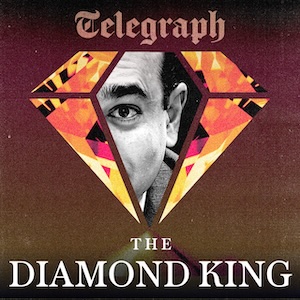
The saga of Nirav Modi—the once-prominent diamantaire accused of bilking India’s state-owned Punjab National Bank of more than $1 billion—is now a podcast, narrated by the two journalists who tracked him down after a year on the lam.
The four-part series, The Diamond King, tells how Modi went from a celebrated gem mogul whose pieces were red carpet staples to a prisoner in a British jail, where he’s spent the last seven years fighting efforts by India to extradite him.
“It’s an extraordinary story—a very compelling story and a very dramatic story,” Mick Brown, a reporter for London’s Daily Telegraph and one of the podcast’s cohosts, tells JCK.
“It has all these elements of glamour, deceit, hubris, alleged fraud. He’s a fascinating character who allegedly pulled the wool over a lot of people’s eyes.”
Indian authorities have accused Modi, who’d opened three stores in the United States emblazoned with his name, of receiving inflated bank loans using phony letters of undertaking (LOUs).
The LOUs “allow you to get foreign currency when importing and exporting from India,” says cohost Robert Mendick, also a Telegraph reporter. “They were giving him these letters based on collateral that seemingly didn’t exist. And the way he did that was by making it look like his businesses, of which there were many, were doing far more trade than they actually were.
“Some of these loans would then get repaid, but they would be repaid with bigger loans. So it was similar to a pyramid or Ponzi scheme. It becomes like an endless carousel, and then when it stops, it stops.”
That moment came in February 2018, when Indian authorities filed charges against Modi, accusing him of committing one of the biggest frauds in the country’s history. But by that point, the soft-spoken billionaire had vanished from view.
A year later, after Brown wrote a long piece about Modi’s disappearance for the Telegraph, he received a call from someone who claimed to know where he was. Brown and Mendick spent 10 days staking out Modi near his ritzy apartment in the middle of London, watching as the wanted fugitive commuted to the diamond business he’d set up nearby.
“It was an extraordinary thing,” says Mendick. “There was an Interpol notice on this man, and yet he’d been hiding in plain sight in London. He was living his best life in some ways, running his business and living in this glorious huge apartment with spectacular views of London.”
Brown says that, after they became convinced they’d found Modi, he confronted him, accompanied by a camera crew.
“He didn’t know what to do,” Brown says now. “When I said, ‘Mr. Modi,’ he turned around. I expected him to keep walking, but instead he stood on Oxford Street trying to get a taxi. And you can’t get a taxi on Oxford Street; it’s very crowded. It all became rather embarrassing, standing there for 10 minutes with him, waiting for a taxi.”
When Brown questioned Modi, he received a series of “no comments”—even when Brown asked if he wanted help getting a taxi.
The discovery of the missing mogul was splashed on the front page of the Telegraph, leading to Modi’s arrest shortly afterward.
The reporters aren’t without sympathy for their subject. Brown even says he had “commendable ambition.” In 2015, Modi told JCK he planned to open 100 stores within the next decade.
“India had never had a luxury brand really go international,” Brown says. “There was never an Indian luxury brand that was on Bond Street or Madison Avenue or Rodeo Drive.
“He hired the best designers; he was spending a lot of money on marketing, promotion, and advertising. He had people like Kate Winslet wearing his jewelry on the red carpet at the Academy Awards. All the pieces were in place. But people began to ask, ‘Where’s the money coming from for all of this?’”
After he was caught, Modi—once a celebrated businessman in his home country—became vilified, with his figure burned in effigy during a Hindu festival. The two reporters say they still wonder how someone so savvy about business could end up so low.
“In Episode 3, somebody talks about riding the tiger,” Brown says. “You get on the tiger, you start to ride the tiger, and you think, ‘Well, I can get away with a little bit.’ And then you maybe think you can get away with a little bit more. And then it’s a little bit more and a little bit more. You keep riding the tiger. But then, of course, in the end, the tiger eats you.”
(Photo courtesy of the Daily Telegraph)
- Subscribe to the JCK News Daily
- Subscribe to the JCK Special Report
- Follow JCK on Instagram: @jckmagazine
- Follow JCK on X: @jckmagazine
- Follow JCK on Facebook: @jckmagazine