For all the confusion and consternation lab-grown diamonds have sown in the fine jewelry marketplace, the science behind how they differ from natural diamonds is well understood. On a recent webinar organized by the Plumb Club and sponsored by Tracr, Dr. Ulrika D’Haenens-Johansson, senior manager of diamond research at GIA, offered a clear-eyed explanation of the key differentiating factors.
D’Haenens-Johansson’s presentation, “Disclosure, Differentiation & Trust: Clear Conversations on Natural and Lab-Grown Diamonds,” included nine insights into natural and lab diamonds that bear repeating—all drawn from more than two decades of diamond research she has performed both at GIA, where she’s worked since 2011, and at the University of Warwick in the U.K., where she earned her master’s and Ph.D. degrees in physics.
“Laboratory-grown diamonds are widely available, accounting for over half of global diamond jewelry sales by value,” she said. “And they also account for over half of diamond engagement rings by volume in the United States. They have a high visibility in the press. And this has led to the case where there’s a mixture of both highly informed and misinformed clients and retailers. And this is a breeding ground for confusion and mistrust.”
Natural diamonds are older than you think.
“Natural diamonds are old, and by old, I mean extremely old,” D’Haenens-Johansson said. “They formed 90 million to 3.5 billion years ago. And to give you a frame of reference of how old that number is, let’s compare that to the age of the Earth. The age of the Earth is 4.56 billion years old. The Earth was a teenager essentially when these diamonds were forming.”
D’Haenens-Johansson drew another comparison—with dinosaurs, which went extinct 65 million years ago: “These diamonds, even the youngest ones, formed way before the dinosaurs existed on earth.”
And they formed at mind-blowing depths.
“Most of them form at about 200 kilometers, or 125 miles, deep,” she said. “But some of them are super, super deep. Coming down to 700 kilometers, or 435 miles, deeper than the Earth. Now, to give you a frame of reference of how deep that is, the deepest structure that a human has made, the Kola Superdeep Borehole, goes down to 12.3 km. It’s just scratching the surface.”
Millions of years ago, volcanic eruptions brought natural diamonds from those depths to the earth’s surface. “The most recent diamond-bearing eruption, a Kimberley eruption, occurred over 20 million years ago in Australia,” D’Haenens-Johansson said. “And the fact that these diamonds have survived that experience, that super-fast explosion up to the surface, is a true testament to diamonds’ resilience. Most things would just fall apart in that journey.”
Don’t let anyone tell you natural diamonds aren’t rare.
Picture a 50-ton dump truck filled to the brim with earth. “It’s going to contain on average about 1 ct. total weight of diamond,” D’Haenens-Johansson said, adding that most commercial mines average about 0.3 to 1 ct. per ton of extracted material.
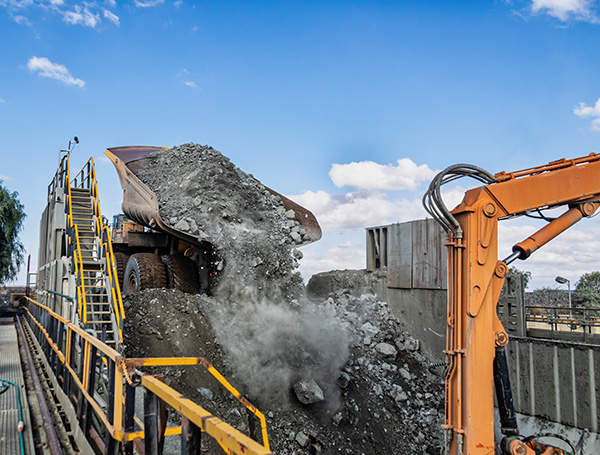
Put another way: “If you want to have a 1 carat D-flawless diamond, on average you’re going to have to extract 100,000 tonnes of ore,” she said. “Because you might extract several carats of diamond per ton, but most of those are not going to be gem-quality and most of those are going to be smaller.”
Natural diamonds offer a snapshot of prehistoric times.
When diamonds form deep inside the earth, they often trap non-diamond materials, which come to the surface with them. Scientifically, the hitchhikers can be extremely valuable. “They are the only, and I’m not exaggerating here, the only way for scientists to access some of these materials,” D’Haenens-Johansson said. “Diamonds are scientists’ best friends, to be honest.”
By studying these inclusions, gemologists and geologists have been able to glean the depth of formation of diamonds as well as their age. “A lot of people think of inclusions as being a detrimental thing, but really these are treasures within a treasure,” she said. “You can have crystals such as olivine, garnets, kyanite, these beautiful sort of peacock-type feathers and colors that you can have in a diamond.”
“Atomic-level defects” are a good thing, and “perfect” diamonds may not be.
“When we think of a perfect diamond, it would just have carbon in it,” D’Haenens-Johansson said. “But that can, to some extent, be a little boring. It becomes way more interesting, especially as a scientist, to deviate from this perfection because this adds character and beauty.”
She pointed to atomic-level defects such as the inclusion of boron or nitrogen atoms, which can produce beautiful colors in a diamond.
“The diamond crystal, although we like to think of it as being perfect, is not perfect,” she said. “Every diamond is going to have small deviations in it. These atomic-level lattice irregularities—missing atoms or impurities, traces of other elements—are actually not a bad thing. This is actually something that’s really exciting and beautiful because these defects, these irregularities in the crystal structure, are going to change the properties of the material. They’re going to change the way that the diamond interacts with the light.”
You may want to reconsider your ideas about fluorescence.
Want to know one sure-fire way to excite a diamond researcher? Look at stones using a deep UV light.
“Deep UV fluorescence can reveal diamonds’ intrinsic growth structure,” D’Haenens-Johansson said, as she referenced a slide depicting fancy color diamonds. “These diamonds would have been D- to Z-colored diamonds. But assume you hit them with a UV light. You see these unusual patterns within them. They’re almost like the tree rings within a tree trunk. When you have a tree that’s growing over years, you have changes in the climate and in the yearly cycles and you get these little rings. You can cut through the trunk and you can count these rings and it’ll tell you the age of the tree and it’ll give you information about the tree.
“Natural diamonds have these unusual growth figures inside of them,” she added. “And these are intrinsic to the stone. They are the true fingerprint of the diamond. And they cannot be modified even through treatment.”
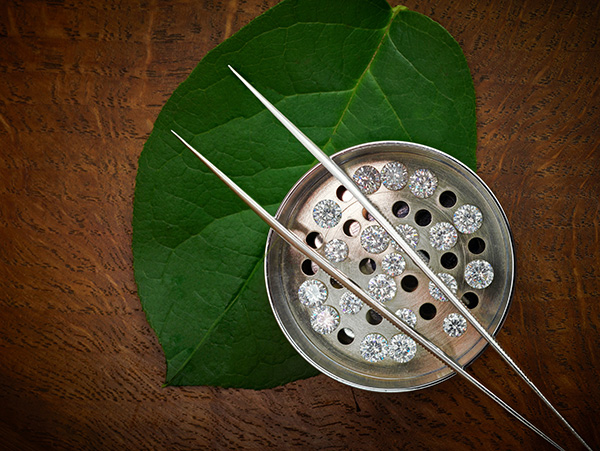
Lab-grown diamonds have experienced a dramatic evolution in size.
Once diamond growers in the early 2000s began using chemical vapor deposition (CVD) to synthesize diamonds (as opposed to high-pressure, high-temperature, or HPHT, methods), they were able to produce diamonds in increasingly larger sizes.
D’Haenens-Johansson said the first faceted CVD diamond larger than 1 ct.—a brown 1.11-carater, to be specific—was produced in 2003. “It looked like a block,” she said. “They’re trying to maximize the weight on it. So they just added a few facets just to make sure that it could be called faceted.”
By 2007 or so, a grower was able to produce the first round brilliant CVD diamond larger than 1 ct. (this time, it was a brownish 1.14-carater). The first near-colorless diamond larger than a carat, a 1.05 ct. pear-shape submitted by a client, came out around 2010.
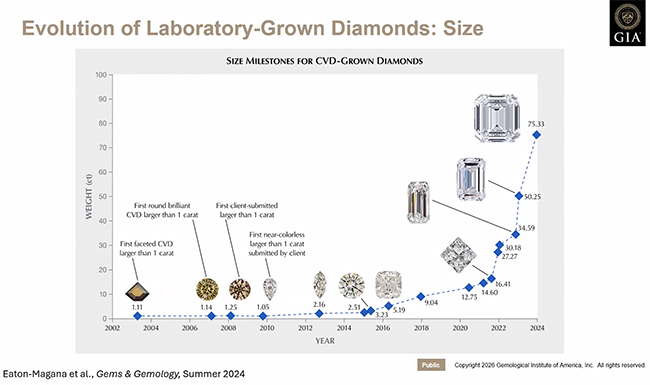
The year 2016 marked a clear turning point, as faceted colorless lab-grown diamonds weighing 3.23 ct. and 5.19 ct. entered the industry. By 2022 or so, we were seeing faceted lab diamonds of 16.41 ct., 27.27 ct., and 30.18 ct.
“Back in 2024, we had the record breaker, the largest faceted lab-grown diamond, the 75.33-carat ‘Celebration of India’ diamond,” she said. (She later noted that this record still stands.)
The majority of lab diamonds are now premium stones.
“When the first lab-grown diamonds were becoming commercially available within the gem trade, a lot of them were near colorless, or faintly colored, with colorless being very, very rare,” D’Haenens-Johansson. “But over time for both the HPHT and CVD processes, they’ve been narrowing down to just the colorless range.”
She showed a slide depicting the color evolution of both HPHT- and CVD-created lab diamonds since 2015. In recent years, the vast majority of stones across both methods were represented in blue, referring to D-E-F colors.
Over time, producers “have been improving their growth methods, making sure that they are not incorporating or creating defects as they’re producing the materials,” she said. “We have seen a huge improvement in the clarity features. So again, you’re getting a lot of flawless to VVS2s. And in line with that, since 95% of lab-grown diamonds fall into such a narrow range of color and clarity, it doesn’t make sense to apply the same scales and terms used for all the colors and clarities of natural diamonds which fall upon a continuum that relates to rarity.
“GIA’s natural diamond grading system was developed for a normal mine run back in the 1940s,” she added. “This doesn’t apply to lab-grown diamonds. Once you know your recipe, once you have your process in place, you’re just going to produce all the high color and high clarity materials. These are the premium goods.”
A lab-grown fancy color diamond does look different from a natural fancy color diamond.
After D’Haenens-Johansson concluded her presentation, someone in the audience asked a question: “Do you find that colored lab-grown diamonds have an artificial-looking color compared to natural diamonds?”
In short, yes. She alluded to the trace elements noted in her talk, which produce color in stones. “The types of color-producing defects in lab-grown diamonds are a very narrow set of defects,” she said. “And their appearance is different to the most prevalent color-producing defects in natural diamonds.”
D’Haenens-Johansson called out pink diamonds, for example. Natural pink diamonds derive their color from deformations deep inside the earth, she said.
“But the treated pink diamonds, whether they’re lab-grown or originally mined diamonds, if they’re treated, the defect that produces that color is the nitrogen vacancy center,” she said. “It has a slightly different absorption. So that’s why the color is pink, but it looks different. It’s a color that in nature accounts for only about 0.6% of natural [pink] diamonds. But amongst all the treated diamonds, it’s very common. Your eye can tell those differences in hue.”
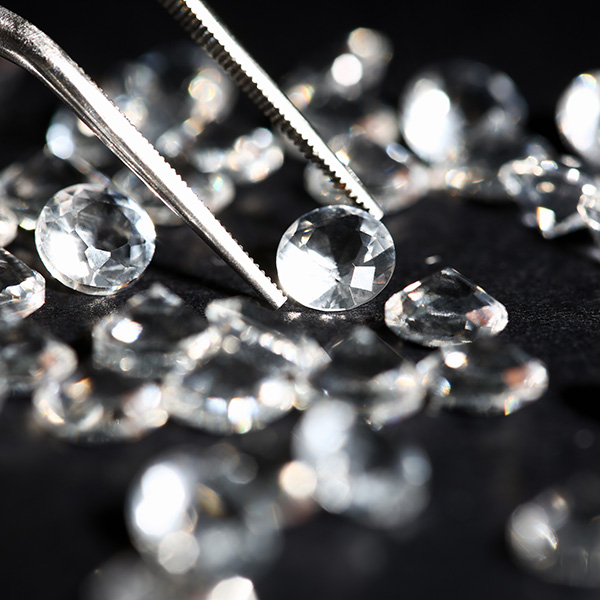
Top: Scattering of natural diamonds (photo: Getty Images)
- Subscribe to the JCK News Daily
- Subscribe to the JCK Special Report
- Follow JCK on Instagram: @jckmagazine
- Follow JCK on X: @jckmagazine
- Follow JCK on Facebook: @jckmagazine