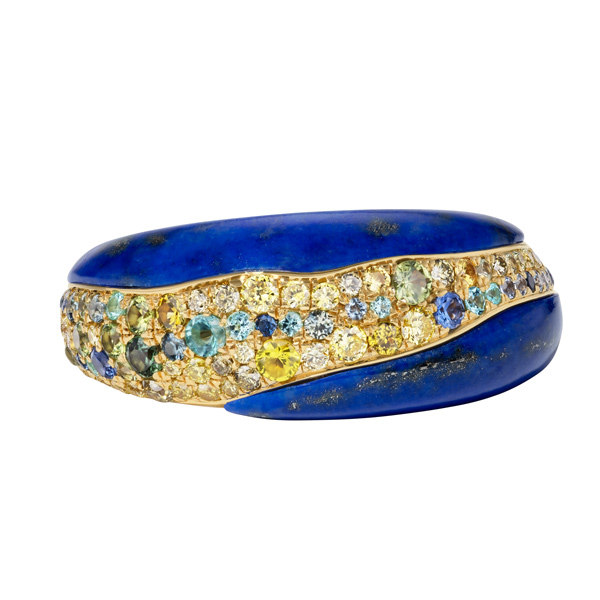
Paula Doebrich didn’t have to travel to Iceland or Norway to get the idea for Meluzza’s Northern Lights ring. She just had to look out the window of her New York apartment.
During one of 2024’s unusually strong geomagnetic storms, the aurora became visible from New York City—and, faintly, from Doebrich’s apartment. What Doebrich actually saw was modest: a pale patch in the sky that revealed itself more clearly through her camera than to the naked eye. But it was enough.
“It made my imagination run wild with what it could be like to see this phenomenon on a full scale,” says the Meluzza founder and designer. “Even on a small scale the sight was inspiring, and I got to sketching the next day.” And so the Northern Lights ring was born.
Doebrich approached the aurora as more than a color story. She has long been fascinated by its mythology and the idea of the lights as a message from another realm—a moment when something normally invisible suddenly announces itself. “I like to see the Northern Lights, with their colors and flicker, as a message from another world and a reminder that there is magic all around us,” she says.
Jewelry, to Doebrich, offers a similar sort of transformation: extraordinary materials pulled from the earth—or, in the case of the elements themselves, born through cosmic processes—then cut, polished, and assembled into something capable of stopping us in our tracks.
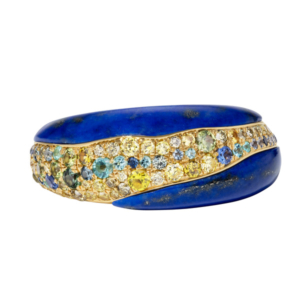
For this ring, stopping power comes courtesy of 92 gemstones in varying sizes: multicolored sapphires, natural fancy colored diamonds, and Paraiba tourmaline set in an irregular pavé that sweeps across the surface like moving light. Doebrich studied images of real auroras to develop the palette, ultimately concentrating on greens and yellows, with blue peeking through like night sky between bands of light.
Using differently sized stones proved essential. “That allowed me to make the pavé look more fluid and helped resemble the asymmetric pattern of northern lights,” she says.
Pink was deliberately left out—not because the aurora doesn’t produce it, but because there is only so much sky available on a ring. That may change. Doebrich is currently working on an emerald-heavy version emphasizing green, and a pink-and-violet Northern Lights ring may come next. “Luckily sapphires exist in every imaginable color,” she says, “so there is room to play.”
The ring’s night sky comes from lapis lazuli, chosen both for its intense blue and for a symbolism stretching back centuries. Its golden pyrite flecks help give lapis its celestial associations. But getting that sky into the ring proved considerably harder than dreaming it up. The lapis elements are curved, pointed, and fitted into the sides of the design, requiring skilled lapidary work to achieve the necessary shapes without breaking the material. The cutting alone took months of trial and error.
In fact, bringing the entire ring to life took more than a year. “As a designer, I let my imagination run wild,” Doebrich says. “But making the vision come to life takes a lot of skilled labor and patience.”
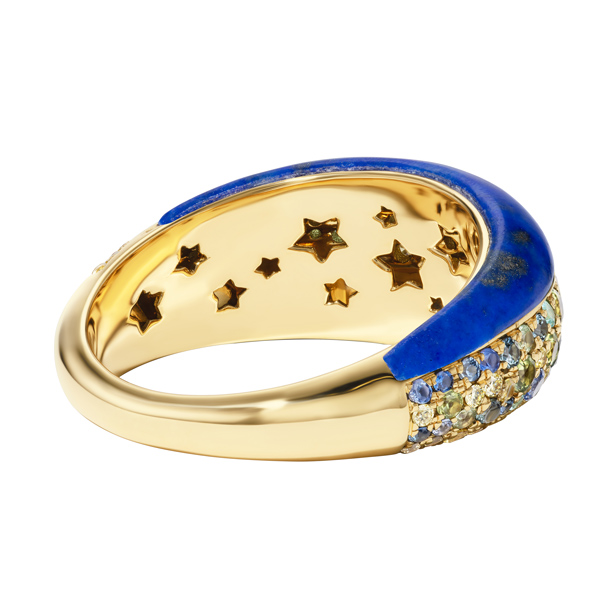
Meluzza’s pavé is set entirely by hand rather than relying on preset prongs, allowing the jeweler to arrange the 92 stones more intricately and use finer prongs for a smoother visual surface. “The goal of any piece of jewelry is to make it look flawless, leaving the wearer unaware of the labor that went into its creation,” she says. That illusion of effortlessness is particularly satisfying considering how much trouble the ring caused behind the scenes—including, Doebrich says, being told at points that the design simply wouldn’t be possible.
The lapis version remains the most faithful to her original idea, though Meluzza also offers the ring with cold enamel for greater everyday durability. Gold flecks are incorporated into the enamel to mimic the texture of lapis and preserve that starry-sky effect.
Because the ring relies on natural stones—and because certain materials, including Brazilian Paraiba tourmaline and untreated green diamonds, can be difficult to source consistently in specific sizes—some variation is inevitable. “No two northern light appearances will ever be the same,” she says, “so I would like to embrace this in the design of the ring.”
That variability also creates an easy opening for retailers. Customers tend to notice the mixed pavé first, Doebrich says, often remarking—before they even know the name—that the colors remind them of a night sky or the northern lights. From there, the story can go almost anywhere: craftsmanship, gem origin, rarity, mythology, or a customer’s own connection to one of the places represented by the stones. “With so many gemstones from so many places, each person could find a piece of themselves in the ring—or the story behind it,” Doebrich says.
Top: Northern Lights ring in 18k yellow gold with lapis, multicolored sapphires, Paraiba tourmaline, and fancy yellow and fancy green diamonds, price on request; Meluzza
- Subscribe to the JCK News Daily
- Subscribe to the JCK Special Report
- Follow JCK on Instagram: @jckmagazine
- Follow JCK on X: @jckmagazine
- Follow JCK on Facebook: @jckmagazine