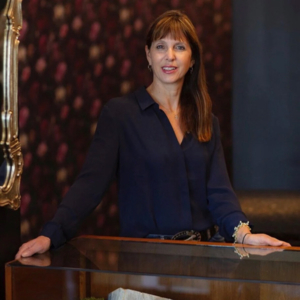
Everyone knows them, but few discuss them. They are the old-school secrets of New York City’s Diamond District, and Heather Sandor—whose family has operated on that storied block of 47th Street since 1957—wants to bring them out in the open.
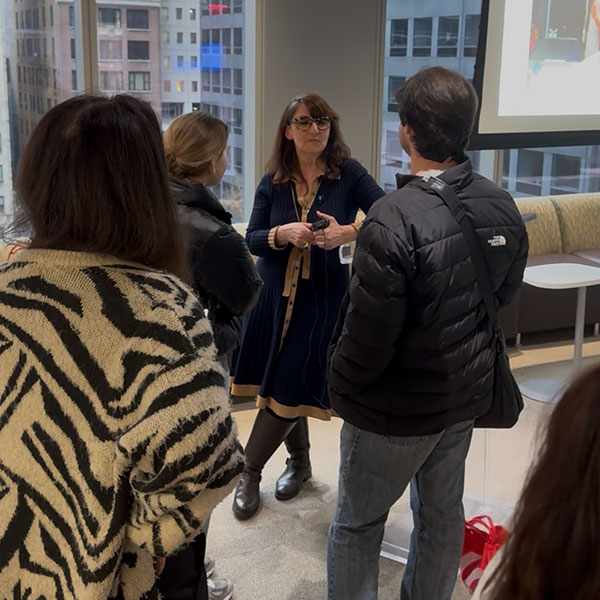
Sandor, a co-owner of A & C Gem Trading Corp., recently was the guest speaker in GIA’s lecture series aimed at the next generation of jewelers. When JCK heard about the class, we had to know more and reached out to Sandor for an interview.
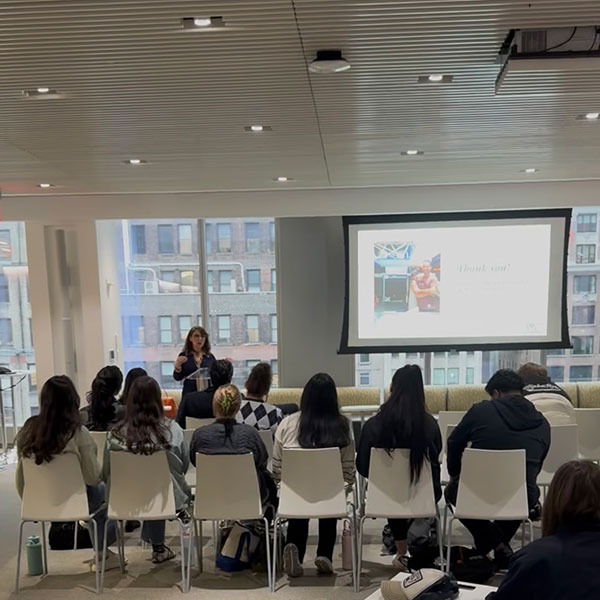
She tells us that her goal with the March 12 GIA talk, “47th Street 101: Decoding the Diamond District,” was to unpack the complex social and professional codes that govern the world’s most famous jewelry hub.
“There’s a language spoken on 47th Street that isn’t found in any gemology or business textbook,” Sandor says. “I am more than happy to speak with groups about this, as it is truly a passion of mine, which combines my inquisitive nature, my mothering instincts, and my absolute love of what I do each and every day.”
“As a mother of three Gen Z/millennial young adults, I have a very soft place in my heart for trying to do the right thing and to help explain navigating the block to the newcomers who I have met over the years,” she says. “This block can be a very expensive place to learn a lesson on how to conduct business safely and properly.”
Here is an edited version of JCK’s conversation with Sandor about her GIA lecture, her life in jewelry, and what she has learned from her experience on 47th Street.
Was this the first time you’d taught this class?
I started doing this in December 2024 as a guest speaker for the Manhattan chapter of the GIA alumni collective. Several teachers and members of the GIA education department were present and asked me to come and speak with their students, so I gave a presentation on June 11, 2025, and then I received a request in January to be in the 2026 roster of speakers for the students.
What is your personal history in the Diamond District?
I came onto this block for the first time in 1985 when I was dating my husband. I found the whole experience overwhelming and truly difficult to understand, whereas my husband grew up on the block, as the son of Hungarian immigrant parents who worked on this block since immigrating. This block was second nature for him. I worked as a journalist in the Washington, D.C., news bureau of Canadian Television Network and moved to NYC in 1991 and then [worked] full-time on 47th street. I was constantly surprised by how business was conducted and all the little unwritten rules of the block. We have always been at the street level in an exchange and never upstairs in an office, so this gives us a unique perspective on the Diamond District. I am a lifelong learner and have been speaking with and learning from every single person who I have met over the last 35 years.
What did you share with GIA students, and why?
I start with a history of the jewelry business in NYC, going back to the original Diamond District on Maiden Lane, which then moved to the Bowery and eventually to 47th Street—when buildings were built that featured reinforced floors which could handle the weight of both the safes and manufacturing equipment, as well as large windows which provided an unusual amount of natural light for diamond dealers.
Another very important and one of the students’ favorite parts is the explanation of common Yiddish and Hebrew and even superstitious phrases that are used on the block. This includes the ubiquitous mazel but also words like metsiye, which means a bargain; to hondl, or to bargain; chazerei, which means garbage merchandise; schnorrer, or someone who begs for a deal; and “touch,” a word used to talk about profit—getting a little touch means making money from the goods. I have a list and definitions for almost 40 terms that are still used by members of the Diamond District business community.
I also explain to the students what a memo is and the precautions that they have to take when signing a memo and how to care for the paperwork, as the paperwork carries just as much value as the items that they are signing for. I explain simple things that the students are not taught, like don’t split up a pair or a matching layout from a memo without the permission of the owner of the goods.
Why do you think your presentation has been received so positively?
These are all answers to questions that they don’t learn from a textbook or a gemology lecture. When the students leave the classroom, they are really lacking in a basic understanding of how to find reliable suppliers and how to cultivate a relationship that can last through decades and even generations. Many of the students are learning from social media how to conduct business in the Diamond District, but this is almost all staged and performative and certainly does not reflect how the majority of the $400 million dollars in daily transactions are conducted.
Students appreciate a decoding of the mysterious inner workings of the Diamond District and the jewelry business, and I am uniquely able to deliver this because I come from an entirely different background but was guided gently through this from my mother-in-law, my husband, and all the many people who I encounter by being at the street level, and not in an office building. We were in an exchange for 10 years that had an average traffic flow of more than 2,700 people each day. Very few people get that kind of daily exposure to everyone, from beginning students to the oldest names in the jewelry industry.
Top: Heather Sandor giving her “47th Street 101” lecture at GIA (photos courtesy of Heather Sandor)
- Subscribe to the JCK News Daily
- Subscribe to the JCK Special Report
- Follow JCK on Instagram: @jckmagazine
- Follow JCK on X: @jckmagazine
- Follow JCK on Facebook: @jckmagazine