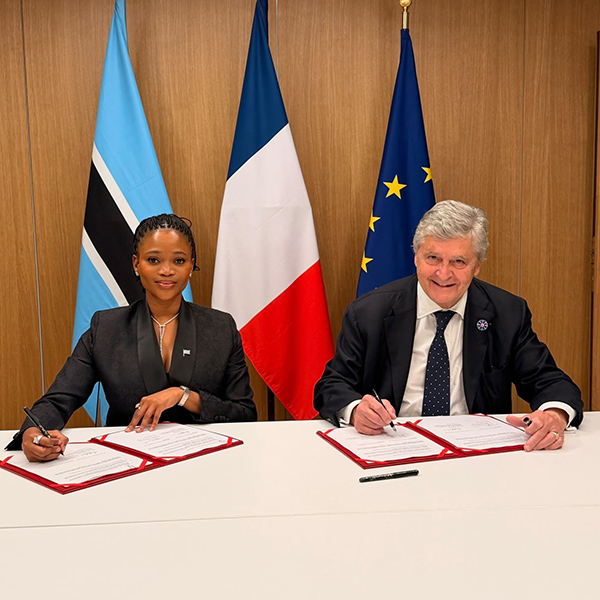
In a move signaled by Botswana President Duma Boko, France and Botswana on Nov. 10 signed the Paris Declaration on Natural Diamonds at the Paris Peace Forum—a move heralded by the Diamond Collective and its CEO, Amber Pepper, for its support of natural diamonds.
One standout effort within the declaration relates to terminology: The two governments agree on “the need for clear, accurate, and consistent terminology” with the word diamond “referring specifically to a natural diamond.”
This kind of language “strengthens consumer trust” while also reaffirming France’s and Botswana’s commitment to “protecting and promoting the distinctive characteristics and integrity of natural diamonds,” a statement said.
The move backs the Diamond Collective’s efforts to reclaim the word diamond as related solely to a natural diamond rather than synthetic or lab-grown diamonds.
In his Nov. 9 State of the Nation address in Gaborone (as well as in other speeches), Boko has indicated he prefers the word diamond refer only to natural diamonds; he wants the term lab-grown diamond to be replaced fully with synthetic.
“Since independence, our story has been interwoven with the story of our diamonds. In recent years, the relationship has lost some of its luster, confronted by the rise of synthetic stones. We’ve argued that they must not be called diamonds,” Boko said in his speech. “I’m happy to indicate that we will be signing an agreement in Paris; our minister will go, where France now has come on board with us, to defend our proposition that diamonds be reserved only for the natural diamond.”
The synthetic debate
In a statement, Pepper said the Diamond Collective (formerly known as the Natural Diamond Council) is “delighted” with the declaration.
“It is a reminder that the value of a natural diamond extends far beyond its beauty, supporting livelihoods, communities, and economies in producing countries around the world,” Pepper said. “Diamonds also sit at the heart of France’s extraordinary jewelry heritage, bringing together the rarity of the stone with generations of craftsmanship and expertise.”
The Diamond Collective chose to drop the word natural from its new name in part to show the difference between a diamond formed in the earth—its providence, history, and cultural relevance—and a diamond created in a factory, Pepper said in an exclusive JCK interview.
In September, the World Jewellery Confederation (CIBJO) affirmed its support for using the word synthetic to describe man-made diamonds in its venerable Blue Books. CIBJO’s general assembly and board of directors took up the name change as suggested by its diamond commission, which had begun studying the revision in 2025 after its Paris congress meeting.
Multiple countries—including Russia—have chosen to use the synthetic term for lab-grown diamonds in recent years.
Groups such as the Diamond Producers Council—a newly formed coalition of lab-grown diamond manufacturers headed by the Diamond Foundry—have protested CIBJO’s move. In its Oct. 20 statement shared on its website and with media, the Diamond Producers Council said it rejects CIBJO’s synthetic recommendation—calling the decision “biased and deceptive”—and asked the jewelry industry to continue using the terms lab-grown diamond, lab-created diamond, or [brand-]created diamond to disclose the origin of non-mined diamonds.
Regarding Boko’s Nov. 9 speech, the Diamond Producers Council tells JCK: “From his spot in Botswana, President Boko keeps doing exactly what the U.S. FTC has specifically warned about: suggesting lab diamonds are fake and not real. It is definitely not up to Botswana to define the law of the land. He is biased and wrong and harming U.S. consumers.”
What is the Paris Declaration?
The declaration connects the two governments alongside private-sector stakeholders across the natural diamond value chain. It comes as Botswana celebrates 60 years of independence and its 60th year of diplomatic relations between France and Botswana.
The declaration was signed on behalf of France and Botswana, respectively, by Nicolas Forissier, minister delegate for foreign trade and economic attractiveness of France, and by Bogolo Joy Kenewendo, minister of minerals and energy of the Republic of Botswana.
Within the declaration, the stakeholders affirmed:
• The essential contribution of natural diamonds to the economic growth and development of producing nations such as Botswana
• The importance of responsible, transparent, and reliable sourcing (supported through the Kimberley Process) alongside the relevant standards for workers’ rights, working conditions, health and safety, and respect for local communities
• The need for clear, accurate, and consistent terminology that strengthens consumer trust, with the term diamond referring specifically to a natural diamond
• The signatories’ intention to establish a joint working group, bringing together the signatory states and representatives of the private sector, to monitor the implementation of the declaration and to publish an annual progress report from 2027.
The declaration’s signatories also said they plan to work together on joint public information and awareness campaigns.
The Diamond Collective shared in its Nov. 10 statement about the declaration that the natural diamond industry supports the livelihoods of roughly 10 million people worldwide, with 80% of the value of a diamond remaining in its country of origin, where it helps finance infrastructure, healthcare, and education. This contribution is particularly significant in Botswana, where diamonds contributed 25% of GDP and 80% of exports in 2023.
Boko’s speech also said Botswana wants to increase its De Beers stake to 30% and announced the government had selected the Gareth Penny–led Global Diamond Consortium as its preferred bidder for the diamond producer. Boko was critical of De Beers during his State of the Nation, which notably was attended by De Beers CEO Al Cook.
“At some point, De Beers seems to have lost sight of what gives natural diamonds their value. It stopped telling the natural diamonds story. And the demand it once had done so much to create began to fade. It is the duty of the government of this republic to see to it that the country’s resources continue to serve its people,” Boko said.
Top: Bogolo Joy Kenewendo, minister of minerals and energy of the Republic of Botswana, and Nicolas Forissier, minister delegate for foreign trade and economic attractiveness of France, signing the Paris Declaration on Natural Diamonds (photo courtesy of the Diamond Collective)
- Subscribe to the JCK News Daily
- Subscribe to the JCK Special Report
- Follow JCK on Instagram: @jckmagazine
- Follow JCK on X: @jckmagazine
- Follow JCK on Facebook: @jckmagazine