De Beers’ Desert Diamonds campaign has been billed as a “beacon,” but it’s not like the traditional beacons the trade remembers (e.g., the three-stone ring or Journey).
Instead, it’s what’s called an “upper funnel campaign,” which, like “A Diamond is Forever,” aims to promote the entire diamond category rather than a specific product.
It’s also a campaign with numerous objectives. It wants to teach consumers that diamonds come in multiple colors—something De Beers’ research has found many didn’t know. But it links that to the brand’s larger message.
“It is taking the palette of natural colors in natural diamonds and using that as a way for consumers to connect them to the Earth,” Sally Morrison, De Beers’ natural diamond lead, tells JCK.
That’s also why it invokes the desert.
“The minute we said ‘desert’ in [focus] groups, they made the connection to the Earth,” Morrison says. “But a lot of other interesting things came out. It ties into a sense of renewal, a sense of rebirth.”
Morrison adds that focusing on diamonds with a distinctive look will help illustrate the difference between natural diamonds and their lab-grown competitors.
“Lab-grown companies can make different colors,” she says. “They can make any colors they want. If browns come out of a machine, they’re all going to be the same brown because they’re replicating a recipe.
“The whole point of this campaign is that every stone is different because nature can’t exactly replicate what it does. Because everybody is different, everybody’s relationship is different, and every diamond is different. You want to find a diamond that reflects you, specifically.”
Some have complained the campaign has no “call to action.” Even if a consumer was intrigued by the idea of Desert Diamonds, most stores don’t stock them.
That’s being fixed, says Lynn Serfaty, De Beers’ general manager for natural diamonds.
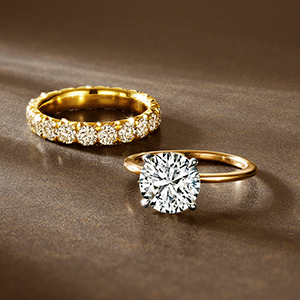
“We’re focusing on very specific objects, like the three-stone ring, the eternity band, the wedding band, and the solitaire,” she says. “And we are working with a store locator on our site. We are trying to direct consumers to specific stores.”
The Desert Diamonds campaign originally targeted fashion and has since moved to bridal. Later this year, it will target classics, including tennis bracelets, halo pieces, and stud earrings.
“We are generally interested in disrupting the status quo,” says Serfaty. “The fact that there was no category marketing for a long time allowed lab-grown to get in.”
She hopes the campaign will “disrupt” the way diamonds are currently being sold, using specific parameters such as color and cut grades. She thinks that has diminished their appeal.
“If you’ve ever held the diamond, especially the first time, it is something very special,” she says, “because of the way light plays within the diamond, because of its physical qualities. It is something rather magical. I remember my first really significant diamond, holding it, playing with it. It’s something that stays with you.
“The standardization, the commoditization in the market, removes the magic. We are trying to rebuild that.”
She feels the campaign plays into a larger trend of consumers wanting “unique” pieces.
“Over the last month and year, we have seen bridal move away from the classic setup,” she says, “whether it be the rings bought by Miley Cyrus or Taylor Swift, or people moving into colored stones, fancy shapes, old-mine cuts, etc. There is an appetite for something new, something fresh.”
(Photo courtesy of De Beers)
- Subscribe to the JCK News Daily
- Subscribe to the JCK Special Report
- Follow JCK on Instagram: @jckmagazine
- Follow JCK on X: @jckmagazine
- Follow JCK on Facebook: @jckmagazine