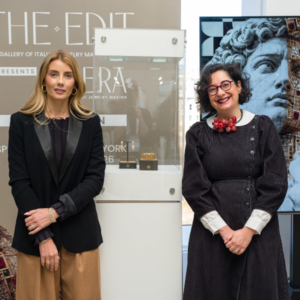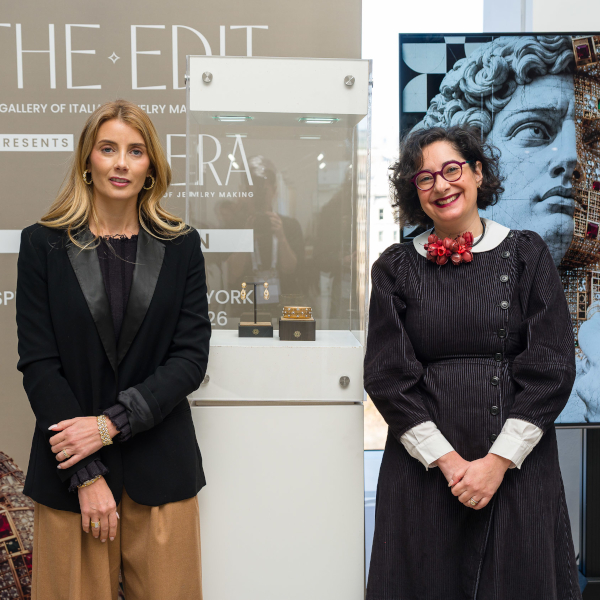
Lucrezia Buccellati kicked off NYC Jewelry Week on Monday by defending one of luxury’s least fashionable ideas: waiting.
Speaking with NYCJW founder Bella Neyman at The Edit, the Italian Trade Agency’s (ITA) showcase of 34 Italian jewelers at Spring Studios in Manhattan, Buccellati acknowledged that some pieces from her family’s Milan house can take a year or two to deliver.
“Everybody’s complaining,” the fourth-generation designer said. “We’re trying to speed up the process.”
But Buccellati won’t fix the wait with machines. The answer, she said, is more skilled artisans, who by her estimate need five years of training to handle most of the house’s work and a decade to master it. In an era of instant everything, she argued, that time is the point.
“With all that’s happening in the world with AI, the ability of having a hand skill—that is what gives the biggest value to our pieces,” Buccellati said. “We have clients that love Buccellati because of the handcraft. It’s not just about the stones or the design.”
“I always say the artisans for us are the biggest treasure,” she added. “If we didn’t have the artisans that we have today, probably Buccellati would not look like Buccellati.”
The talk was the first of roughly 200 events, including a dozen online, on the calendar for NYCJW’s ninth edition, which runs through Nov. 22 under a fitting theme: craftsmanship. Trade editors, Italian diplomats, and buyers filled the room, surrounded by display cases of work from more than 30 exhibitors who had flown in from Italy for the show.
The Edit, organized by the ITA’s Houston office, ran under its own theme, “Opera: The Italian Art of Jewelry Making,” divided into three sections: Makers, highlighting generational knowledge rooted across Italy’s regional districts; Signatures, for the aesthetic identity that makes Italian design recognizable around the world; and Masterpieces, celebrating the ability to turn heritage into enduring works of art.
Giuseppe Pastorelli, Italy’s consul general in New York, told exhibitors in Italian that without their work there would be no “Made in Italy,” before turning to English to acknowledge the strain of selling into the U.S. these days.
“I know it can be difficult times,” Pastorelli said. “There are things that we can work on, and there are things that are out of control, like customs duties. But the message we would like to give, together with the Italian Trade Commission, is that companies are not alone.”
The point landed close to home for the Italians abroad. On opening day, more than one exhibitor’s booth sat empty because their merchandise was held up at the airport.
Italian craftsmanship on display at The Edit
Buccellati wasn’t the only one on the floor playing the long game.
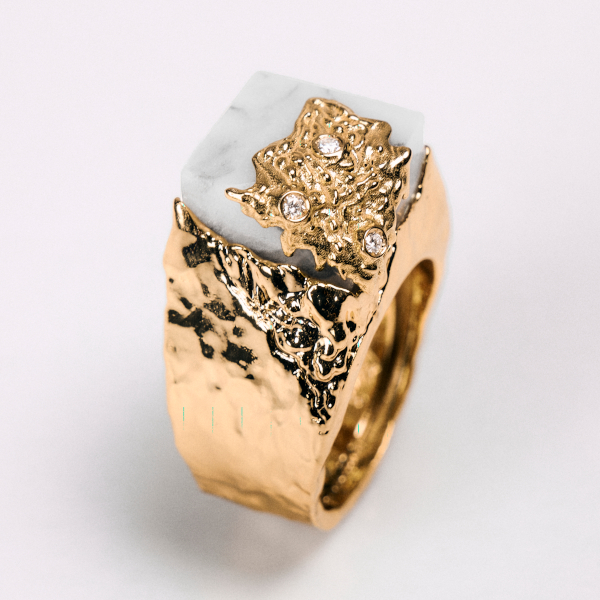
Isac Deil, founder of Milan-based Deil Isac & Co. and a repeat exhibitor at The Edit, flew to New York with his family to show the company’s newest craftsmanship. His daughter, Sara Deil Kash, pulled two gold-leaf rings set with cubes of Italian marble: one in white, and the other black. Called the “time cube”, these rings are meant to combine Italian sculpture with jewelry.
“It’s like a piece of Italy on your finger” she tells JCK.
Also exhibiting was Grimoldi Milano, a family-run goldsmith founded in 1964, whose booth centered on custom watches and bespoke rings. Designer Giorgio Grimoldi unveiled one of his newest creations: The Nail, an 18k white gold bendable ring.
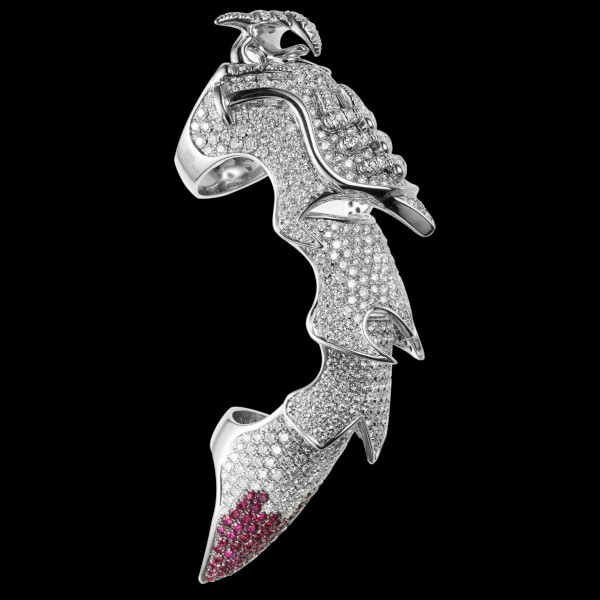
“This is a bendable ring, comfortable, and supposed to cover up the finger,” says designer Giorgio Grimoldi.
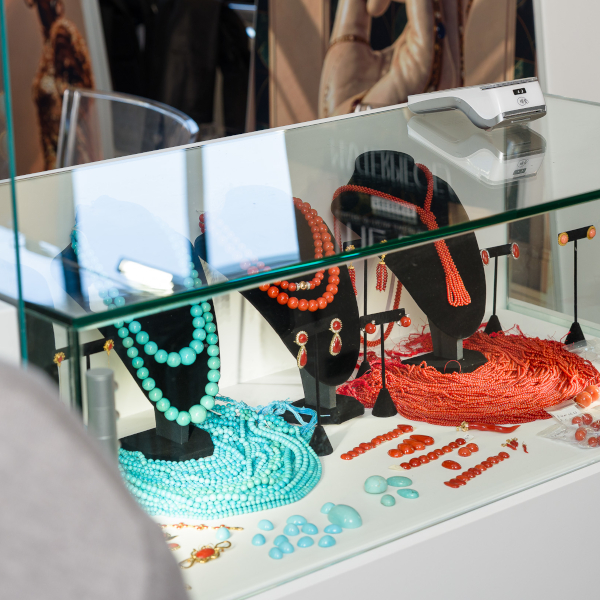
Several other exhibitors brought jewelry in natural coral, a longtime Italian specialty.
During the event’s opening, Pastorelli summed up the pitch with a line he said he’d heard recently: “Italy is where fashion and this kind of jewelry is created, but New York is where jewelry is purchased. So, let’s make this great combination.”
Buccellati’s call for craftsmanship
For Buccellati, craftsmanship starts with fabric. Her great-grandfather, Mario Buccellati, opened his first shop in Milan in 1919, steps from La Scala, and set out to replicate in gold the Venetian lace, trims, and embroidery he saw on Milanese women headed to the opera.
The house’s signature engraving style of jewelry, fine parallel lines cut by hand, mimics silk.
“If you see fabric, it’s all work,” she said, explaining why no Buccellati surface is simply left polished.
Each artisan brings their own hand to that style, and the house keeps pushing them. Compare a cuff from Mario’s era with one from her grandfather Gianmaria’s, she said, and the engraved lines on the later piece are noticeably finer.
“We constantly challenge our artisans to get better or make it different,” she said. “It’s a constant learning between us and the artisan on how to make this masterpiece.”
For a while, artisans’ children wanted to become accountants or lawyers instead. That’s changing.
“There’s a huge comeback in being an artisan,” she said. “They are proud of being an artisan.”
Top: Lucrezia Buccellati and Bella Neyman speak at the second edition of The Edit in Manhattan, New York City, 2026, photo by Simon Leung
- Subscribe to the JCK News Daily
- Subscribe to the JCK Special Report
- Follow JCK on Instagram: @jckmagazine
- Follow JCK on X: @jckmagazine
- Follow JCK on Facebook: @jckmagazine