
It hasn’t been a particularly good year for the diamond mines, though it’s been an unprecedented year for diamond mines closing. Consider this:
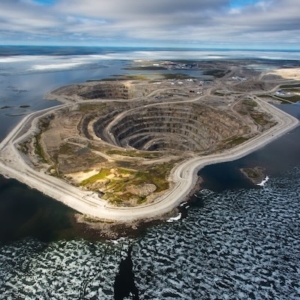
• In March, Diavik (pictured), which mining giant Rio Tinto has operated in Canada’s Northwest Territories for 23 years, ceased production a few months ahead of its intended closure date.
• Four months later, Ekati, the mine that sparked the Canadian diamond rush, also announced it would close, following its parent company’s second trip to bankruptcy court. It had been producing diamonds since 1999. That mine originally had been set to produce until 2029.
That leaves only one mine left in Canada currently producing—Gahcho Kué—and its future is also looking shaky. It’s jointly owned by De Beers and Mountain Province Diamonds, but Mountain Province, the junior partner, is heavily in debt and now stands at risk of default, according to a recent report from S&P Global. De Beers has said the mine will likely close in 2028, but some now believe its end could come sooner.
The picture looks similar in South Africa, once the world’s largest diamond producer:
• Petra put the Finch mine, which it bought from De Beers in 2011, into “business rescue.” When the receiver found no takers, Petra announced the mine would close.
• De Beers is halting operations at the Venetia mine for two years in order to “reduce costs while also rephasing capital expenditure on its underground project,” it said. In just 2023, De Beers called Venetia a “world-class” asset.
• The Ekapa mine, which has been open for some 158 years, was put up for sale earlier this year. When no one came forward to buy its mostly tailings-based production, owner Ekapa Minerals decided it would close.
The National Union of Metalworkers of South Africa successfully petitioned the Northern Cape High Court to halt Ekapa’s liquidation and place the mine into business rescue. A local diamond dealer has expressed interest in buying the property.
Avi Krawitz, the journalist behind The Diamond Press, expressed sorrow at the closures, calling Ekati, Finch, and Venetia “almost legendary mines.”
He adds that “apart from Ekati, whose closure was coming up, [shutting] the other two was not necessarily in the cards. Venetia’s life of mine theoretically extends into the 2040s.”
While these closures generally have been blamed on the diamond industry’s wider issues, miners in Canada and South Africa have to contend with their own distinct challenges that make things worse.
Operating a diamond mine in the Northwest Territories has required the construction and maintenance of a large (and expensive) ice road. And since the territories’ mines are older, the operations had to go underground, which is a far more expensive way to mine.
In South Africa, Lyndon de Meillon, founder and owner of Paleostone Minerals, which owns several alluvial sites, tells JCK that the country’s “corruption and incompetence” have made it near-impossible to mine there.
“Lab-grown is an easy scapegoat,” he says. “But this has been going for 20 years. Without the administrative burden and social burden that’s been placed on these mines, I think they would still be able to operate.”
As a result of the closures, the number of carats mined will likely fall to around 98 million carats this year, according to report from Morgan Stanley. Industry commentator Paul Zimnisky believes total production will fall below 95 million, which would be 40% lower than total production in 2015 and the lowest level in 40 years, he says.
“There has been an absolute reckoning upstream,” Zimnisky tells JCK. “Miners have been hit by all sides, and this reached a crescendo this year.”
But while the mines’ closures will likely spur a humanitarian disaster—causing thousands of people to lose their jobs—they may end up benefiting the overall diamond industry. With lab-grown taking market share away from natural stones and demand falling in China, supply has generally outstripped demand. Now, it may be brought more into balance, analysts say.
Former Tracr chief operating officer Jason McIntosh wrote on his Substack that the diamond mine closures are meaningful because they are “irreversible.”
“The thing about natural diamonds is that everything usually moves slowly—mines operate on long cycles, inventory moves slowly, and marketing operates over long time periods,” he wrote. “But once supply has genuinely disappeared, the market may adjust much faster than expected.”
That may be why even Mountain Province, which posted a $120 million loss in its most recent quarter, believes things are looking up for the industry, after spending the last four years in constant crisis.
“Our most recent diamond sale showed an improvement in pricing, which we believe may in part reflect the tightening of global diamond supply following a series of mine closure and cessation announcements,” it said in a statement. “While it is too early to determine whether this represents the beginning of a sustained improvement in the market, the recent sale was encouraging.”
De Meillon believes the drop in supply “will start to help. But it won’t be a V-shaped recovery like we had after the 2007 crash. There’s still a lot of diamonds in the system, and the demand for natural diamonds hasn’t increased.”
Zimnisky is similarly cautious.
“I am beginning to see the dramatic cut in supply supporting prices,” he says. “Just within the last few weeks, I have seen most categories of diamonds show signs of life for the first time in a while.
“Of course, you want to see price appreciation ultimately driven by both supply and demand. So, I think we will also need to see demand pick up to sustain any meaningful rally.”
(Photo courtesy of Rio Tinto Diamonds)
- Subscribe to the JCK News Daily
- Subscribe to the JCK Special Report
- Follow JCK on Instagram: @jckmagazine
- Follow JCK on X: @jckmagazine
- Follow JCK on Facebook: @jckmagazine