Over the past 15 years many gem dealers across the world have bemoaned what they’ve described as a “hollowing out” of the midrange colored gemstone market.
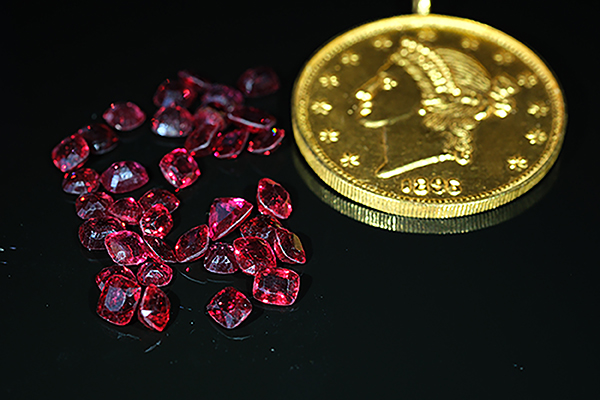
Slightly pale blue sapphires. Cloudy rubies. Big Fanta-colored garnets. Star sapphires in muted hues. In other words, stones that aren’t worth a million dollars, but aren’t worthless fracture-filled glass either.
These types of gems are often lumped into a middle category of natural colored stones that many analysts and dealers say is losing its luster. It’s not a new story, but it came up again during AGTA’s GemFair in Tucson earlier this year, where Gemworld International president Stuart Robertson told a room full of dealers that the colored stone market has split in two. The high end is active, the low end is active. What’s gone quiet is precisely this middle category—a range that’s been the industry’s bread and butter for decades.
And yet, six months later, dealer Eric Braunwart is selling more of it than ever.
“That middle category that lots of people have moved out of, we’ve doubled down,” says Braunwart, president of Columbia Gem House, the Vancouver, Wash.–based cutter and wholesaler.
Both Robertson and Braunwart are talking about the same market. What separates them is which stones they say constitute the middle.
What left, and what replaced it
The market stagnation is real, but it is concentrated in the big three gems (ruby, sapphire, and emerald), says Brecken Branstrator, editor-in-chief of Gemworld’s GemGuide.
“Buyers at the top end of those three are, for the most part, still willing to pay prices,” she tells JCK. “Buyers that would normally be purchasing in the middle tier seem to be turning away from those goods and looking for something else.”
That something else is the market Columbia Gem House has spent two decades building. The company’s gems retail between $20 and $10,000 per stone. They are, by and large, the kind of stones the industry would once have thrown over its shoulder: misty and opalescent material, bicolors, oranges and pinks—included but still good gems. Beyond corundum, Braunwart says sphene, andalusite, and spinel are all moving well.
“A lot of the stuff we cut is what people used to throw away,” he says.
Branstrator says the pricing data confirms this. Unusual color sapphires, she says, represent probably the single biggest transition of the past few years, with bicolor and parti-color material leading the way. Spinel and garnets are also clear winners because of the colors they offer, and their accessible pricing.
“These categories’ middle tiers seem a little more stable but demand for them is also growing as more buyers find their way into them, so there is still a level of discovery here,” she says.
Braunwart assumed the appetite for unusual goods was an American quirk until the same material started to sell in Europe and through a dealer he works with in China. He is explicit that none of this existed at scale before. The market has widened over the past 15 or 20 years to include more gems, he says, and the trend has accelerated since the pandemic.
Price is secondary to availability
The squeeze at the top among the big three colored stones is showing up in the charts, and on the floor of trade shows—or, rather, in their disappearance.
Over the past year, GemGuide repeatedly has narrowed what it is willing to publish on corundum categories. Last fall, the company divided its heat-treated Ceylon and Burmese sapphire charts into smaller-sized spreads because price jumps between adjacent sizes (sometimes less than a carat) had grown too sharp to average.
In the Burma sapphire chart, GemGuide axed sizes above 12.99 cts. this year. “We saw that material in those sizes is so scarce in today’s market that we felt there wasn’t enough transactional data to produce meaningful pricing guidance for the larger, finer-quality sapphires,” says Branstrator.
Then, earlier this summer, GemGuide cut its Burmese sapphire chart down to only three grades from its usual 10 grades. Users are being instructed to interpolate in between these ranges. “This, as with the others, is due to the scarcity of the category,” she says.
Availability, as opposed to price, now dictates whether a stone sells. Buyers priced out of the benchmark don’t necessarily stop buying—they simply change what they buy.
Gold ate the credit line
Buyers are also changing the frequency with which they make purchases, says Braunwart. And he says his customers are telling him the pressure is coming from metal rather than stone.
Braunwart’s customers are mostly small-to-medium designers working off fixed lines of credit. When the metal portion of their raw materials jumped in price, a larger share of that credit was consumed before a single stone was purchased. The result, he says, is not necessarily that designers are buying less overall. They’ve stopped buying in lumps.
Where a designer might once have confidently spent $100,000 at a trade show and gone quiet for the rest of the year, Braunwart now sees the same buyer placing smaller orders every six to eight weeks. For his business, he says this has been neutral to positive: a steadier cadence, with more frequent contact.
Braunwart flags a subtler version of the same math. When a designer sells through inventory, more of the replacement capital goes to metal than in previous years, even with gold’s recent pullback. The share going to stones has shrunk.
According to Branstrator’s read on this year’s shows, there’s a consistent pattern forming. Attendance and foot traffic have been down as spending turns cautious, she says, though the buyers who do come are intentional and still spending. Notably, the pattern has outlasted the pricing volatility: Metal has come down somewhat since February, she says, yet the buying behavior has remained in place.
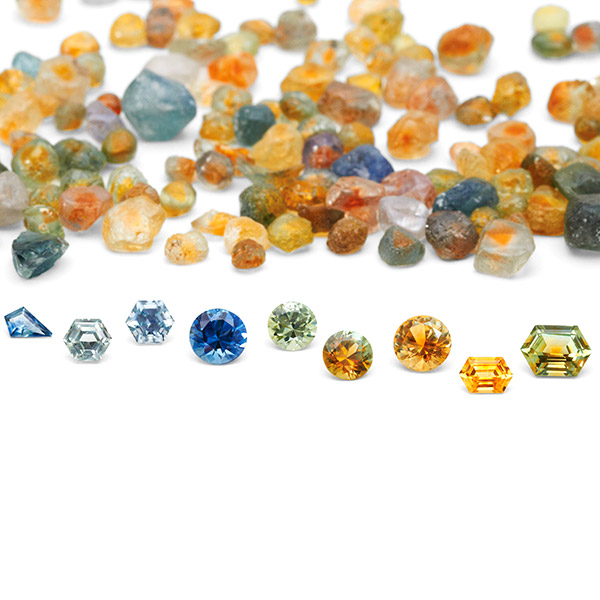
Top: loose Montana sapphires cut by Columbia Gem House (photo courtesy of Columbia Gem House)
- Subscribe to the JCK News Daily
- Subscribe to the JCK Special Report
- Follow JCK on Instagram: @jckmagazine
- Follow JCK on X: @jckmagazine
- Follow JCK on Facebook: @jckmagazine