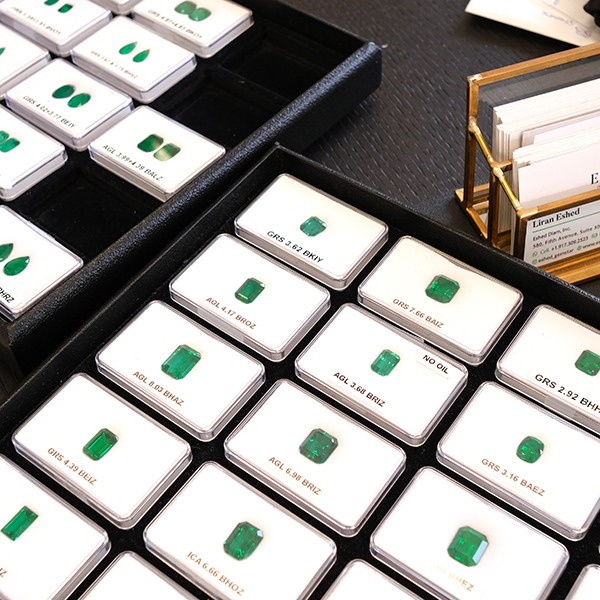
Picture three trays of emeralds, each a different price, arranged from left to right in ascending order of financial justification—$4,000 per carat, $9,000, $15,000. All fine Zambian goods, all from the same industrially procured batch of stones. The spread represents quality, not origin.
It’s an important reminder that, for an American retailer, the practical question isn’t where a stone came from, but if the seller will have another one next month.
We’re in an office above New York City’s Diamond District, where each emerald sits uniformly ensconced in a plastic case and foam pillow laid out by Liran Eshed, whose family business, in 2022, set a Guinness World Record for the largest uncut emerald. A poster of the stone hangs on the wall: a single crystal weighing 7,525 cts., or a kilo and a half.
Looking closer at the trays of faceted Zambian emeralds, the variation becomes obvious. Human beings are unusually well equipped to see it. Our eyes detect subtler variations between hues of green than any other color in the visible spectrum.
According to prevailing research on color perception, we owe this to mankind’s continued reliance on foraging—rather than hunting—as a means for survival. Finding a ripe fruit or edible leaves against a wall of foliage, rather than hunting a target in the wild, made all the difference to our ancestors. This is a useful distinction to carry into a gem office, because the trade depends on both.
Hunting and foraging emeralds
There are hunters in the business of precious stones: dealers who track a single extraordinary gem, take it, and live off the kill. One transaction, one margin, then back to looking for the next target.
Other dealers look to where the trees are—the mines—and keep going back on behalf of clients. Eshed runs the North American arm of Eshed-Gemstar, the Israeli cutting house his father built.

“It’s not a hit-and-run business,” he says.
What he means is that the company depends on a repeatable cadence when acquiring rough emeralds, not one-off deals. Eshed-Gemstar competes at the top of the market—record-breaking tenders, stones that make headlines—but the headlines aren’t the business. Once cut, the finest goods are handled out of Israel, whereas the New York office works the upper-fine middle and up.
“When I know that I have buyers that can buy from me every month, and they are happy, and they come back the month after, and the month after—you have a stable business,” he says. “And they have stable businesses.”
Eshed credits, in part, his ongoing relationship with Gemfields, the London-based mining company that operates the Kagem open-pit emerald mine in Zambia. The mine supplies roughly a quarter of the world’s emeralds and feeds the tenders where Eshed buys.
“This is the power when you have regular supply,” he says. “If somebody wants something, and he has a budget—whatever he wants, I got it.”
For a retailer, the benefits of repeatability show up at the counter. Say a client returns a year later seeking a matched pair, or the same stone but a size larger, or a store wants to run one design across a case. That requires a supplier who can restock. Trophy material can’t do it.
Origin carries a measurable premium, though less than the trade’s romance about Colombia suggests. In Gemworld’s July-August GemGuide, upper-fine Colombian goods at half a carat fetch a premium of roughly 14% compared with similar quality Zambian emeralds. Once a stone reaches 15 carats, that gap approaches 70%. Dealers, however, say the premium runs far steeper. The guides and the street rarely agree—but both put the biggest premium in the larger sizes.
Kimberly Collins, a dealer in Reno, Nev., who wholesales loose gems and also sets them in her own jewelry line, carries emeralds, but it’s one category among many: sapphire, spinel, tourmaline, garnet—which is how most American stores carry it.
She says clients have been behaving differently in the past six months. A request for emeralds used to come with a preference attached: 2 to 3 cts., Colombian if possible. Now, Collins says, callers specify Colombian and leave it there. The budget attached to the request, however, hasn’t moved.
Collins’ emerald stock is mostly Zambian, and it’s not only because of price. She says much of the Zambian material she sees carries minor oil treatment—sometimes none at all, which is helpful in a disclosure conversation.
Colombia’s difficult year
Colombia’s mostly artisanal emerald mining has never been industrialized the way Zambia’s has. The country’s emerald belt runs on hundreds of small operators, commission agents, and family holdings, and production surfaces through the trade rather than scheduled tenders.
In 2018, Fura Gems set out to change that at one mine. The company, then led by former Gemfields chief operating officer Dev Shetty, took control of the Coscuez mine in Boyacá and brought the Zambian playbook with it: mechanized extraction at scale, organized rough tenders on a calendar, open to international bidders. By June 2023, it was running a 240,000 ct. auction in Bogotá, marketing itself as the only supplier of Colombian rough on an organized platform.
In September 2025, Fura asked Colombia’s mining agency to suspend operations at Coscuez, citing violent incursions, blockades, assaults on workers, emerald theft, and what it called minería ilegal tecnificada—mechanized illegal mining—as opposed to traditional miners, or guaqueros, with hand tools. Mine invasions, sometimes backed by criminal organizations, are not unusual in Colombia.
Colombia’s national emerald federation, Fedesmeraldas, says Colombian emerald exports have fallen from $182 million in 2023 to $116 million in 2025.
A catastrophic earthquake struck western Colombia on Aug. 10, killing more than 300 people and injuring thousands. Though Boyacá’s emerald-mining districts do not appear in government damage assessments, widespread public and private infrastructure destruction is reported to have occurred across many major cities. Rural areas are impacted by landslides, complicating transportation. The effects on the emerald trade remain to be seen.
Pricing the gap
For retail jewelers in the United States, Colombia’s mining troubles are a pricing problem rather than a geopolitical one. A client asking for a Colombian 2–3 ct. emerald is seeking a stone that has become scarcer, and it often comes with a heftier price. GemGuide places Colombian emeralds (of that size) between $5,500–$7,000 per carat in the upper fine category against $4,500–$6,300 for comparable Zambian. (Note: GemGuide price ranges are heavily modified based on the presence or absence of various types of treatments.)
The conversation that saves the sale is about the stone at hand—color, clarity, what it will look like set—rather than its passport.
Colombian looks worse on paper largely because there is paper. There is no Zambian version of Fedesmeraldas, no mining agency publishing emerald output in the same fashion. What the trade knows about Zambian supply it mostly learns from Gemfields, which reports to shareholders of Kagem.
In 2024, Kagem produced 159,351 cts. of premium-quality emerald. Some are sitting in Eshed’s office on Fifth Avenue.
On the trading floor of an adjacent building in the Diamond District, nobody is reading export figures. Dealers work from their own books: what they last paid, what they sold, and to whom. Those books stay closed.
Samuel Millard, a colored stone dealer on West 47th Street, reaches into his display case for a parcel of emeralds. Where Eshed argues supply, Millard points to price.
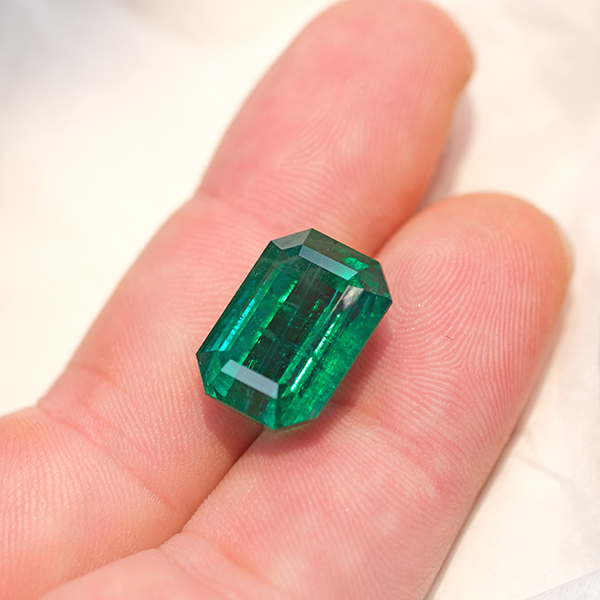
“Zambians are a good investment,” he says. They’re very well-priced compared with the Colombian market, which has become rigid.” He holds out a 15.7 ct. moderately oiled Zambian emerald priced at $1,100 per carat. A stone that size for under $20,000 wholesale—that’s something.
Like many dealers, his prices vary wildly based on quality. And yet availability is just as, or perhaps even more, important. Whether the same offer exists now or tomorrow, buyers must wait for the market to decide.
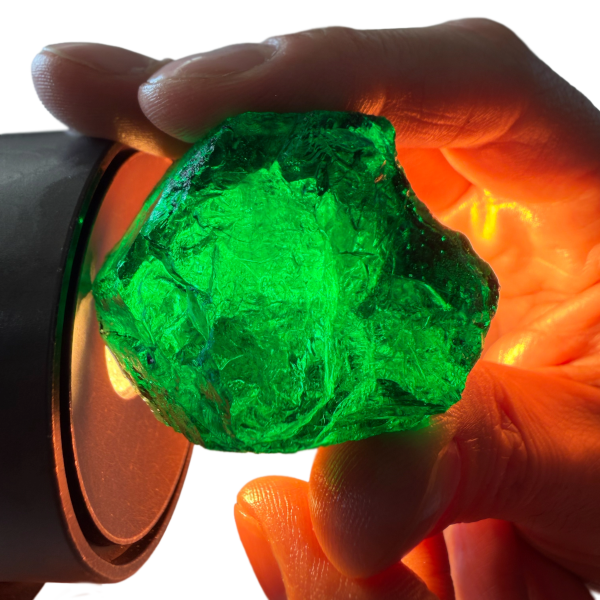
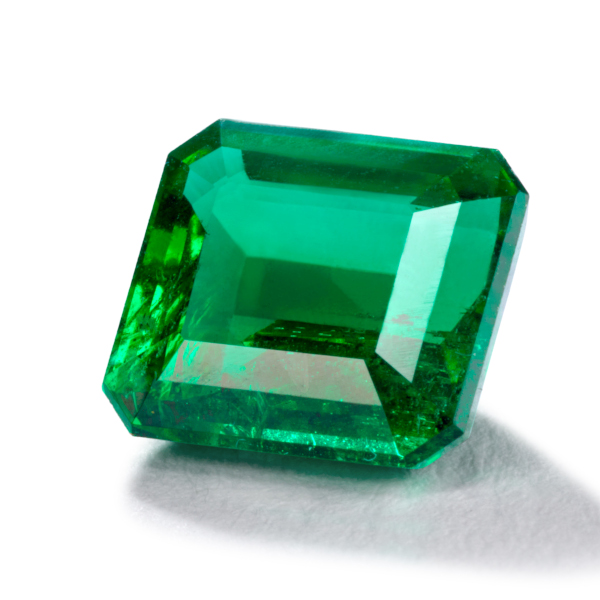
Top: Eshed-Gemstar’s price-record breaking 520 ct. “Legacy Emerald” purchased at a Gemfields auction in 2025 (photo courtesy of Eshed-Gemstar)
- Subscribe to the JCK News Daily
- Subscribe to the JCK Special Report
- Follow JCK on Instagram: @jckmagazine
- Follow JCK on X: @jckmagazine
- Follow JCK on Facebook: @jckmagazine