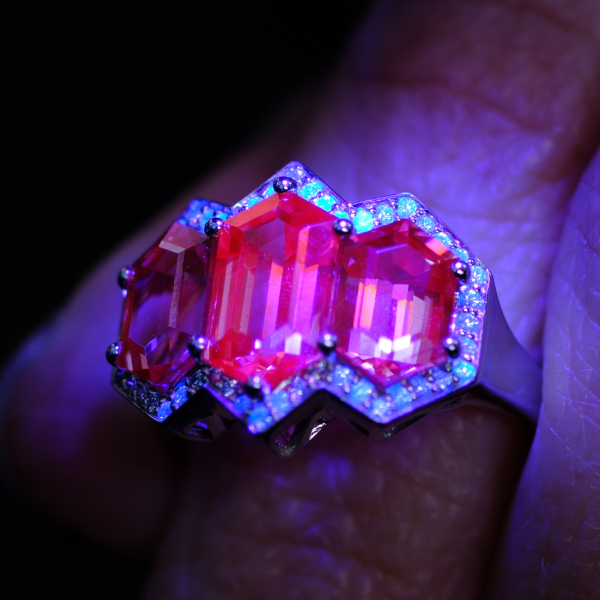
For decades, GIA’s research has said blue fluorescence rarely hurts a diamond’s appearance—implying that, in fact, it may be optically more pleasing. Soon, the lab may say so on the grading report itself.
The Gemological Institute of America (GIA) is preparing to add direct comments about fluorescence to its diamond grading reports, further addressing a characteristic that has divided the trade and weighed on prices among dealers for decades.
GIA plans an announcement in the fourth quarter to inform clients and the trade about the details before the new comments are implemented to new reports, Stephen Morisseau, GIA’s director of corporate communications, told JCK. (He confirmed the plans first reported by Rapaport News in June.)
After GIA rolls out its new policy, two different comments can be expected to be appended to lab reports for diamonds submitted for testing. These certificate comments will be encountered only by those whose stones submitted for testing carry a high enough level of fluorescence—in other words, the glow given off when a stone is subjected to artificial or natural ultraviolet light.
A minority of all stones submitted for diamond testing carry enough fluorescence to be noteworthy to GIA in the first place; a 2021 peer-reviewed Gems & Gemology paper on the subject places that number at about 30%. But within that group, fluorescence itself can range from faint to very strong. Only about 10% of those fluorescent stones register as medium, strong, or very strong—the levels GIA says may affect a diamond’s appearance, according to GIA’s guide to diamond fluorescence. That works out to roughly 3% of all diamonds GIA grades.
What the GIA comments will say
For the small group of stones that possess a high enough degree of fluorescence to warrant new comments from gemologists, GIA’s new wording on diamond reports is expected to be quite flattering: GIA indicated that comments are expected to state that fluorescence may enhance a diamond’s appearance in environments rich in ultraviolet light, such as natural daylight.
The other possible comment, expected to apply to a tiny amount (less than 0.2%) of natural diamonds certified by GIA, will state that fluorescence “can make existing characteristics unrelated to fluorescence, such as reduced transparency, haziness, or milkiness, more noticeable under UV-rich lighting.”
While GIA’s final wording is still being worked out, its message over decades of research has been consistent: For the vast majority of diamonds with notable fluorescence, the comment should flatter rather than warn.
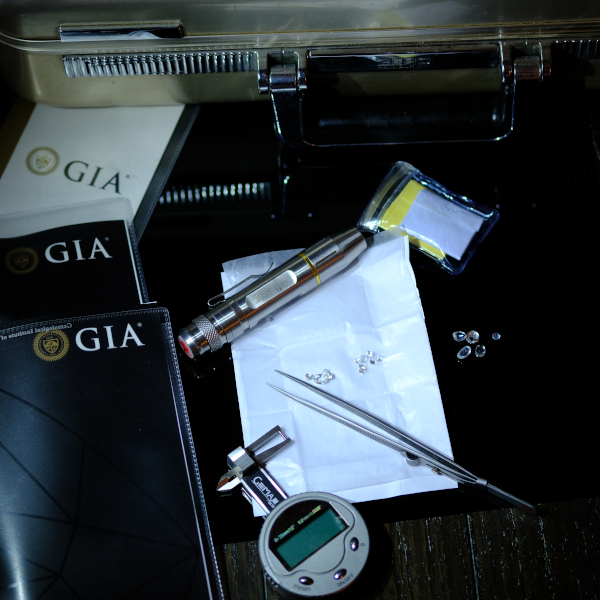
It’s a subject not everyone in the trade agrees on—and many benefit from such disagreement depending upon whether they’re bidding or asking.
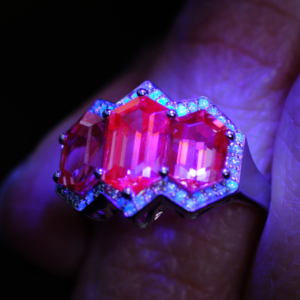
Gemologist and designer Erica Silverglide, founder of GemologyGeek, built her Ignite jewelry collection around fluorescent stones, hand-sorting accent diamonds under UV light and keeping only those with medium or strong fluorescence. “Fluorescence was one of these things that got massively criticized,” she told JCK in an interview last month, recalling a 1980s magazine article that dismissed fluorescent diamonds as a poor man’s stone.
The lingering discount works in her favor. Asked about dealers who use UV light to talk down fluorescent stones so they can buy them cheaper, Silverglide was blunt: “Which is great for me,” she said. “It helps me.”
Why now?
Asked what prompted the change, Morisseau pointed to the institute’s long-published research on this subject.
“The decision to add a comment is based on extensive work by GIA researchers into the effect of blue fluorescence on the appearance of diamonds,” he said. “The research demonstrates that fluorescence generally has a neutral-to-positive effect on appearance and, in many cases, may cause a diamond to appear brighter in daylight-equivalent environments.”
Ye olde fluorescence debate
None of this is new. The 2021 research builds on GIA studies dating back to 1997. Its authors then noted that, despite no actual evidence that fluorescence harms a diamond’s color or appearance, the trade has kept discounting fluorescent stones.
“These complexities confound the trade notion that nonfluorescent diamonds are more ‘pure’ than those that fluoresce,” reads the 1997 Gems & Gemology study.
Price is something GIA’s grading reports never mention. Its researchers, however, have acknowledged the discount since the 1990s. Dealers, the 1997 study noted, generally applied fluorescence distinctions “in the direction of lower offering prices” for colorless and near-colorless diamonds; at the time, some D-to-H stones with very strong fluorescence were listed for up to 15% less than comparable nonfluorescent stones.
These days, major diamond sellers, such as Blue Nile, have a dedicated and advanced filtration mechanism for buyers to select the level of fluorescence they wish to acquire.
GIA has not yet released sample reports showing the new comments. JCK will provide updates as the institute releases more details.
Top: A ring purposely designed with fluorescent diamond-accent stones, lit up by a UV light, designed by gem dealer and designer Erica Silverglide, from her 2026 Ignite collection (photos by Sam Cooley)
- Subscribe to the JCK News Daily
- Subscribe to the JCK Special Report
- Follow JCK on Instagram: @jckmagazine
- Follow JCK on X: @jckmagazine
- Follow JCK on Facebook: @jckmagazine