
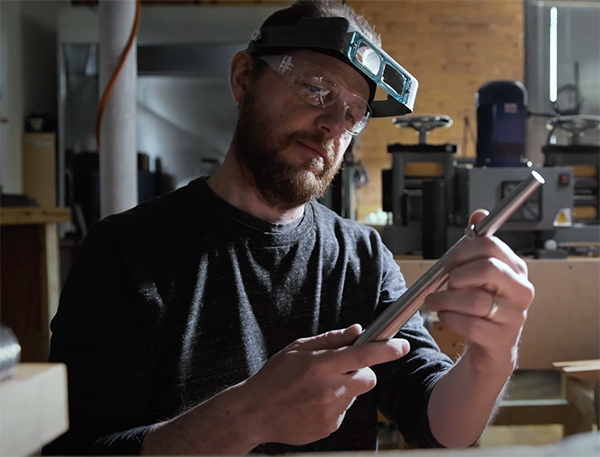
Arn Krebs (pictured) has always been an artisan. “I was making knives when I was 8 years old, grinding steel, whatever I could find,” he tells JCK on a call from his studio in Warren, R.I. “My dad was a fearless mechanic, and he would work on whatever and modify whatever, sometimes with mixed results and no eye to aesthetics, which was a little bothersome to me. I definitely learned that fearlessness from him.”
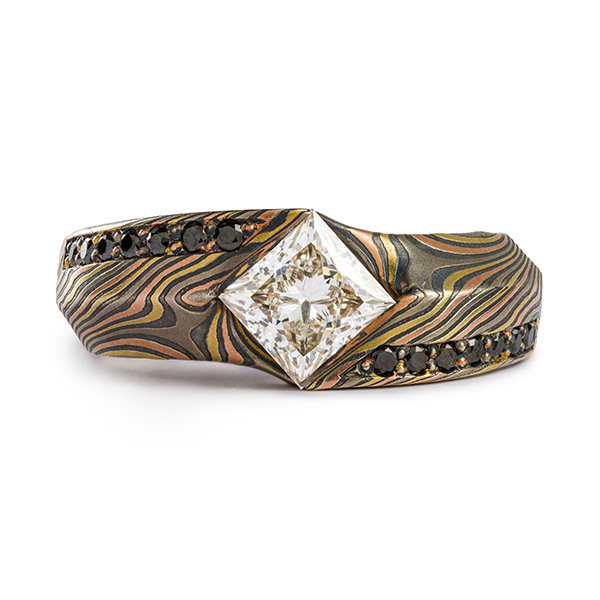
And while Krebs has worked in plenty of mediums—ceramics, wood, glass—it took a chance encounter nearly two decades ago with a night watchman at the University of Hawaii in Honolulu, where he attended grad school, for him to discover his love of metalsmithing, particularly Damascus steel and mokume gane (“wood eye metal”), an ancient Japanese technique in which layers of precious metal are alloyed together under heat and pressure, then manipulated to create organic swirling patterns that recall the look of wood grain.
“The night watchman was a swordsmith,” Krebs says. “Grey Wolf was his name—he was this giant Native American guy. And he’s like, ‘Well, if you want to make some Damascus, let’s do it.’”
Channeling his father, Krebs said yes and set about teaching himself how to bond metals. “Basically, it’s heat, pressure, and time,” he says. “You get it ripping hot, smash it with the hammer, and it molecularly bonds just like that. It’s magic.”
This was around 2008. A professor who noticed Krebs’ passion for Damascus steel prodded him to try mokume. Krebs picked up Steve Midgett’s seminal book, Mokume Gane: A Comprehensive Study, and, once again, jumped in feet-first.
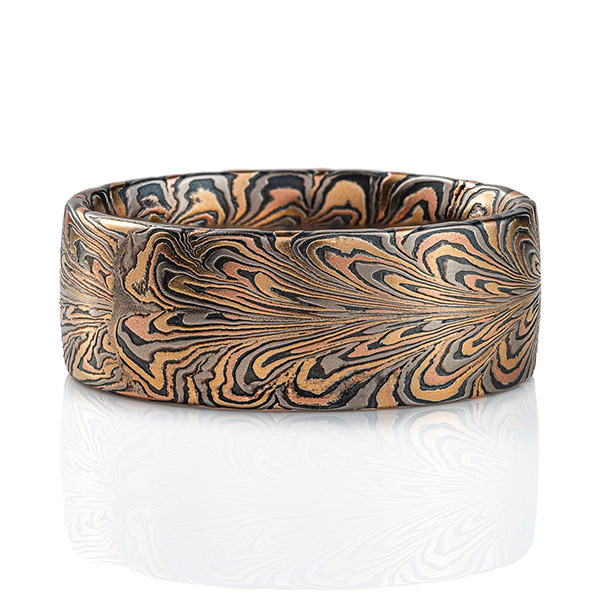
Today, Krebs has built a custom jewelry business around mokume gane, creating engagement rings, wedding bands, and wedding sets for clients drawn to the distinctive patterning and blend of metals (platinum, palladium, gold, and silver are his favorites). Although most people have never heard of the technique, it certainly has its die-hards, and is especially resonant among lovers of the Japanese aesthetic.
“The organic, the asymmetric, letting nature do its thing—it all makes sense in the mokume,” Krebs says.
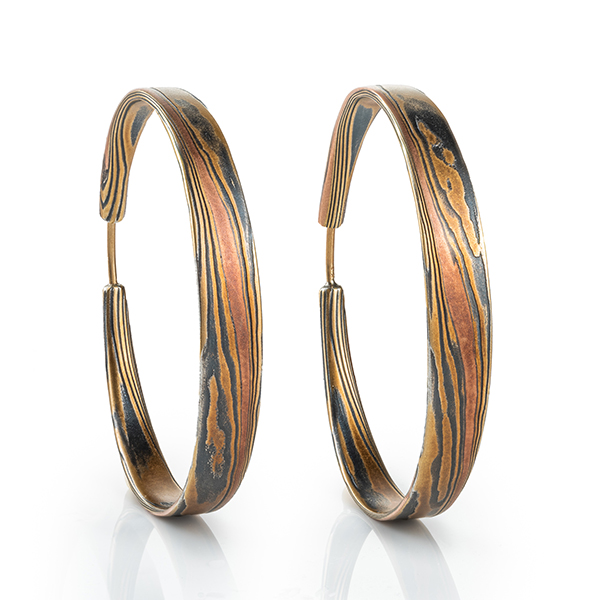
The very nature of mokume is that it is, by definition, custom, and naturally satisfies clients in search of one-of-a-kind pieces. On that note, Krebs has fielded requests to replicate the clouds of Jupiter in a mokume pattern or the topographical features of a place that holds meaning for a couple, such as Utah’s Zion National Park.
“Mokume is fabricated, start to finish, and there’s no other way to do it,” Krebs says. “You can’t cast it. You can’t use CAD. You have to bond the billets and forge the billets out and make each ring, pattern each ring. It’s just how it goes. So there’s a lot of labor and makes it more expensive.”
Krebs’ rings start around $1,200 and go up from there based on the metals, sizing, and patterning. He points out that a mokume gane wedding ring is the perfect metaphor for a couple. “You have two different metals,” he says. “You put them together under heat, pressure, and time, and there’s a boundary at which they intermingle and become bonded to each other. That’s literally how it works.”
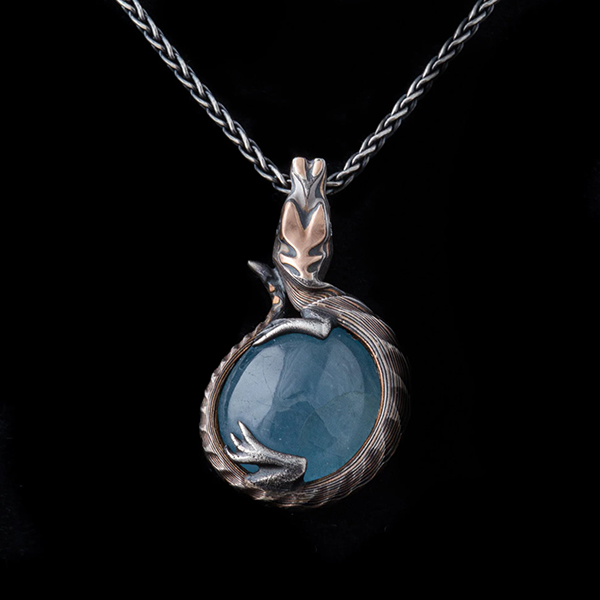
The other aspect of a mokume jewel is that, to the trained eye, the layers of metal offer “a perfect record of what happened from start to finish,” Krebs says. “Mokume is absolutely transparent. Everything you do shows up, which is also challenging because there’s no way to hide a hole. It’s going to be there. You can’t just put some solder in and call it good.”
To Krebs, the technique’s inherent transparency is something of a guiding philosophy. Unlike many jewelers who are territorial about their knowledge, he is committed to sharing his expertise and insights about metalsmithing through his social media pages, which feature videos and photographic tutorials designed to spread knowledge of the craft.
“Sometimes I wonder, ‘Am I giving my patterns away to everybody in the world?’” Krebs says. “Yes. But it’s much more fun to share it, so why not? In the last couple of years I’ve been deliberate about it. ‘This is a new pattern. It’s a lot of work. I’ve developed it for years. If I show all the steps in here, is that stupid as a business move? Am I going to get ripped off?’ And then I think, ‘Go ahead and try it. Good luck.’”
Top: Woodgrain pattern ring in 14k yellow gold, 14k red gold, palladium, and sterling silver with diamonds, $5,355 (not including stones); Arn Krebs
- Subscribe to the JCK News Daily
- Subscribe to the JCK Special Report
- Follow JCK on Instagram: @jckmagazine
- Follow JCK on X: @jckmagazine
- Follow JCK on Facebook: @jckmagazine