
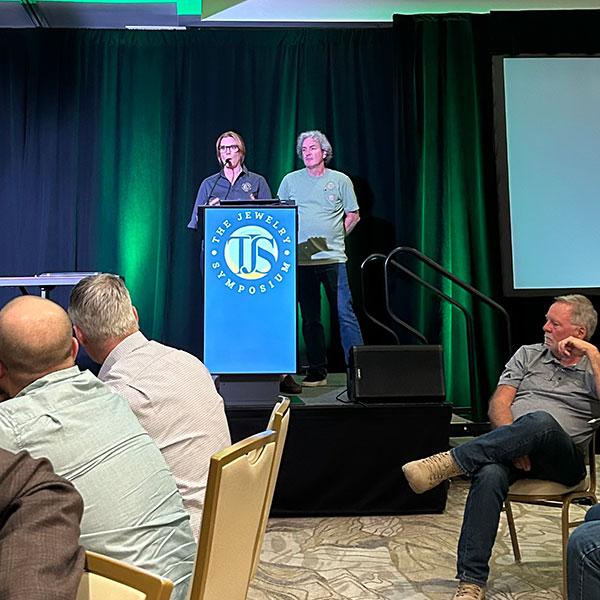
The industry’s need for talent at the bench, in stores, and across manufacturing can grow through collaboration and school jewelry programs, according to panelists at the Jewelry Symposium (TJS).
A roundtable titled “Sharing Solutions for Rebuilding the Industry Workforce” was held Saturday, the opening day of TJS, an annual international event in the Detroit area for jewelers, suppliers, manufacturers, and students. A similarly themed discussion at last year’s Jewelry Symposium was held before a standing-room only crowd.
“We’re not going to have all the answers, but we hope what we do is stimulating some additional conversation and maybe get some unity in our industry,” Linus Drogs, chair of the TJS board, said at this year’s roundtable.
The MJSA Education Foundation—cosponsor of the panel with Jewelers of America—recently surveyed students at nine colleges offering jewelry-related degrees on their career aspirations. Bench jeweler ranked No. 1, and business owner came in second, reported Rich Youmans, the foundation’s executive director.
Survey respondents indicated that they value career advancement potential and challenging opportunities as much as salary considerations when seeking employment, Youmans said. Students in the survey said they’ve found jobs through school resources, online boards, and personal contacts—and Youmans noted the latter was understandable given the deep relationships within the jewelry industry.
TJS board member Ann Cahoon, director of manufacturing and repair at Long’s Jewelers in Massachusetts, said that TJS surveys show the skilled labor shortage is universal and getting worse.
“It’s not just not enough people—it’s not enough qualified people with real bench skills,” Cahoon said. In addition to bench jewelers, the labor shortage includes setters, operators of engraving and milling machinery, and production-level craftspeople, she added.
Presenter Elisabeth Gillett spoke via Zoom about the Jewelry Uplift program at Albuquerque public high schools. The jewelry-making classes raise awareness among younger people about jewelry as a career option, said Gillett, who teaches in the program
Another presenter, Erica Meier, reported that the University of Wisconsin–Milwaukee’s jewelry and metalsmithing program—where she’s on faculty—has grown its mentorships, internships, and scholarships. Jewelry businesses, such as Kesslers Diamonds, have been instrumental in showing students how their academic skills transfer to the workplace, said Meier.
Drogs shared that he decided to take action after last year’s TJS and created an internship at Au Enterprises, his manufacturing services company in Troy, Mich.—in part because of an email inquiry from an interested local college student. Now his business has multiple paid internships for high school and college students looking to learn more about jewelry manufacturing.
Audience members from companies and trade groups including Tiffany & Co., Signet, GIA, Rio Grande, and Catbird, also spoke at the roundtable about their experiences working with students and helping them enter or move up in the jewelry industry, and suggested the types of programs that are needed so younger generations can find their way into the industry.
Top: The Jewelry Symposium board members Ann Cahoon and Linus Drogs speak during the May 16 roundtable on finding solutions to workforce shortages in the industry. (Photo courtesy of Karen Dybis)
- Subscribe to the JCK News Daily
- Subscribe to the JCK Special Report
- Follow JCK on Instagram: @jckmagazine
- Follow JCK on X: @jckmagazine
- Follow JCK on Facebook: @jckmagazine