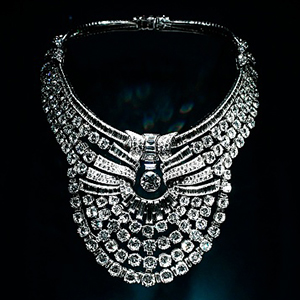
An international manhunt is underway after two men stole a Van Cleef & Arpels platinum and diamond necklace valued at more than $4 million from the Vienna Museum of Applied Arts (MAK) on Thursday afternoon. The heist is part of a larger trend in high-level museum thefts across Europe that may reveal a new criminal profile.
In plain sight
The suspects purchased tickets to the exhibition before smashing a glass display case and seizing the necklace (pictured). They acted without masks, during the museum’s open hours. Investigators believe one of the two perpetrators carried a firearm.
The art deco piece—which features 673 round and baguette diamonds totaling over 200 carats—was commissioned in 1939 by Egyptian Queen Nazli for the marriage of her daughter to the future Shah of Iran. Van Cleef & Arpels described the monochrome collerette as “an iconic example of the success of white diamond jewelry in the late 1930s, playing on the contrast between the different cuts of diamond and the positioning of the ornamentation.”

In 1975, Queen Nazli auctioned the necklace at Sotheby’s, where it sold for $140,000. Van Cleef & Arpels reclaimed the creation at auction for $4.3 million in 2015. And in 2019, the piece appeared on a Vogue Arabia cover worn by Queen Nazli’s great-granddaughter Amina El-Demirdash.
Manuel Arnaut, head of editorial content at the magazine, took to Instagram to share the cover, saying, “The historic necklace holds a particularly special place in Vogue Arabia’s story.”
“The theft of a highly valuable piece of jewelry…has hit us hard,” said Lilli Hollein, MAK’s general director. In a statement, Hollein said the museum had developed a specific security plan with Van Cleef & Arpels for the exhibition. She added that they had recently assessed its security protocols “in light of the incidents at major museums in recent years.”
Austrian authorities released a photo of the suspects, as captured by CCTV, and entered the item into INTERPOL’s Stolen Works of Art database.
A new brand of thief
The theft follows a series of museum heists, including recent incidents in Paris, Sicily, and Parma.
Earlier on the same day as the robbery in Vienna, in fact, an important collection of Bronze Age artifacts and jewelry—mostly made of 23.5 karat gold—was stolen from the Museo Arqueológico Municipal de Villena in southeastern Spain. During the estimated four-minute robbery, thieves broke in through a window and smashed display cases before fleeing with the 3,000-year-old trove worth an estimated $2 million.
A 2026 Europol report noted that these recent thefts reveal a shift in both criminal methods and targeting: “Offenders are adopting more direct and confrontational approaches and focusing on specific categories of cultural artifacts.”
These factors suggest the rise of a new criminal profile: a market-agnostic, aggressive opportunist. “Unlike typical cultural goods traffickers, who usually avoid violence and specialize in organized property crime or the theft of cultural goods, these individuals often have histories of involvement in other types of crime,” the report wrote.
“Thieves apprehended in recent cases appear to coordinate their efforts on an ad-hoc basis,” continued the report. “This differs from the usual structure of criminal networks involved in cultural goods trafficking, which typically operate in a core group organized around a leader.”
As Vogue Arabia’s Arnaut said, “We can only hope this irreplaceable treasure created by Van Cleef & Arpels is recovered safely and returned to where it belongs.”
The JCK News Desk uses AI to help produce the first draft of articles. This story was then reviewed and edited by staff writer Libby Rutkey.
(Top: Stephane de Sakutin/AFP via Getty Images)
- Subscribe to the JCK News Daily
- Subscribe to the JCK Special Report
- Follow JCK on Instagram: @jckmagazine
- Follow JCK on X: @jckmagazine
- Follow JCK on Facebook: @jckmagazine