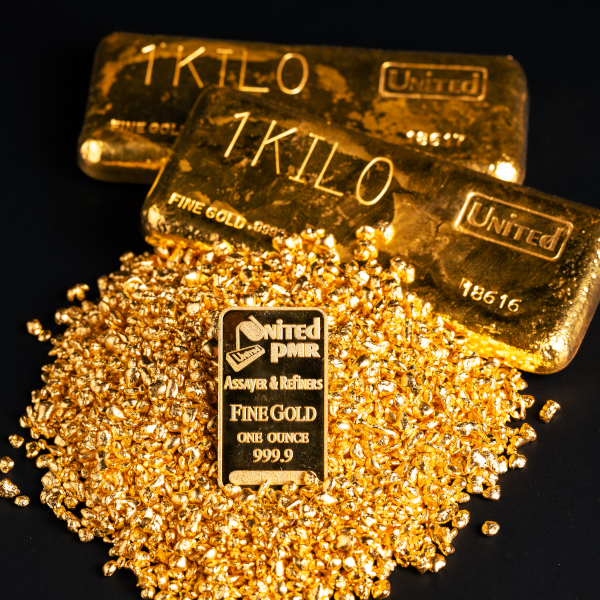
During the last week of January, as gold blew past $5,500 an ounce and every jewelry drawer in America suddenly held real money, United Precious Metal Refining (United PMR) stopped accepting new clients.
During the spike, the Alden, N.Y., refiner kept servicing the accounts it already had—volume from those accounts rose 40%—but turned away hundreds of prospective customers eager to sell scrap gold.
The bottleneck wasn’t the furnaces.
“When I talk about capacity, it’s not just physical capacity or refining capacity,” says Rafael Amador, director of marketing at United PMR. “It’s also the financial side. We’re running our credit lines. We have insurance limits. We can’t have more than X amount for our insurance coverage.”

JCK has written this year about the boom in over-the-counter buying, as record prices pulled scrap gold onto store counters. Less visible was the refining end: how companies hit capacity and remained that way for longer than anticipated.
This presented a challenge for jewelers wishing to cash in on scrap gold bought over the counter. Now that the doors are open again, and gold is still swinging, this comparatively quiet stretch for the market may be a chance to sort out who processes your scrap, and what they charge for refining.
A snapshot of the first quarter of 2026
At press time, gold was trading at around $4,394 an ounce.
The precious metal peaked at $5,594.82 on Jan. 29, then fell 9.5% in a single session—its steepest daily drop since 1983.
According to Amador, the refining backlog ran deeper than just a few weeks.
“All of the major refiners had almost a shutdown, like phases, where they continued servicing existing accounts, but were not onboarding new ones,” he says.
This matches with the World Gold Council’s first-quarter note about capacity constraints that slowed recycling collection in North America and Europe. Global recycling rose 5% in the first quarter, despite record prices, then fell 6% in Q2 as lower prices discouraged selling.
Preparing for the next gold spike
For refiners, there appears to be two major schools of thought regarding gold’s run-up and subsequent retreat in the markets this year.
“Some refiners said the spike was just a fluke, a blip,” says Amador. “Others, like United PMR, have taken steps to prepare themselves for this type of incident again.”
Prior to working for United PMR, Amador himself used to be a gold buyer who regularly shipped out metals to refiners for cash. He says jewelers would be wise to start building relationships with refiners before really needing to sell.
This can take the form of sending in a few small batches of scrap gold just to get things going for when it really matters.
“You want to build a relationship with at least two refiners and do regular business with them,” he says. “If one goes down, you still have the other one as a possibility.”
The melt math of scrap gold
Speaking to JCK by phone from a trade show in Florida, Amador explained the math of scrapping gold.
Say you have a 10-gram 14k gold ring. The first step is to convert the weight to troy ounces, the unit gold trades in (a troy ounce is equal to 31.103 grams). Therefore, 10 grams divided by 31.1035 is equal to 0.3215 troy ounces. Multiply that figure by 0.5833—the gold content of plumb 14k—and you get 0.1875 ounces of fine gold in the ring, which comes to about $824 at press-time prices.
United PMR charges a flat $100 fee, or 2-3% of the gold’s value on average, whichever is larger. The fee covers everything involved in the refinement process.
The minimum is what matters on small parcels. If you were shipping that single ring, the $100 fee would equal roughly an eighth of the gold’s value—not a great deal. The flat fee stops being an impediment once a lot is worth closer to $5,000—roughly 61 grams of 14k (at press time) gold. Above that amount, the 2% or 3% fee kicks in.
Jewelers are therefore incentivized to accumulate a fair bit of scrap gold before shipping to refiners. Amador describes a 90-gram lot—worth roughly $7,400—as a reasonable starting point for a jeweler shipping out scrap.
“That’s pretty small when it comes to the world of jewelry,” he says. “But for some of the independent shops, that’s a good amount of money.”
What should you pay for scrap gold?
For years, Amador has trained store teams on how to properly buy gold. In 2023, he published a manual on how to do it right: Gold & Silver Buying Tips: Understanding and Mastering the Art of Precious Metal Buying.
When buying from the public, Amador advises paying 50% to 70% of gold content, warning against lowballing because “offering a good rate may lead to referrals.”
He also explains why a lot of scrap gold will not necessarily yield plumb results.
“There are two types of solder,” he says. “There’s plumb solder, and there’s repair solder. A plumb solder for 18k is 75% gold. But a repair solder for 18k gold might be 14k [or 58.3% pure gold]. So now you’re using a piece of 14k gold to seal off links in a chain, and when you mix it together, you don’t have a piece that is 75% anymore.”
Where shops lose money
After years of store visits, Amador is not surprised when he sees outdated, broken, or incorrectly used testing equipment.
His fixes are cheap. Most involve tools a store already owns.
Gold isn’t magnetic. Before anything gets weighed, run a rare-earth magnet over the lot. It’ll pull out steel clasps and base metal cores hiding inside hollow chains.
He also encourages buyers to file past the plating on a piece before applying an acid test or X-ray fluorescence test (XRF), which only reads microns deep. Nobody wants to make a purchasing decision based on the purity of plating.
With the seller’s permission, test several links on a chain, especially near the clasp, where repair links are often located. On a heavy Cuban link, it may be worthwhile to cut one out and test the middle.
Lock in your prices. Refiners typically let a seller choose when to price a lot. Amador says United PMR takes its percentage on completion from the gold contained. A jeweler shipping out scrap before locking in a price may, for good or ill, be in for a surprise if the market turns.
“When it comes to buying over the counter, it really requires a special skill set,” he says.
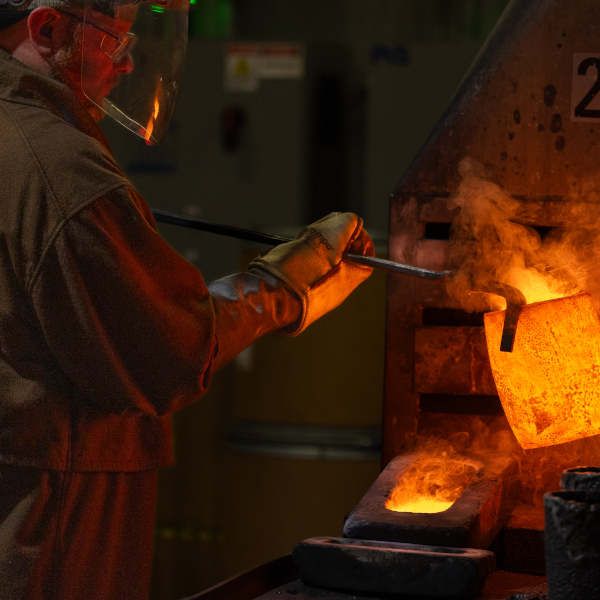
Top: A United Precious Metals Refining operator pulls a crucible out of a furnace and prepares to pour molten gold into a metal mold. (All photos courtesy of United PMR)
- Subscribe to the JCK News Daily
- Subscribe to the JCK Special Report
- Follow JCK on Instagram: @jckmagazine
- Follow JCK on X: @jckmagazine
- Follow JCK on Facebook: @jckmagazine