Sean Dunn was in the middle of one of those lab-grown–versus–natural debates that consume so much industry discussion on LinkedIn. He was making the widely accepted point that diamonds have contributed to the development of Botswana’s economy.
Then he heard from Ada Thela, a 32-year-old Motswana who owns Zoe Diamonds, a diamond manufacturing and trading business. The two began to talk.
“I was listening to her plight,” says Dunn, the owner of J.R. Dunn Jewelers in Lighthouse Point, Fla. “I was getting to understand her and how the market worked.”
They began exploring how they could work together. Thela regularly bid on the rough tenders held by Botswana’s state-owned diamond trader, Okavango Diamond Company (ODC), but being a small player, she was regularly outbid. Dunn decided he’d help her out and see what became of it.
After he went through the lengthy ODC Know Your Customer protocols—”it took weeks,” he says—the two being submitting bids for rough.
“It took us two auctions, but we finally got one,” Dunn says. “It’s been a great experience learning how both sides of the business work and learning from each other.”
Thela says the collaboration with Dunn “was an answered prayer. I had not had any success in securing international clients. I would reach out to a lot of people mostly through LinkedIn or referrals. But it would fizzle out, most due to people being skeptical that I could deliver on what I said I could do.”
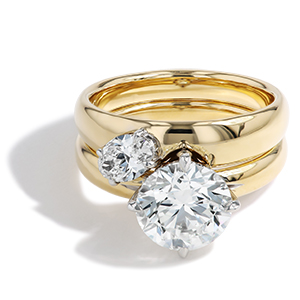
Thela had won a 5.79 ct. rough. The top part of it was cut into a 2.51 ct. round brilliant. But there was enough left over to make another stone.
“We were so focused on the main piece that, when Ada asked, ‘What are we going to do with the other part?’ I was like, ‘What do you mean?'” Dunn recalled in an Instagram video. “And she said, ‘There’s another little oval.'”
That “little oval” became 0.4 ct. oval brilliant. Dunn decided to combine the two gems into a single piece, called Two-From-One.
The promotional efforts behind Two-From-One discuss its backstory and its Botswana origin, as well as the larger message about Botswana diamonds. Dunn also carries De Beers’ Origin brand, which is composed of tracked-and-traced stones.
The trade has long debated whether consumers would be interesting in buying a diamond that “does good” in Botswana. Dunn says, so far, the evidence is mixed, though he adds it helps that the De Beers Origin brand doesn’t carry a premium.
“You can’t force [the origin story] on people,” he says. “You go with the flow if people are open to it. Some guys are totally into it. Sometimes they listen, and then they still buy something else.… I think all customers respond to and respect the underlying message. It shows that you care about your sourcing.”
He says that J.R. Dunn has not made Botswana origin its main selling point—and doesn’t plan to—but believes it gives customers extra confidence.
“We tell our sales associates to mention it on the way to the diamond room just the way that you would mention anything that sets the store apart,” he says.
And he stresses: “At the end of the day, the person is there because of their relationship and because of what that signifies. Origin is not going to replace that. You can’t make it about the country more than about the couple.”
Top: The Two-From-One ring set (photo courtesy of J.R. Dunn Jewelers)
- Subscribe to the JCK News Daily
- Subscribe to the JCK Special Report
- Follow JCK on Instagram: @jckmagazine
- Follow JCK on X: @jckmagazine
- Follow JCK on Facebook: @jckmagazine