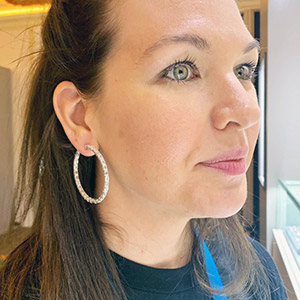
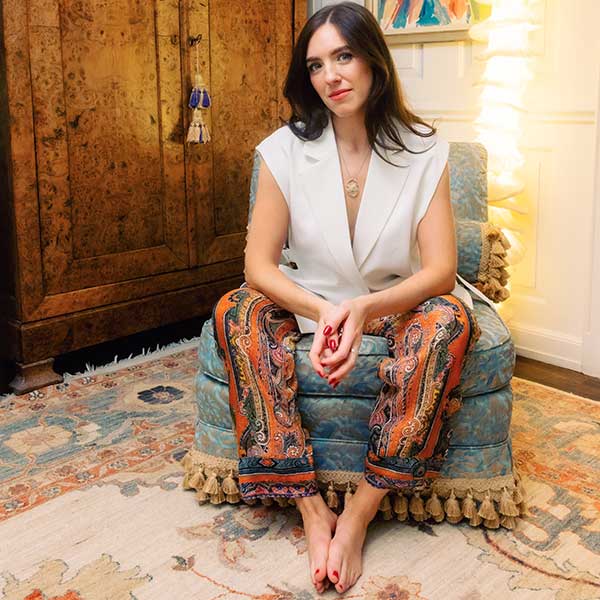
Jackie Ansell (pictured) balanced her jewelry side hustle with full-time corporate work for years until she was asked by her employer, Walmart, to relocate from New York City to Arkansas.
“It felt like a signal,” says Ansell, whose background spans art, design, psychology, and technology—all of which she’s channeled into her jewelry brand, Hysteria, which officially debuted last fall. It’s the product of a childhood steeped in creativity, a career that flirted with fashion, and a sister’s medical issues.
Just as there is a weight to Hysteria’s jewelry pieces in both mass and meaning, Ansell says her shift into jewelry comes from a heavy place. Ansell’s sister has been diagnosed with myalgic encephalomyelitis/chronic fatigue syndrome. In the past, when women sought help with symptoms of the disease, doctors often dismissed them as “hysteria.”
“In a way, it’s an ode to her experience and, more largely, the female experience,” Ansell says of her jewelry company. “The history of women spans every culture and every era, and each one has its own visual language, its own symbols, and its own aesthetic.”
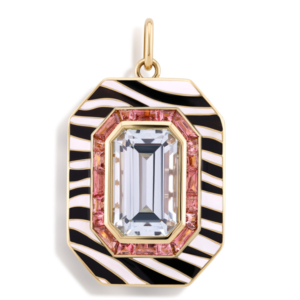
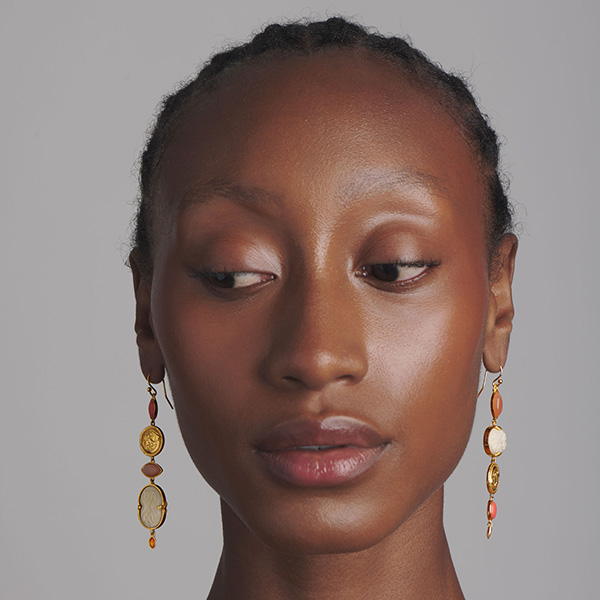
She has researched and experimented with styles of these different eras for her jewelry design. In one example, Hysteria has reclaimed cameos as modern and chic.
Ansell is the youngest of three siblings, and was born and raised in Cincinnati. Growing up, her weekends centered on crafts—ranging from using duct tape in creations to making pottery. And, in a hint of her future career, her materials included beads from a local bead shop.
“My first real jewelry memory was a friend’s birthday party at that bead shop,” Ansell says. “I was completely obsessed. My mom would drop me off for hours, and I’d lose myself exploring different beads, playing with color combinations, just getting inspired.”
She also developed a passion for art history, starting with a high school class and continuing at Colgate University in upstate New York. She recalls a studio course in sculpture during college as particularly meaningful. So was a summer job at an art museum, where Ansell felt surrounded by people who cared deeply about art.
“Looking back, I think what I learned was that the work behind something beautiful is rarely glamorous,” she says. “There’s a lot of unglamorous ‘scaffolding’ that holds up anything worth making—and being willing to do that work, whatever it is, is how you actually get close to the things you love. I’ve found that to be true in building my own company.”
After her 2014 Colgate graduation, Ansell worked at VaynerMedia for two years. Then she went back to school, earning her master’s in design management from Pratt Institute, in New York City. Over the next six or so years, she worked for such technology-forward companies as the Total Brain mental-health app, Twitter, and Stripe, as well as Walmart, where she was a product designer.
“It was genuinely rewarding in a lot of ways,” says Ansell of her corporate jobs. “I was fortunate to work at companies where design actually had a seat at the table, and I learned how good design can shape real business decisions. But I never quite felt meaning in the work itself. The pull toward fashion and jewelry never went away.”
Ansell was hand-making and selling jewelry as a side hustle the whole time she was employed elsewhere. But she associated fashion with frivolity and overconsumption, and always told herself it wasn’t a serious career.
Plus, she felt she would need a mentor in the space. She found one in Gretchen Jones of Weird Specialty, a consultant for creative business. Ansell worked with Jones as she was creating Hysteria, and that gave her a path forward. She elevated her side hustle to a full-fledged business rather than move to Arkansas for Walmart.
“My philosophy is rooted in the idea of intentionality,” Ansell says of her jewelry designs. “I’m not interested in jewelry as trend or as status or as an afterthought. I’m interested in pieces that mean something, and I think the story of the piece is just as valuable as the materials.
“I’ve always been a maximalist dresser, jewelry included, and find that what you put on your body is a form of autobiography.”
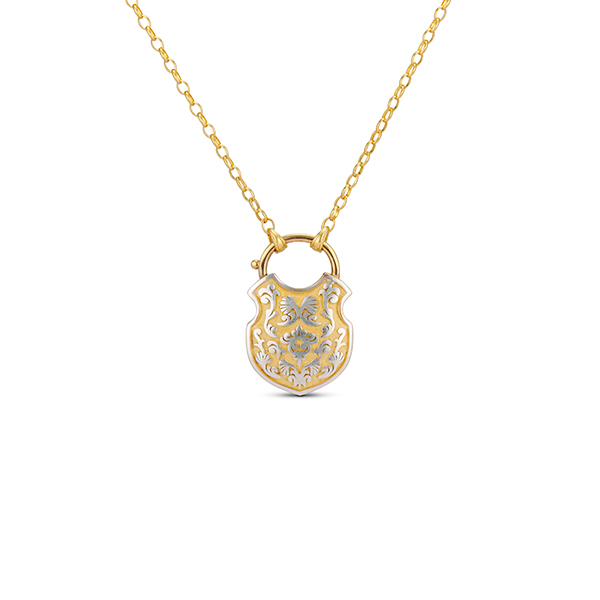
Hysteria embraces that idea of jewelry as a way of saying something true about who you are or how you’re feeling through symbolic motifs, like the padlock. And Ansell continues to look to the past, particularly the past for women, for inspiration.
“Right now I’m deep in the Victorian period, and, honestly, I could stay there for years. The romanticism, the darkness, the contradiction of it: Women corseted and constrained on the outside while entire interior worlds raged beneath the surface. It’s endlessly rich,” she says.
“But there’s the Renaissance, the Belle Époque, ancient mythology, the early feminist movement—the brand has so many directions it can take, and that’s what genuinely excites me to keep building it.”
(Photos courtesy of Hysteria)
- Subscribe to the JCK News Daily
- Subscribe to the JCK Special Report
- Follow JCK on Instagram: @jckmagazine
- Follow JCK on X: @jckmagazine
- Follow JCK on Facebook: @jckmagazine