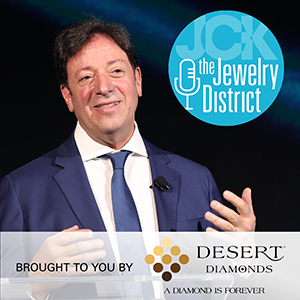
JCK editor-in-chief Victoria Gomelsky and news director Rob Bates interview Eddie LeVian, CEO of Le Vian, who regales them with his family’s history in jewelry dating back to the 1500s. They discuss the pivotal moments that shaped Le Vian’s identity as a brand, including the story behind Chocolate Diamonds (hint: a well-known JCKer plays a part!), and delve into how Le Vian’s trend forecasts started and where the intel behind them comes from. Eddie may even tease some future trends at the end, so listen closely.
Listen Now
Title sponsor: De Beers (adiamondisforever.com)
Sponsor: Facets of Fire (facetsoffire.com/retailer-testimonials)
Show Notes
03:45 The LeVian family’s jewelry legacy
06:40 Eddie’s upbringing in the industry
08:20 The story that drew him into the family business
10:20 How Chocolate Diamonds were born
13:55 Le Vian’s first trend forecast
15:40 The marketing strategy behind Chocolate Diamonds
18:15 How Le Vian uncovers trends
20:45 The importance of celebrities and authenticity to the brand
23:30 A trend tease before the JCK show
Episode Credits
Hosts: Rob Bates and Victoria Gomelsky
Producer and engineer: Natalie Chomet
Editor: Riley McCaskill
Plugs: @jckmagazine; adiamondisforever.com; facetsoffire.com/retailer-testimonials
Episode Transcript
This transcript has been abridged and edited for clarity.
Victoria:
Welcome to The Jewelry District. … I spent most of last week in Tucson, and I’ll save my takeaways about it for our next podcast, but there’s lots to say.
It’s funny that the last time I saw our guest today happened to be in the aisles of Tucson. We ran into each other, and it was a delightful meetup. He is very, very well known in this industry and a real mover and shaker. Thrilled to welcome Eddie LeVian, the CEO and designer of Le Vian, one of the biggest jewelry companies in our business. Welcome, Eddie. It’s so great to finally have you.
Eddie:
Thank you, Victoria and Rob. We go back a long way, and I’m looking forward to having the conversation.
Victoria:
I know he’s going to come up during our questions, but when I ran into you, we made a phone call to a beloved JCKer and former podcast guest, Bill Furman, who retired over the last few years. It was Eddie’s idea. He phoned him right in the middle of the aisle, and Bill even picked up. It was a fun moment.
Eddie:
You know, Bill Furman ended up playing a pivotal role in the history of Le Vian. And I never miss a chance to give him credit for that.
Victoria:
We’re going to get to that, for sure, because that’s a big part of Le Vian’s story. Let’s go back to the very beginning, because your family has been in the jewelry trade for generations, since the 16th century, which sounds mind-blowing. Can you tell us a little bit about that family history, and then what it was like to grow up with such a legacy in this business?
Eddie:
The LeVian story spans over centuries in jewelry. The oldest pieces that the family made that are in our possession date back to the early 1500s. And there are several pivotal points in our history. One of the most notable ones was when the family was chosen to be the guardian of the royal jewels in 1746 in Persia.
When Nader Shah chose the LeVian family to be the guardians of the jewels, it wasn’t necessarily for our jewelry-making skills, more so for the integrity and reputation of the family that we were chosen.
However, if you look at our historical pieces and what happened after that guardianship of the royal jewels, there’s a dramatic change: The family started to see itself as the guardian of the jewels and began spending years collecting suites of gems, focusing on single-mined gems, and making jewelry that was very gem- and diamond-intensive. The style of jewelry-making shifted from the handwrought gold and the filigree work and not many gems, maybe only turquoise, to very gem-intensive pieces and focusing on gems and diamonds that only came from one place in the world.
Victoria:
When did the family come to the U.S.? What was the migration like?
Eddie:
After World War II, in 1950, our late father immigrated to the U.S. He was still running the business for the first 50 years in the U.S. He passed away in 2000, 26 years ago.
So 1950 was a pivotal point. The style of jewelry-making had other transitions, including the late 20th century where we were highly influenced by the jewels of the Duchess of Windsor, which sold for 70 times their appraised value in the auction of her estate. And some of the timeless designs and whimsical pieces caught our attention. The type of workmanship, like the invisible settings, was inspiring to us and defined some of the work we did in the late 20th century.
Victoria:
Was it just a foregone conclusion that you were going to join the family business, or did you grow up thinking, “I want to do something else”? What was your mindset?
Eddie:
First of all, our father was very smart in the way that he brought us up. From our early teenage years, he showed us that kids need to work after school, and he encouraged us to do that. He also combined trips for vacation and business. He took us on these trips. For example, if we went to Arizona, he would take us to the Kingman mine or the Sleeping Beauty mine so that we could see how he bought the rough turquoise and how he had it cut. Those experiences in our youth helped us learn.
When I was in my early teenage years, he convinced me to intern in his stone-cutting shop. I learned how you take a rock and turn it into a gem, how cutting and polishing helps reveal the inner beauty of the gems, and the techniques. All these became the parts of the trade that were passed down by him in ways that felt easy.
However, as a young man, I wanted to make a difference in the world. I grew up seeing the jewelry business as a luxury business, but not one that would change the future of the world, not one that would make an everlasting difference in the world. So I wasn’t sold on the idea that I would be joining the family business, and I thought I could make more of a contribution to society otherwise.
What convinced me was whenever I would ask my father about his mother, who I never met, he would bring out her ruby ring, and he would talk about the color of the ruby from those days: “You don’t see them in that color anymore.” And the workmanship: “This is hand workmanship, and there’s not many craftsmen who still do the work by hand.”
This was one of the ingredients that enticed me—how a person could be remembered two generations later by a piece of jewelry that they wore, how the story of that jewelry captures the story of their era in a way that is timeless, and how making beautiful pieces would allow that to be passed down in the family.
Our father was a master at luring us into the business. My siblings and I are still in it. There are now 12 members of the next generation who have different roles in the business as well.
Sponsor message:
This podcast is brought to you by De Beers. It’s not every day you get to talk about a truly new idea on natural diamonds, one that gives customers a way to celebrate their person with diamond jewelry as unique as they are. Desert-toned diamonds come in unexpected shades of pale, sunlit whites to deep, smoky whiskeys—natural colors unlike anything else, for people unlike anyone else. This year, introduce your clients to Desert Diamonds. A diamond is forever. Visit adiamondisforever.com to learn more.
Rob:
I remember years ago, they used to call brown diamonds champagne and cognac, but you went the other way, you decided to go for chocolate. And that’s a great story. Do you want to tell us about that?
Eddie:
In 1980, my father sent my brother Moossa to Africa when Tiffany lost their exclusivity on tanzanite, and tanzanite is only found in one location in Africa. This became part of our strategies from the ’80s to the ’90s. We became the world leader in tanzanite.
By 2000, when our father passed away, we were looking for that next big single-mine gem that we would promote. We saw that the Argyle mine was producing 34 million carats a year. They were also producing a few dozen red and pink diamonds that were selling for as much as a million or more. The Argyle mine had tried to market these diamonds, but they were trying to get rid of the 34 million carats of highly included stones, but ignoring about 400,000 carats a year of high-clarity, well-cut, beautiful fancy color brown diamonds and mixing them up with the poor-quality stones.
They were trying to market them as champagne diamonds, but they were not successful in registering champagne diamonds as a brand. So they didn’t have any rights to champagne diamonds. And their strategy was to farm it out to Indian companies who would make silver jewelry retailing for under $200. Instead of turning it into a luxury item, they tried to get rid of the bulk by making inexpensive, low-quality items out of it, and that failed.
In 2000, we identified that small percentage—maybe only 3 or 4% of the production of the mine—that had that quality. But it was enough to turn millions of Americans into collectors of natural colored diamonds. So we defined them as Chocolate Diamonds. It took eight years to register them.
Bill Furman of JCK, a close friend, used to visit us when our offices were in the city. He loved artisanal chocolates. He would talk about the passion, the addiction, and the aphrodisiac qualities of chocolate. That was fascinating. So many people think, “Chocolate Diamonds is the name because they’re brown.” But in fact, Bill got me addicted to chocolate, good chocolate. It was because of the quality, not the color, of the chocolate. And we felt that this type of diamond has those kinds of addictive qualities.
The diamond can be different than something dressy that people would wear. It could be something that people could wear all the time. This became part of our strategy to reinvent the world of fine jewelry: Chocolate Diamonds, Strawberry Gold, Raspberry Rhodolite—all of these ingredients that we reinvented by our knowledge of gemology, of the supply chain, of the world of jewelry that enabled us to reinvent that world. At that time, we struck a deal with JCK, where we moved out of the JA show and used the money to invest in JCK and started to do our annual trend forecast there.
Victoria:
When was the first annual trend forecast?
Eddie:
In May, it’ll be 26 years from the first time that we did that at JCK. We moved, we canceled our show in New York, and we were spending a good six figures there. JCK enticed us that if we came to the show, they would treat us well, and they did.
It enabled us to not just create all these new designs, but do a trend forecast each year where we would give the world a direction as to the trends in fashion and fine jewelry. In the beginning, only buyers would attend, and we were happy if we had 100 people there.
People were snickering, “Who do the LeVians think they are, that they’re going to tell the world what the trends are?” But the world needed the branding and a trend forecast that would be authoritative enough that consumers, especially guys who only wanted to buy safe pieces like a solitaire diamond. The women who wanted the fancy pieces and a different one every season needed the guys to know that there is a new trend, a new season, and that they have to keep up with the times.
Victoria:
We’ve seen De Beers introduce this beacon of Desert Diamonds, which is this palette that you’ve been working in for coming on 26 years. But at first, when you started marketing Chocolate Diamonds, my understanding is that retailers who were the gatekeepers of this industry really disdained these stones. They thought they were very, very low quality. How did you convince [them], especially independents, that this was a solid bet? Le Vian pioneered the idea that you could look to these, which were formerly called off-color stones. Was it tough going at first?
Eddie:
It was, but because of the way we were brought up in the industry and the different experiences and learnings, we have a very clear picture of where we’re going and the right thing for the future. So we didn’t doubt it.
As it turned out, our marketing was phenomenal. We also were able to strike agreements with some of our larger retailers to invest heavily in TV commercials and other marketing about Chocolate Diamonds that helped build awareness of the brand.
Where many designers, after they get to a certain point, choose to become the retailer themselves, we took a different point of view. We felt that each segment of the industry should stay in their own lane and be the best in class. By doing that and not threatening or competing with retailers, we were able to gain their trust in investing in a brand that wants to help drive many billions of dollars of sales for them.
Sponsor message:
This podcast is brought to you by Facets of Fire. As an industry, we know natural diamonds mean more, but too often it’s hard for clients to actually see the difference. Facets of Fire changes that. Working exclusively with natural diamonds, Facets of Fire uses patented nanotechnology to unlock more sparkle, more fire, and more brilliance than traditional cuts. The difference is unmistakable when you see it in person. If you’re attending the IJO or Leading Jewelers Guild shows, visit the Facets of Fire booth and see it for yourself.
Victoria:
Can you tell us a little bit about how you come up with the trends report? I attend every year and always look forward to it because it’s great to get insight from a company of your size. Do you have a team gathering the research for this starting in January? I mentioned seeing you in Tucson. Are you there looking at what seems to be trending?
Eddie:
Part of the story is the shows that we do. In the 1980s, when we started the branding, we learned very quickly that running ads is a double-edged sword. If you do it right, it can really work for you. But if you make mistakes, they bury you in the [magazine], or you don’t create the proper ads, you lose the money, and you can’t get it back. It became very dangerous in the early years to invest a lot of money in ads, but we needed to get the name known nationally. So the one-day events that we do became our way of going into cities and having the retailers buy the media in their town and get the word out.
Over a number of years, these helped us get name recognition. We now do thousands of these one-day events in stores. What happens is we have our people in something like 30 different cities a day at a time. We have the pulse of the consumer, even more so than the retailers themselves, because we are in their stores talking to the consumers and understanding what they’re looking for. So that became one of our sources for understanding what’s working.
When we decided to do the trend forecast, we also invested heavily in innovation. Every year, we make tens of thousands of new samples to tie into the trends that we’re announcing. The consumers react to all the samples that go to our shows, and we understand what they’re gravitating towards and what they’re not. That fountain of innovation, it doesn’t always hit a home run, but being in front of the consumer day in and day out in different cities gives us real-time feedback on what’s going on.
Part of our reinvention in 2000 was, while our history is tied with royalty, the royalty of today in the United States are the stars—the stars of music, TV, and film. We started by taking a bag of jewelry to the backlot of the Daytime Emmy Awards, where the stars of the soap operas would come to choose jewelry that they would wear for the red carpet at the awards.
We’ve always been about authenticity. We certify that all our pieces contain only genuine natural material, never use any synthetic, lab-grown, or other doctored-up stones. When we started to work with celebrities, we realized two things. One, these women have the magic potion. If you see them while they’re rehearsing and they’re not all made-up, you will be stunned at how they have developed the skills to reinvent themselves for the red carpet. They use a combination of hair, makeup, dresses, and jewelry to create something that you can’t take your eyes off when they’re on the red carpet. They become a different person. They morph into a star.
The second thing we realized was that authenticity has to be part of dressing the stars. We decided not to pay or gift any celebrity or their stylist for the red carpet. And I’m so proud that for the last 26 years, we have not done so. Karol G is decked out in Le Vian at the red carpet. She has 78 million followers, and everything Le Vian she wore wasn’t gifted, wasn’t paid, was completely organic.
The celebrities love that more because for them, their authenticity is also on the line. The going rate is a half a million to $3 million for them to wear something to one of the top award shows, but if they are genuine, not sponsored, and are being themselves and wearing what they think is great, that gives them a lot more credibility with their audience. So it’s mutually beneficial.
Rob:
Can you give us a taste of what you see coming up this year?
Eddie:
I think the tides are turning. I think you’re doing a great job covering it, but if you want to understand where things are going, you could look at what kind of engagement rings celebrities who have unlimited money choose.
Rob:
You mean natural versus lab-grown?
Eddie:
There’s more to it. I think this is where the De Beers story came in. Last fall, De Beers approached us and said, “We’re now doing a beacon campaign. And instead of choosing a design like a three-stone ring or a journey, this year we’re choosing a diamond to promote.” When we asked what diamond, they said, “we’re choosing to promote the shades of brown diamonds, natural brown diamonds.” We said, “That’s interesting—after 25 years! We’re honored that you’re doing this. But what led you to do it?”
They said, “We do extensive studies. We’re known for how our studies are so well done. And they showed that these shades of brown diamonds are considered by a vast majority of consumers to be natural, and we want to promote natural. They also resonate with many different demographics. They’re not just appealing to one type of consumer. And so those two ingredients convinced us to go after that.”
When they were shooting their commercial and looking for jewelry to put in it, our big stocks of this kind of product at all ranges became attractive to them. So we ended up being a large portion of the pieces in the commercial.
Victoria:
I’m looking for a one-word answer to this question. If you were going to bet on one gemstone this year or one color, what would it be?
Eddie:
If I was a betting man, I would bet on American gems.
Victoria:
Nice. I like that. Turquoise, of course, would be one of them. Eddie, thank you. You’ve got so many years of experience and so much great family history to share.
Any views expressed in this podcast do not reflect the opinion of JCK, its management, or its advertisers.
- Subscribe to the JCK News Daily
- Subscribe to the JCK Special Report
- Follow JCK on Instagram: @jckmagazine
- Follow JCK on X: @jckmagazine
- Follow JCK on Facebook: @jckmagazine