The venerable cameo is having yet another comeback in estate and vintage jewelry cases, as well as through a more modern take as today’s designers bring their design aesthetic to this beloved jewelry piece.
This summer, intaglios got a publicity bump with the success of Christopher Nolan’s take on The Odyssey, bringing engraved precious gemstones back into conversation. Cameos are more of a slow burn, showing up more and more on the fashion industry’s radar over the past two years.
One big cameo moment came from Mellerio, whose famed Marie Antoinette cameo bracelet in 2024 stole the spotlight when the company put it front and center in its Bergdorf Goodman residency in New York City.
Then cameos showed up both on and off the runways at fashion shows, including when Rihanna in 2025 wore cameo jewelry created by Marlo Laz and Lydia Courteille. The Zoe Report also pushed interest higher when its writer declared “Cameo Jewelry is My Newest Obsession” earlier this year.
And on-trend jewelry brands such as Maison Alix Dumas, with its bejeweled cameo earrings, and Broochella (with its pins in neon and other unexpected colors—decidedly not your grandmother’s cameo) and you can see why cameos are cool.
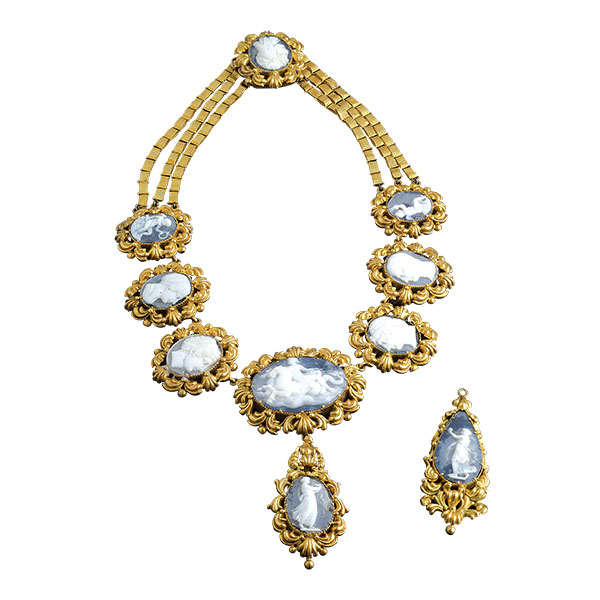
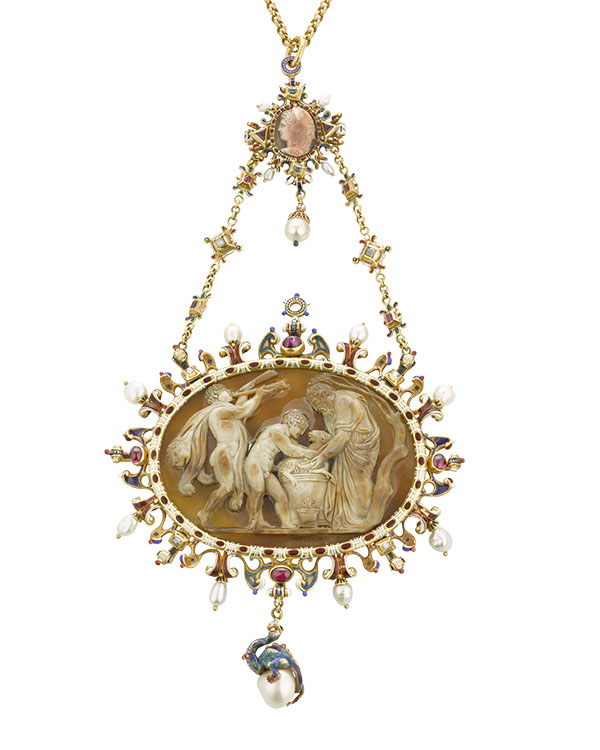
M.S. Rau researcher and writer Elle Spurr understands the appeal. M.S. Rau has a bevy of interesting cameos in its stock; the antique dealer carries everything from Victorian-period cameo necklaces to Renaissance-era examples made with gemstones, pearls, and gold. Spurr says the cameo has such staying power because of its history.
“Cameo carving flourished in Hellenistic and Roman workshops, returned in the Renaissance, was revived under Napoleon, then swept through the Victorian era and reappeared in art deco design,” Spurr says. “The form sits at the intersection of jewelry, sculpture, portraiture, and personal sentiment, which gives it more footholds than most motifs. Look at a profile carved 2,000 ago and reduced to line and shape. That face is not so different from your own.”
Spurr says the finest cameos can have remarkable depth, approaching sculpture in their dimensionality. Artists also skillfully utilize the material’s natural coloration, carving through different layers of the shell or stone to distinguish figures, clothing, and other elements of the composition.
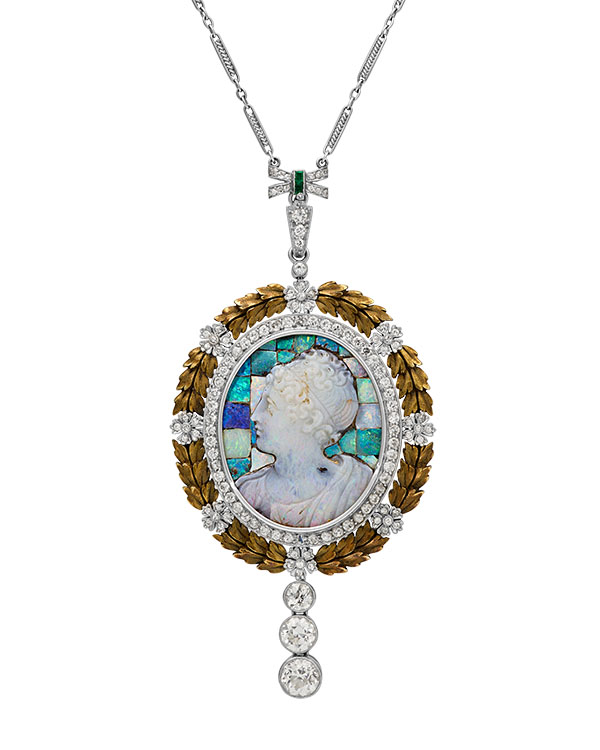
“Some even incorporate extraordinarily intricate details, such as tiny flowers carved into the hair. Molded reproductions look uniform by comparison. In an era of 3D printing, the carved examples only grow scarcer,” Spurr says. “A cameo is an exercise in line—one of the most fascinating elements of art, in my opinion. The carver takes a face full of form, value, texture, and color, then distills it to its essential contour. That reduction is fascinating. You are seeing a person at their most essential, and the effect is both tender and, dare I say, dramatic.”
People tend to be attracted to cameo jewelry for a variety of reasons, including as a nod to the past. Perhaps their grandmother wore a cameo pin, and they want to carry that forward but with their own take. Whatever the reason, cameos carry tradition as well as sentimentality, and that is what makes jewelry so special, Spurr says.
“A cameo signals an appreciation for tradition without sacrificing personality. They often display a portrait, so no two are exactly the same. Few pieces carry that much history and still feel personal,” Spurr says.
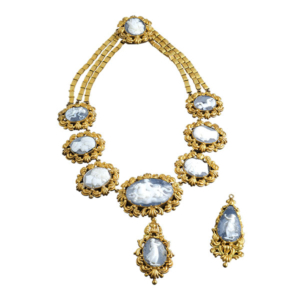
Top: M.S. Rau Victorian cameo necklace ($40,500) with nine cameos in 18k gold (photos courtesy of M.S. Rau)
- Subscribe to the JCK News Daily
- Subscribe to the JCK Special Report
- Follow JCK on Instagram: @jckmagazine
- Follow JCK on X: @jckmagazine
- Follow JCK on Facebook: @jckmagazine