
American Gem Trade Association (AGTA) leadership says their months of lobbying on trade and tariffs, on-the-ground efforts in Washington, D.C., and international meetings with government and jewelry industry leaders are starting to come to fruition.
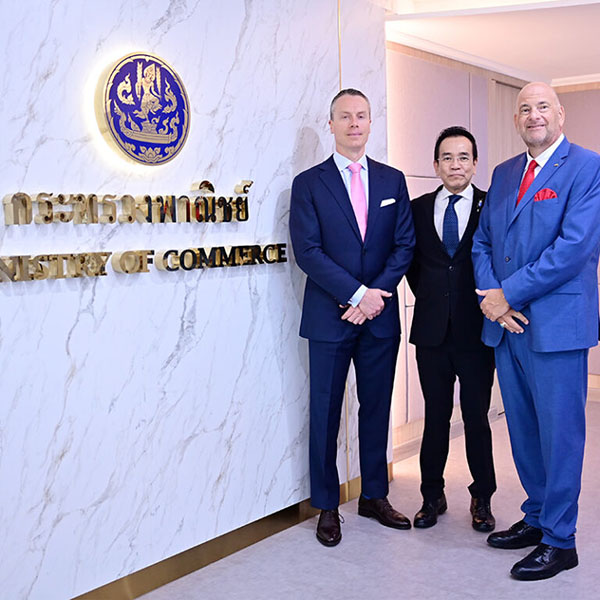
One example is their recent conversations in Bangkok. That is where AGTA CEO John W. Ford Sr. and president Bruce Bridges met with Thai officials to talk about arguably the most important issue to the jewelry industry today: bilateral trade negotiations.
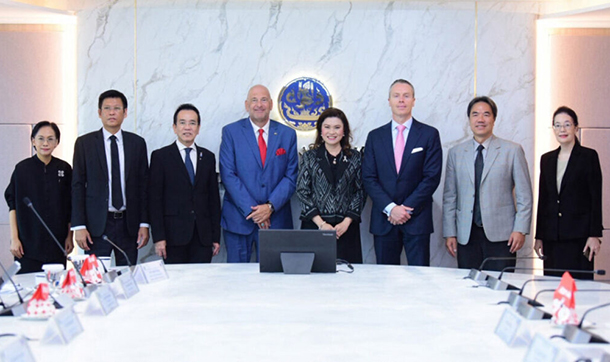
Ford and Bridges met with senior officials of the Royal Thai Government, as well as members of Thailand’s gem and jewelry industry, during the Bangkok Gems & Jewelry Fair. Subsequently, they shared takeaways from these meetings and conversations at the fair with U.S. government representatives.
As a result, the AGTA is “extremely optimistic” that a trade agreement between the United States and Thailand will happen in the near term, Ford says. Furthermore, Ford and Bridges say they can see additional reciprocal-trade agreements happening with other countries who want to see their tariffs lowered or eliminated.
“They knew we had a message to deliver, and we delivered it,” says the president of Bridges Tsavorite.
This week, Ford and Bridges are in New York City, where they will meet with more leaders and United Nations officials, advocating for tariff relief for the jewelry industry. And while they can’t reveal many details at this point, both agree their efforts over the past 16 months on behalf of AGTA members are making things happen behind the scenes.
For Ford, this whirlwind of activity began in early 2025. The year had started as one of AGTA’s best yet, coming off one of its most successful Tucson shows.
“Everybody was on a high after Tucson, thinking about the year ahead and how fantastic it was going to be for our industry,” Ford says. “Then, the [IEEPA] tariffs hit on April 2. And it was something no one was prepared to deal with.… It was the biggest threat to our industry in the past 100 years.”
AGTA’s board of directors met, Ford says, and agreed to take action. First, it hired a Washington, D.C.–based government adviser to work with AGTA leadership. Next, AGTA set up staff in Washington, D.C.—a trade attorney, a policy advisor, and a trade specialist—to ensure continuing coverage of the situation.
Simultaneously, Ford and Bridges began traveling to D.C. to be their group’s boots on the ground. Since then, they have made more than a dozen trips to meet one-on-one with members of Congress, U.S. Trade Representative (USTR) Jamieson Greer, and others.
“We took a different approach from the get-go,” Ford says. “We were going to do something different than what other people had started to do—we wanted a whole-government approach.”
One surprising realization: The pair had to give a crash course in gemstones to those in power, Ford says.
“What Bruce and I did is painstakingly, very carefully, educate senators and House members as to why AGTA members deserved an exemption,” Ford says. “And we were successful, because Bruce explained the geology and I explained the market forces.”
Their lobbying efforts took on a new meaning when in February the U.S. Supreme Court ruled against the IEEPA tariffs and the Trump administration brought in its Section 301 tariffs.
“We had the tariff issue settled for diamonds, precious gems, and natural pearls prior to the Supreme Court ruling. We had an understanding with the USTR, which we had reached in September of 2025, that on a country-by-country basis, once reciprocal trade deals were done, these products would receive duty-free status,” Ford says.
“Unfortunately, after the Supreme Court ruling, AGTA had to effectively start over because all the bilateral trade agreements, including Thailand’s, and of course the EU did not get ratified by the EU Parliament, were now null and void. They were irrelevant. All our work…and money was for naught,” Ford says. “We put our nose to the grindstone and started again.”
In May, their educational commitment expanded in a unique way when Bridges joined the U.S. Trade Advisory Committee on Africa for a four-year term. In early September, Ford and Bridges spoke at the CIBJO Congress in Vicenza. Their talk, “Navigating Tariffs and Trade Policy,” outlined what they had achieved thus far.
For Ford, the biggest lobbying push is over; now, he says, the AGTA is hoping to see its efforts pay off.
“I don’t want to pretend that it’s clear sailing from here on out, but I pray that it is,” Ford says. “But we are prepared for any contingency. I believe we are prepared, and the relationships we have built through multiple sectors and at all levels will continue to help us.”
Top: AGTA president Bruce Bridges, Sumed Prasongpongchai of the Gem and Jewelry Institute of Thailand, and AGTA CEO John W. Ford Sr. during their September meeting (photos courtesy of AGTA)
- Subscribe to the JCK News Daily
- Subscribe to the JCK Special Report
- Follow JCK on Instagram: @jckmagazine
- Follow JCK on X: @jckmagazine
- Follow JCK on Facebook: @jckmagazine