Earlier this year, a laboratory technician in Lucerne, Switzerland, reached for a cotton swab and ran a PCR test.
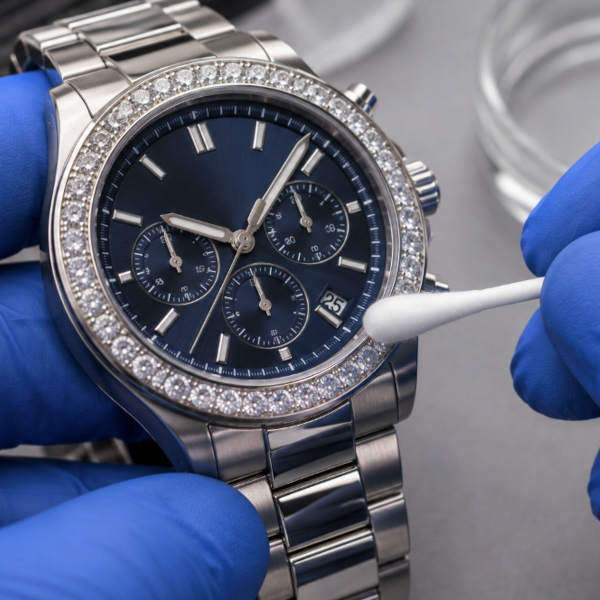
The swab wasn’t applied to someone’s nostrils, but rather something far more elegant, non-biological, and pleasing to look at: melee diamonds set into the bezel of a beautiful Swiss watch that arrived in the mail.
The test result: cut and polished in Surat, India, by KGK, in the third quarter of 2025. The stones didn’t leave the watch.
That test is the newest capability from Provenance Proof, the Swiss traceability company spun out of Gübelin Gem Lab. They’ve been tagging emeralds at Gemfields’ Kagem mine in Zambia since 2017 and became a standalone Gübelin entity in 2020 during covid.
Provenance Proof’s premise is that a supply chain should track the material itself, not just the documents that follow it.
The process involves the application and retrieval of nanoparticles so tiny they measure about a thousandth the width of a human hair—too small for any optical microscope to detect, says Provenance Proof managing director Daniel Nyfeler.
These physical tracers of synthetic DNA are applied to gemstones, preferably as soon as they leave the ground.
“Ideally it’s done at stage one, so in the mine, on the rough crystal,” says Nyfeler.
Stones go into a carrier liquid holding the particles in suspension, then they undergo a process that drives them into the stone rather than leaving them on the surface, Nyfeler tells JCK. That’s why they can survive cutting, polishing, and mounting.
From Mine to Market: Provenance Proof and the Zambian Emerald Pipeline
Nyfeler says a recent run at Kagem mine earlier this month tagged about 10 kilos of rough emeralds, with each lot weighing about 500 grams.
Every stone in each lot is grouped together and assigned the same DNA sequence, which encodes the mine, the mining company, and the year. The lots are then shipped to Bangkok and sold at auction, sometimes to manufacturers like Eshed-Gemstar, who cut Zambian emeralds and make them available to Americans in Manhattan’s Diamond District—and, ultimately, to retailers and consumers.
Melee Diamonds, Swab Tests, and Provenance of Other Gems
In 2025, clients started applying tracers to melee, a category diamond manufacturers had largely written off due to the cost. Existing traceability methods scan a large rough diamond and match it to the polished stone afterward, a workable process for a stone of significant value.
But the economics collapse at small sizes, when scanning a stone eclipses the cost of the product being tested. Nanotracers, though? They’re applied in bulk, kilos at a time.
The next problem needing solved was resolved earlier this year. Reading back the DNA sequence afterward—the second part of Provenance Proof—used to require an immersion process. The swab test does not. This is how the diamonds of a watch bezel can be checked without taking anything apart.
Provenance Proof also runs a blockchain-powered digital ledger to record each transfer, but the physical tracer is what stays on a stone.
“Indeed, we can now offer to the industry verifiable auditable traceability also for small diamonds, which so far was something that the diamond industry was happily avoiding to have to deliver,” says Nyfeler.
So far, Nyfeler says, paraiba tourmalines and pearls can also use Provenance Proof.
Rubies and sapphires—the vast majority of which are heated to temperatures so high it likely destroys the nanoparticles—have escaped the technology’s reach, for now.
For retailers, this is increasingly moving into wholesale markets, and maybe even their own inventory. Traceable melee is moving through major manufacturers now. Brands are tagging finished pieces.
Unlike a paper certificate, which can be conveniently discarded the moment it no longer serves a purpose to whomever is holding it, stones themselves are carrying new signatures that are harder to avoid.
“They are putting it on their stones, and they’re putting [it] into their jewelry…so that they can identify fakes, or if stones get swapped,” he says.
Top: Technicians at Provenance Proof in Switzerland swab a watch bezel to detect nanoparticle DNA of melee diamonds (photo courtesy of Provenance Proof)
- Subscribe to the JCK News Daily
- Subscribe to the JCK Special Report
- Follow JCK on Instagram: @jckmagazine
- Follow JCK on X: @jckmagazine
- Follow JCK on Facebook: @jckmagazine