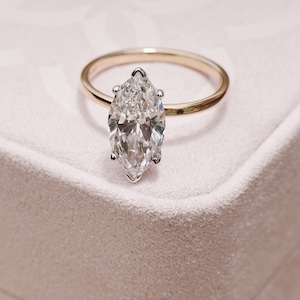
While Charles & Colvard said last year that it would focus on its “core business” of created moissanite, it is now emphasizing lab-grown diamonds, because of a deal with an investor affiliated with Indian producer Bhanderi.
In June, Ethara Capital—a fund managed by a principal of Bhanderi Lab Grown Diamonds—agreed to buy $2 million in Charles & Colvard secured notes. The purchase gave Ethara the right to convert those notes into common shares in the publicly traded company, pending shareholder approval.
Charles & Colvard CEO Don O’Connell tells JCK that by joining with Ethara, and by extension Bhanderi, his company can now offer loose and mounted lab-grown diamonds wholesale.
“In 2024, we said we were going back to wholesale, with Charles & Colvard Direct,” he says. “With the downward pressure on lab-grown diamonds, moissanite has gone by the wayside a bit.
“As a stand-alone moissanite company, we knew that Charles & Colvard Direct was not as appealing to the independent community. We knew that we needed to sell lab-grown diamonds to independents, and we needed to do that as vertical as possible.”
O’Connell admits the lab-grown diamond wholesale sector is quite crowded right now, but he feels Charles & Colvard can still stand apart.
“The differentiator is we’re tied to a grower, which gives us the right price point,” he says. “[There’s] that, mixed with our brand, mixed with our quality, the value, and what Charles & Colvard stands for.”
The company will continue to sell moissanite, both to consumers and the trade, says O’Connell, but now “that we have a strong strategic partner in the lab-grown diamond universe, we’ll shift to where that consumer demand is, and that’s lab-grown diamonds.
“In the past, we had an excessive inventory—millions of dollars—in moissanite,” he explains. “We couldn’t focus too much as a brand on lab-grown diamonds because we didn’t want to cannibalize our own business. Now we can be fully immersed in all things ‘made, not mined.’
“We lost a lot of ground by not really offering a big variety of lab-grown diamonds when the consumer and our wholesale distributors were asking us [for them]. But we were in a stalemate, between where we were with moissanite versus how we could cross into lab-grown diamonds. So even though we had [sold] lab-grown diamonds, we’re going to lean into them more. We believe there’s plenty of space for us.”
In addition to offering more lab-grown diamonds wholesale, Charles & Colvard plans to expand its LGD product line sold direct-to-consumers—though O’Connell says shoppers shouldn’t expect bargain-basement prices.
“We believe that now that we’re close to vertical, we could really affect change in the pricing,” O’Connell says. “But we’re not sure that is the right approach.… I don’t believe that we’ll be the lowest-cost provider, but we’ll be more competitive than most of the retailers out there, for sure. This partnership puts us in a position to do that.”
As a result of the transaction, Ethara gained two board seats. The first was filled by Ruten Bhanderi, the 22-year-old vice chairman of Bhanderi. The second went to James Tu, a Bhanderi adviser, who is now the chairman of Charles & Colvard as well as a company consultant.
This summer, Bhanderi Lab Grown sold 1,000 growing machines to Indian manufacturer Greenlab. However, Ruten Bhanderi says his company still has plenty of devices that produce gems.
Greenlab was expanding and “didn’t want to make their own machines,” Bhanderi tells JCK. “Half of the machines [Greenlab bought] were already running, and half of them were ready to be shipped. They were able to start growing in one month.
“[Bhanderi] still owns 2,500 machines,” he adds, “and we have an additional 300 to 400 machines for R&D, under the Bhanderi name. We also have about 400 machines that have yet to be built, but we’re still looking at the current economic conditions—how the tariffs turn out and how demand comes in—to see if it’s time to turn on those machines.”
He notes that two years ago, Bhanderi Lab Grown abandoned its former model, where it leased out its growing machines to other companies. It now follows the traditional path of producing diamonds and selling them wholesale.
Charles & Colvard’s deal with Ethara—particularly the provision allowing Ethara to convert its debt into shares—has come under fire from Riverstyx Capital, an activist investor that holds approximately 5%–7% of Charles & Colvard’s common stock.
In July, Riverstyx filed suit against Charles & Colvard in North Carolina Superior Court, seeking a court order to force the Morrisville, N.C.–based company to hold its annual general meeting and board election. Charles & Colvard eventually agreed to do so, on Oct. 13.
Results of Monday’s vote have yet to be announced, but the board’s pre-election actions sparked another dispute. In a second lawsuit, filed Sept. 17, Riverstyx claimed that the board had issued “dilutive” shares to Ethara and Charles & Colvard executives in an effort to “rig” the election in favor of the incumbent directors. Riverstyx asked that the court enjoin the issuance of those new shares.
That ruling might make the difference, says Michael R. Levin, one of four candidates that Riverstyx nominated for the five-person board.
“It looks like our candidates will win the board election,” Levin tells JCK. “We received about 1.1 million votes compared to about 600,000 for the current incumbents, including Don, Ruten, and three others.
“This assumes the 1.3 million votes that Ethara voted in their own favor won’t count, because they improperly converted a part of their debt. We will know this for certain in a couple of weeks, after the judge rules on that conversion.”
O’Connell counters: “We believe we will have enough to have the majority. That’s still undecided at this point.
“Because our share price was down so low, some people were able to accumulate significant shareholder positions,” says O’Connell. “A lot of the people who are shareholders do not understand the complexity on the jewelry industry and don’t understand the downward pressure that lab-grown diamonds was having on moissanite, as well as [issues with] rising commodity prices.
“If we didn’t have the partnership with Ethara Capital, it would definitely be a big challenge for Charles & Colvard, especially just being a moissanite company.… Make no mistake: We were challenged. As you know, the company was having a difficult time.
“All the benefits that Ethara Capital brings, all the excess capital and additional money, the ability to invest in and grow the lab-grown diamond business, we believe it’s a win-win and the best outcome for the shareholders,” O’Connell says.
“We did vet our strategic opportunities for alternatives, and none of them panned out to be as beneficial for the shareholders as the group that we have now.”
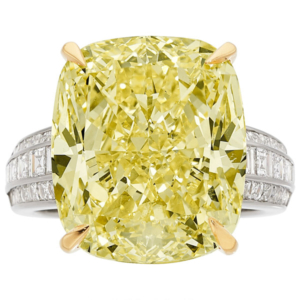
Top: A Charles & Colvard lab-grown diamond ring (photo courtesy of Charles & Colvard)
- Subscribe to the JCK News Daily
- Subscribe to the JCK Special Report
- Follow JCK on Instagram: @jckmagazine
- Follow JCK on X: @jckmagazine
- Follow JCK on Facebook: @jckmagazine