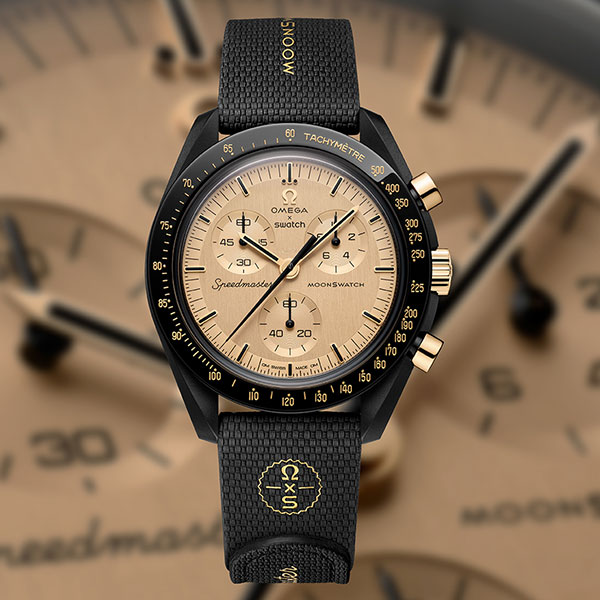
They did it again: In May, Swatch Group created unprecedented demand for its Royal Pop, and it got the watch world in a lather again in July with a quiz-based application process for the Mission to the Moon 1969 MoonSwatch.
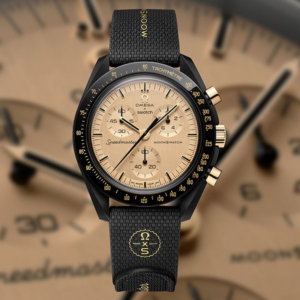
More than a million people reportedly applied for the limited-edition 1969 MoonSwatch model that some observers called “an instant collector’s item.” Swatch made only 1,969 units available worldwide, and watch lovers went gaga for the 11 grams of 18k gold on its dial, hands, crown, and pushers. Swatch amped up the tension even more with its retail price of $570 (based on the price of gold on July 21, 1969).
Swatch’s headline-making quiz format—the Electronic Swatch Timepiece Application (ESTA)—got massive buzz, and came only two months after its unforgettable Royal Pop debut, the collaboration with Audemars Piguet in May that caused Swatch to close stores and enlist a police presence outside locations in cities such as New York City, Paris, and London to calm crowds.
JCK reached out to watch experts to ask: What is Swatch doing right to get this massive impact and what could it do in the future to maintain positive traction?

The quiz is the smartest thing Swatch has done since the original MoonSwatch, says Eugene Tutunikov, CEO of the Atlanta-based pre-owned luxury watch retailer SwissWatchExpo.
“The 1969 release moved that entire scrum online. Roughly 1.2 million people filled out a 32-question form—about 600 applicants per piece—and nobody slept on a sidewalk,” Tutunikov says.
“It also solved a problem every luxury brand is chasing right now: knowing who your customer actually is,” Tutunikov says. “Swatch now has more than a million qualified enthusiasts who volunteered their contact information and proved they knew the brand’s history. That list is worth more than the watches.”
Tim Richardson—CEO and cofounder of Naples, Fla.–based Exquisite Timepieces—agrees. A longtime luxury expert who advises collectors on buying, selling, and investing in high-end timepieces, he closely follows both the watch market and the marketing strategies driving today’s biggest debuts.
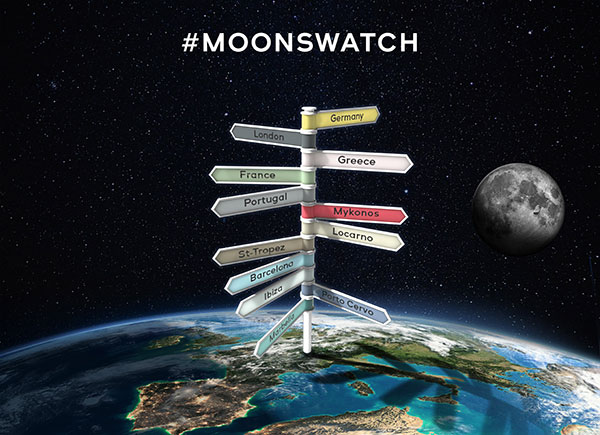
“Swatch turned the purchasing process into part of the story. You weren’t just buying a MoonSwatch. You were completing a mission,” Richardson says. “The application mirrored the anticipation, preparation, and exclusivity associated with the moon landing itself. Rather than simply entering a lottery, applicants became participants in the narrative. That is a very different experience from clicking ‘buy now.’”
More important, Richardson says, luxury has always been about access. Swatch didn’t create exclusivity through price. It created exclusivity through experience.
“Collectors love stories almost as much as they love watches. They remember where they found a watch, how they acquired it, and what made it special. Swatch managed to give owners that story before they even received the watch,” Richardson says.
“One thing we’ve seen at Exquisite Timepieces is that collaborations like this often become the starting point for a collector’s journey. Someone may first become interested in a MoonSwatch because it’s accessible or culturally relevant, but that curiosity often leads them to research the original Omega Speedmaster and, eventually, aspire to own one. That’s the mark of a successful collaboration. It creates long-term interest in the category rather than simply selling one product,” he adds.
Did the MoonSwatch quiz and buying method stop flipping? No, says Tutunikov. A watch with 11 grams of 18k gold is an arbitrage opportunity on Day 1, and flippers can take quizzes too. He says the early secondary-market asks ran into the thousands of dollars within days.
Was the Royal Pop debut more successful? Debatable, according to Tutunikov, and it depends on what you are measuring. Commercially, it worked, he says. Swatch Group’s share price climbed roughly 15% in the two weeks around the debut, StockX logged more than a thousand sales within days, and full sets were clearing five figures on launch weekend. As pure attention, few product launches this decade have done better, he notes.
“As a brand decision, I would separate the two companies. Swatch got foot traffic, relevance, and association with one of the most respected names in Swiss watchmaking,” Tutunikov says. “Audemars Piguet got exposure and a bill that comes later. The ‘accessible icon’ format dilutes the brand. If you want a masterclass in brand protection, look at Rolex. When they want to offer accessible pricing, they use Tudor. They don’t make a plastic Submariner.”
The resale trajectory tells the rest of the story, Tutunikov says. Pieces that were trading at four and five times retail in May now can be found below the $400 retail price. Meanwhile, the buyers he sees at SwissWatchExpo are still after steel Royal Oaks.
“Hype that corrects that fast was never demand. It was speculation,” Tutunikov says.
Richardson says he thought the Royal Pop was a long-term play. Swatch didn’t simply create a plastic Royal Oak wristwatch—it chose a pocket watch, which immediately made the collaboration feel like an innovation rather than an imitation.
The Royal Pop pocket watch also tapped into something happening across luxury. Consumers are increasingly drawn to heritage, nostalgia, and objects that feel timeless, Richardson says.
“It wasn’t nostalgia simply for nostalgia’s sake. It referenced Swatch’s own history while also bringing back a category that most consumers rarely think about anymore. People didn’t have to love the design. They simply had to have an opinion about it,” Richardson says.
Swatch offered its first MoonSwatch in 2022 through in-store exclusivity, interesting teasers, and fun visuals. The $260 watch was a merger between Swatch and Omega’s well-known Speedmaster, and its hype included social-media posts, a digital countdown, and ads in The New York Times. Swatch did a planetary campaign, hoping to appeal to both watch collectors and space fans.
Regarding the latest MoonSwatch, Swatch replied to a JCK interview request via email, describing the response to its quiz as “amazing.… Doing an ESTA is one thing but having the right questions is as important as the system itself. The message of Swatch is positive provocation and joy of life,” the brand told us. “The storytelling of Mission to the Moon 1969 linked to an ESTA was perfect.”
In the future, Swatch likely will continue to offer these one-of-a-kind collaborations as well as conversation-starting debut schemes, Richardson says. They work, and they are smart.
“To me, that’s why these collaborations have been so successful. The true measure of these collaborations won’t be how quickly they sold out. It’ll be how many people buy their first Omega or their first Audemars Piguet five or 10 years from now because a Swatch collaboration sparked their interest today,” Richardson says.
“In luxury, conversation has value. Where the launch struggled was at retail. The crowds, long lines, and store disruptions demonstrated incredible demand, but they also showed that the retail experience wasn’t prepared for the level of excitement the collaboration generated. There’s a difference between scarcity creating excitement and scarcity creating frustration,” he says.
“Consumers will accept difficulty if they believe the process is fair. They become much less forgiving when they feel access depends on luck, location, or chaos,” Richardson adds. “The collaboration absolutely succeeded. The execution simply left room for improvement.”
Top: MoonSwatch Mission to the Moon has gained tons of online and newspaper ink as more than a million people applied to buy the latest version. (Photo courtesy of Swatch)
- Subscribe to the JCK News Daily
- Subscribe to the JCK Special Report
- Follow JCK on Instagram: @jckmagazine
- Follow JCK on X: @jckmagazine
- Follow JCK on Facebook: @jckmagazine