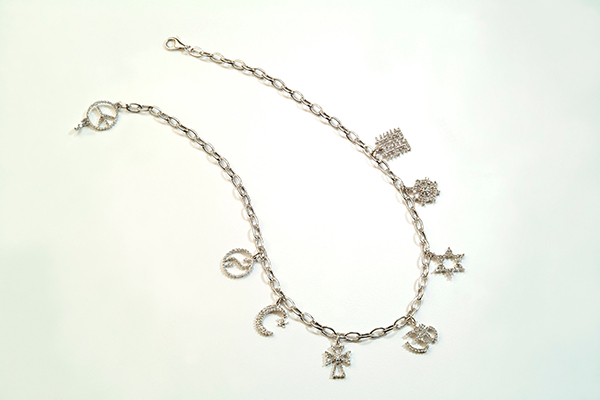
Mary Margrill, a fine jewelry designer in Austin, Texas, was at the vanguard of the self-purchase phenomenon when she introduced her brand in 2002. The New York City native was living in Greenwich Village, “doing a lot of yoga and Kabbalah studies,” when she designed a necklace called “One World.” It was inspired by the realization that with the advent of the World Wide Web, “we were all connected,” Margrill tells JCK.
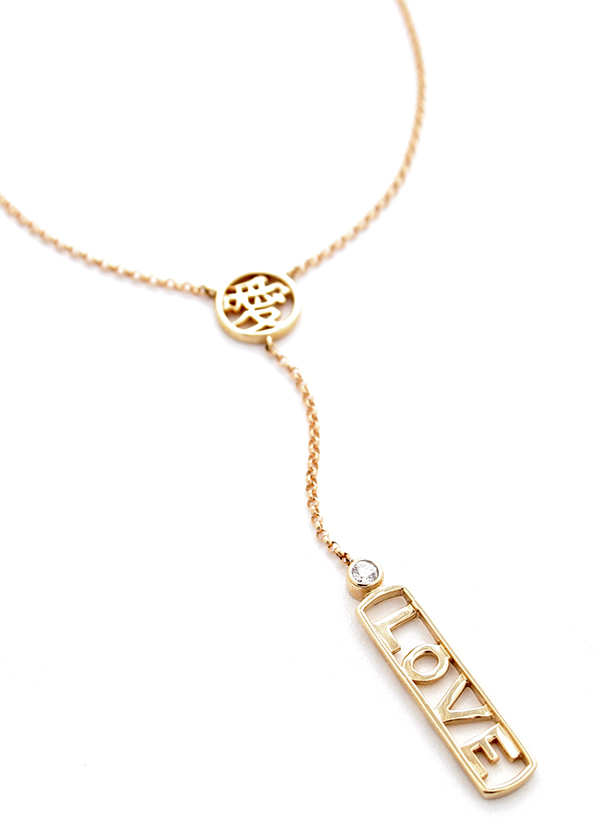
The early Aughts, of course, were a much different time in the jewelry trade. “When I launched my line, everybody was wearing platinum and white gold,” Margrill recalls. “I launched in 14k because I wanted women to self-purchase. Back then, in 2003, my bestselling necklace—the Y necklace that says Love that put me on the map with Jennifer Aniston—was $300. Now, it’s $2,000.”
The New Sweet Spot
It’s worth remembering that in 2002, gold peaked at $349 per ounce. It now sits at more than 10 times that amount. And even though the precious metal has slipped from its record high of $5,589 per ounce in late January, there’s no denying that the sweet spot for self-purchase customers, traditionally defined as $500 to $2,500, no longer buys what it used to.
Phillip Maroof, vice president of design and marketing at Royal Chain in New York City, says the $500 self-purchase entry point isn’t realistic anymore. “You’re probably pushing closer to $700 to $800,” he says. “Then you jump from there to $1,000 and then skip to $2,000. Right in the middle never finds that sweet spot—it’s either under $1,000 or over $2,000.
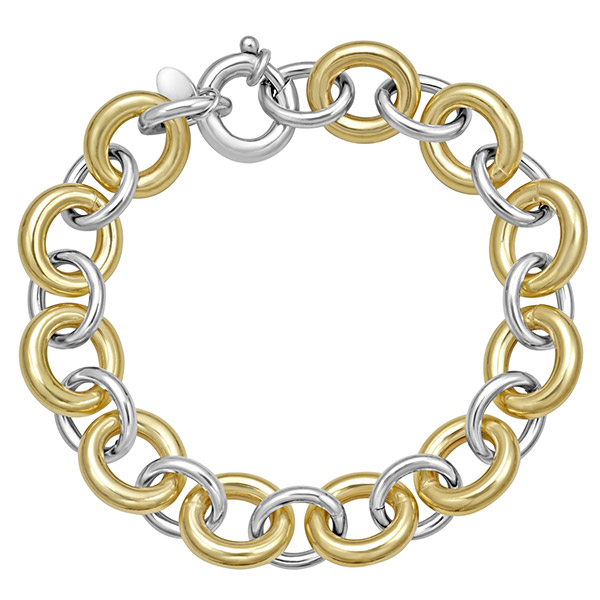
“A decade ago, you would have gotten a gold bracelet, maybe a nice chain,” Maroof adds. “Now it’s more like a pair of earrings. Maybe a thinner chain or a bimetal bracelet. It becomes a hard category to fill.”
Margrill came to the same realization in 2025, when she restarted her brand after a long hiatus. (She stepped away from the business after the financial crisis of 2008 and rejoined the industry after former clients who’d lost homes in the L.A. fires reached out to inquire about replacement jewels.)
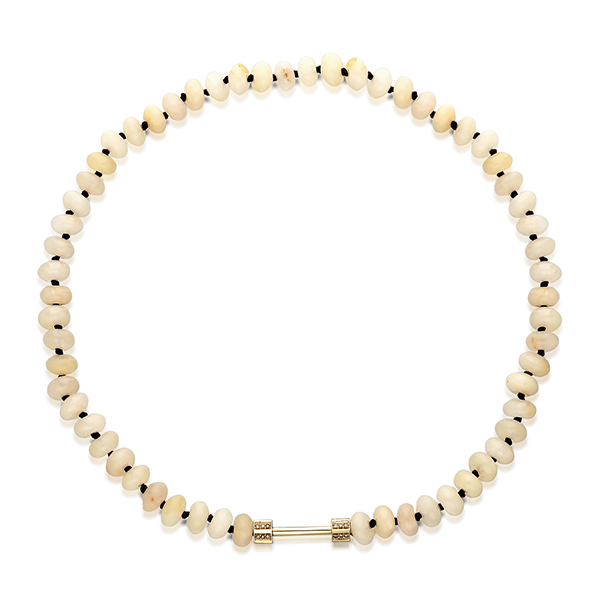
She has once again begun making women’s self-purchase pieces. She says she has managed to keep some styles under $2,500 because she’s had plenty of practice designing jewels that have a substantial look but still hit the right price point. “That’s why pearl necklaces and wood are being added to jewelry now—it still has the look but gets it to be cost-effective,” Margrill says.
Downsizing Expectations
At retail, however, the struggle is real. Lisa Vinicur and her mother, Diane Glynn, owners of Diane Glynn Jewelry in Jenkintown, Pa., lament the lack of affordable self-purchase and gift options to offer their clients.
“You can’t really do anything in the $500 to $1,200 price range—$2,500 maybe,” Vinicur says. “We were actually looking at a pair of earrings that are costing me $795: a little hoop with a dangle heart on it. The little bit of diamonds are so miniscule. You look at it and say, ‘Am I going to spend $1,700 on that? The customer won’t—that’s what I used to sell them for. When somebody wants to buy a $500 gift, that doesn’t exist. When gold was $2,000, we were okay. But creeping up to $3,000, then $4,000, $5,000—that’s when I noticed the rings got smaller and the gold got thinner.”
In order to hit the gifting price point, Vinicur and Glynn have shifted to selling beads, ceramic bracelets, and stylish pieces in silver with gold accents—“but you can’t satisfy everyone with beads,” Vinicur adds.
Glynn says the new arithmetic of fine jewelry has forced them to rethink their selection. “We’re a store that is fashion and value and we have to find something to satisfy that customer,” she says.
“I won’t go into ‘costume jewelry,’” Glynn adds. “I draw the line. Sterling with gold on top has a presence.”
High-End Times
And yet even the most accessible designs have gone up in price. “The low end has a new entry,” says Andrea Hill, founder and CEO of Hill Management Group in Chicago. “It used to be $100, but now you can’t get anything that will work in a jewelry store for less than $200 to $500.”
She voices a takeaway about today’s marketplace that most fine jewelers have experienced for themselves: “We are seeing that the high end is doing very well, but the middle has disappeared. We used to get people shopping for less than $3,000. You need to be underneath that or way above that.”
Hill emphasizes that luxury retailers need not apologize for offering pieces at higher price points. “If you’re a fine jeweler, this is what it sells for now,” she says. “It is a luxury.”
She notes that the best-performing retailers have leaned into higher-priced gold. “What’s not working is downgrading the offer,” Hill says.
She shares an anecdote about a retailer who swapped out his entire case of gold jewelry for gold-fill pieces “and customers just rejected it,” she says. “He gave up an entire case that would have sold if he’d just been more confident. It was a fear move rather than a merchandising move.”
Hill signs off with one final bit of advice for fine jewelers struggling with what to make of their gift and self-purchase cases this holiday season: “Stock color,” she says. “It’s hot.”
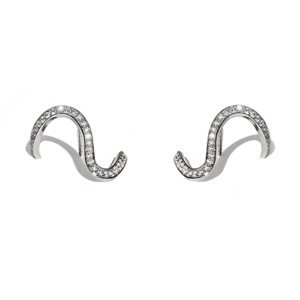
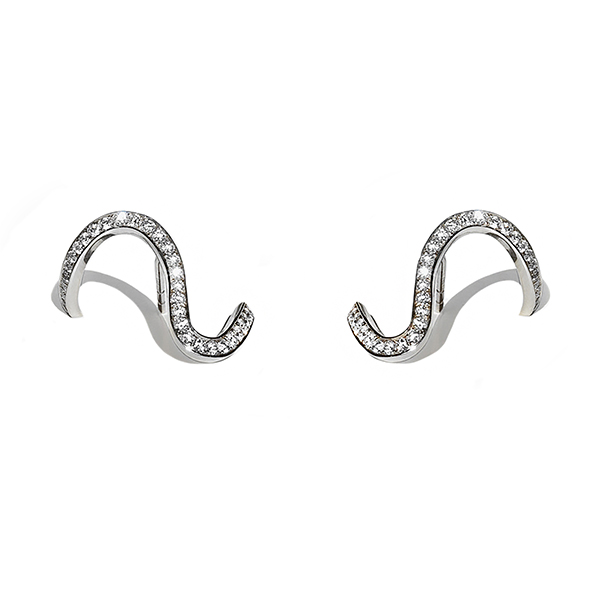
Top: Trace Pavé earrings in sterling silver with diamonds, $1,380; Katkim
- Subscribe to the JCK News Daily
- Subscribe to the JCK Special Report
- Follow JCK on Instagram: @jckmagazine
- Follow JCK on X: @jckmagazine
- Follow JCK on Facebook: @jckmagazine