Fifteen stories above the corner of Pearl and Wall streets in Manhattan, a chef approached a long table of trade editors to announce a delicacy rarely served in the United States.
This wasn’t meant to be an exotic food tasting event, yet there it was: pearl meat, the adductor muscle of Pinctada maxima, the same oyster that grows Australia’s South Sea pearls. Served in small strips, it tasted more like scallop than oyster. As the plates went around, so did a 20 mm round pearl from the Paspaley family’s private collection.
Dinner and jewel came from the same species of shell. Only one was meant to be eaten; the other, executive director Chris Paspaley told the room, might never be sold. It was a fitting display for a company that controls every step of its supply chain, from seabed to showcase. Paspaley says it accounts for about 80% of Australia’s South Sea pearl production and has been retailing its own jewelry for more than 35 years.
The pearl meat, however, is a rare delicacy from the farms, which yield a mere 7 tonnes of it a year, highly sought in the markets of East Asia. The pearls themselves are globally sought: sold at auctions, traded to wholesalers, supplied to leading jewelry houses around the world, and made into Paspaley jewels, which have been slowly making their way into select American jewelers over the past couple of years.
“We’re now in 14 doors in the U.S., and it’s very intentional that we are not in 70 doors,” Paspaley said at the Oct. 15 event.
Earlier, on a balcony of the Wall Street Hotel, a building that was once headquarters of the world’s largest mother-of-pearl importer and is now owned by the Paspaley family, Paspaley explains why.
“We’re not looking to grow at any cost,” he says, “as opposed to growing at the rate that we think is right.”
His caution comes from what he has seen happen to others. Retailers and buyers, he says, often tell him of brands that arrived promising to add more stores, then grew too fast to keep up with service or stock to existing clients. “They scaled too quickly, at the sacrifice of the experience, sacrifice of the partnerships,” he says.
Paspaley is trying to avoid that by capping the number of new retail partners it takes on each year. “We don’t want to promise the world and then not be able to do it,” he says. “So we are making sure we take sustainable, progressive steps—very intentional with it as opposed to rapid.”
When Paspaley last spoke to JCK in 2024, the company had just completed what Chris Paspaley called its reconnaissance of the American market and debuted with its first retail partners.
That recon went well beyond retailer visits, he says. The company spent heavily on market research firms and data analytics, alongside conversations with established retailers across the United States. “It really cemented and developed our strategy,” he says.
The evening’s purpose was Icons, a campaign gathering three of Paspaley’s existing collections under one banner: Lavalier, Strands, and Cicada.
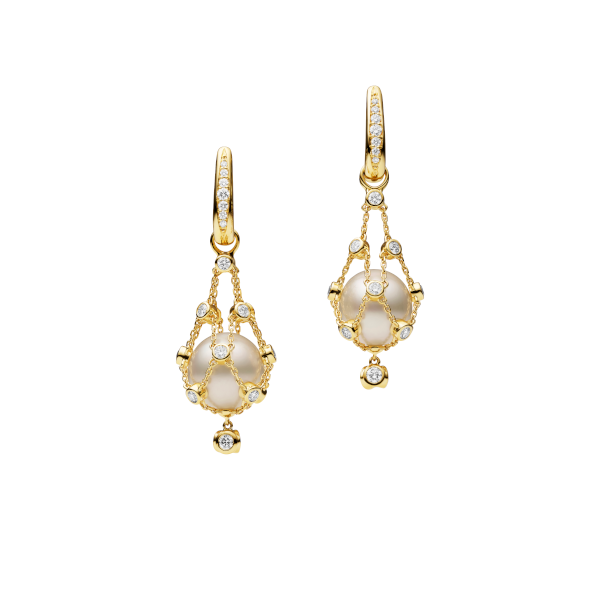
Lavalier is the one Paspaley reaches for first. Its gold mesh is modeled on the glass buoys that once held up the pearl lines on the family’s farms, and on the net bags divers use to collect shell. Inside sits a single South Sea pearl, undrilled.
“The pearl is the hero of the piece,” he says, demonstrating by hand. The pearl isn’t set; it rests freely in its net and can be lifted out, much as a pearl is taken from the shell that grew it.
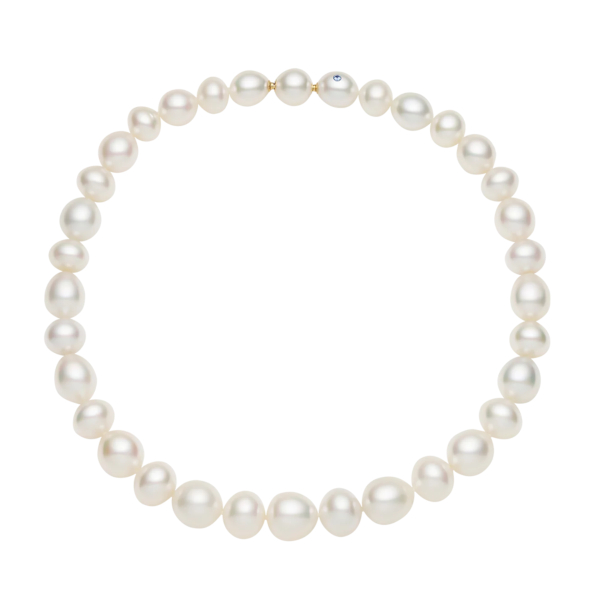
Lavalier has been one of the brand’s two best sellers in the United States. The other is its Strands.
Each strand is matched pearl by pearl, starting from the center and working outward. Some of the finest, Paspaley says, can take up to eight years to assemble. The one he shows that evening, 15 mm to 18 mm in size, is among the company’s rarest. Its luster, he says, comes down to what hasn’t been done to it: “That’s one of the key differences between our process and the other processes, that they’re untreated.”
Every pearl Paspaley supplies is untreated—never bleached or washed with acid—and the company guarantees the pearls’ natural color and luster.
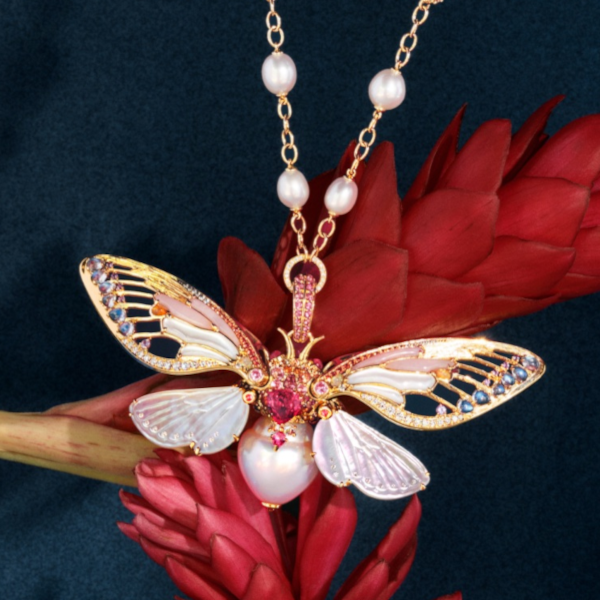
Cicada, the newest of the three, leans on movement. On Australia’s northern coast, the cicada’s call signals the monsoon and the end of the pearl harvest, when Paspaley’s divers return from sea. The collection’s pieces are built to change with the wearer: One pendant inverts, enclosing its pearl or opening to present it.
Paspaley added eight designs to the line last year with its Blushing Cicada series, whose wings move.
For retailers wondering what it takes to carry the line, Paspaley says the company partners with multigenerational family jewelers that “do not think in quarters.”
So far, American customers are buying in ratios similar to Australians, with the main differences in sizing and in regional tastes the company is still learning. The buyers are also changing. At a recent client event in Connecticut, Paspaley says, a doctor bought pearl bracelets for himself rather than his wife.
A business dictated by nature
Paspaley’s empire runs on more than 40 businesses, from wine to aviation to cruises and hospitality. Its most influential adviser on growth can’t be reached in a boardroom, though. It lives in the waters off the Kimberley coast: the oyster itself.
“We know that what we can produce is dictated by what nature gives us,” he says. Even when the farms do everything right, “it’s left in the hands of nature. And you never know what you’re going to get.… Sometimes we get these incredible gems; sometimes we get nothing.”
It’s one more reason Paspaley wants partners who “really appreciate what it is that we are bringing to the market.” Supply this unpredictable doesn’t scale on command.
Nor, he suggests, does it need to. “Our journey into the U.S. is not something that is a beginning,” Paspaley told the room. “It is continuing.”
Top: A Paspaley pearl strand worn by a model for the company’s Icon campaign (photos courtesy of Paspaley)
- Subscribe to the JCK News Daily
- Subscribe to the JCK Special Report
- Follow JCK on Instagram: @jckmagazine
- Follow JCK on X: @jckmagazine
- Follow JCK on Facebook: @jckmagazine