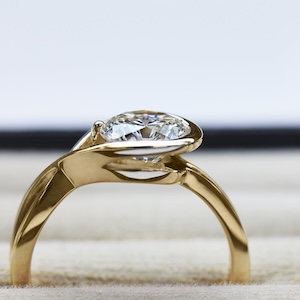
This week, Pandora said it was adding “carbon footprint labeling” to its lab-grown diamond collection. Yet, the marketing behind its announcement has stirred up a hornet’s nest of controversy, possibly breathing new life into the age-old—and endlessly contentious—lab-grown-versus-natural debate.
The Copenhagen-based company clearly wants consumers to take its sustainability claims—including its assertion that its diamonds have the same carbon footprint as a pair of jeans—seriously. It backed them up by posting two consultant-authored reports on the impact of its diamonds and diamond jewelry.
But not everyone was happy about the company’s claim that the carbon footprint of its lab-grown stones is “around 90% lower than a mined diamond of the same size (based on a 2019 study by the Diamond Producers Association).”
Many were surprised that Pandora had decided to again “go negative” against lab diamonds, considering that the lab-grown boom has badly hurt people in diamond producing countries. In addition, Pandora’s offerings don’t really compete with natural diamonds, as they’re being sold at a much lower price point.
In its last financial report, Pandora said that comps for its lab-grown diamond collection fell 15% in the first quarter of the year. CEO Berta de Pablos-Barbier told analysts the problem was that lab-grown diamond jewelry was being sold at too high a price point, and it’s now targeting the $250 to $500 range.
The Natural Diamond Council (NDC) issued a statement calling Pandora’s campaign “another disappointing PR stunt that unfairly attacks the natural diamond industry to promote synthetic diamonds. This misleading narrative has real consequences for the tens of millions of people worldwide who depend on the natural diamond industry for jobs, income, and social development.”
It added that the carbon footprint data Pandora used for the natural diamond industry is “outdated” and in some cases dates back to 2013.
“Such comparisons are inaccurate and inconsistent with credible sustainability and responsible marketing standards,” the NDC said.
Ironically, the report the NDC is calling out was commissioned by its predecessor, the Diamond Producers Association (DPA). After lab-grown producer Diamond Foundry complained about it to the National Advertising Division (NAD), the ad watchdog ruled that the study, prepared by TruCost, had “several flaws,” including its use of “old” data and numbers “conveyed through second- and thirdhand sources.”
The NAD also told JCK that true industry-wide comparisons should include 85% of available production. The DPA/TruCost study only surveyed its members, which at the time accounted for 75% of production.
The Natural Diamond Council statement. which was addressed to de Pablos-Barbier, concluded by saying that if “Pandora is serious about supporting sustainability and supporting the wider jewelry sector,” it would “re-engage constructively in industry forums where both the natural and synthetic diamond sectors are working to strengthen environmental stewardship and social responsibility.”
That seems to be a reference to Pandora’s decision to leave the Responsible Jewellery Council (RJC) in 2022, in protest of the membership of Russian miner Alrosa. (Alrosa suspended its membership soon afterward.) However, unlike other companies that left the RJC at that time, like Richemont and Kering, Pandora never returned. Pandora did become a member of the Watch and Jewellery Initiative 2030, led by former RJC executive director Iris Van der Veken.
Pandora didn’t respond to a request for comment on the NDC’s statement.
(Photo courtesy of Pandora)
- Subscribe to the JCK News Daily
- Subscribe to the JCK Special Report
- Follow JCK on Instagram: @jckmagazine
- Follow JCK on X: @jckmagazine
- Follow JCK on Facebook: @jckmagazine