Luxury jewelry and watch brands are opening fewer stores but investing more heavily in flagship locations, according to a new report from JLL, the worldwide real estate services firm.
In a Sept. 8 report tracking recent retail leasing activity, JLL said luxury store openings in the United States totaled 123,334 square feet during the first half of 2026, down 46% from 227,000 square feet a year earlier.
The slowdown does not necessarily signal retrenchment. Instead, JLL said many luxury companies are shifting toward a “quality over quantity” strategy, focusing on larger, higher-profile locations rather than expanding their store networks. The firm cited research from the Bain & Co. consulting group that found the average size of a luxury flagship store has grown by more than 30%.
Yet JLL said smaller stores focusing on jewelry and watch brands remain an important part of the expansion picture. Stores under 2,500 square feet accounted for nearly half of all luxury openings tracked by JLL, and jewelry and watch retailers represented 43.5% of that smallest store-size category. The report said many of these locations are compact stores positioned within shopping malls or established luxury retail districts.
JLL found that luxury expansion during 2026 has remained concentrated in a relatively small number of proven luxury corridors rather than spreading broadly across secondary markets.
New York City’s Madison Avenue leads the country in total luxury retail square footage, driven largely by large-format flagship projects such as Dior’s 52,000-square-foot store.
But Miami’s Design District is emerging as one of North America’s strongest jewelry and watch markets. JLL cited the presence of brands including Rolex, Bulgari, and Vacheron Constantin as evidence that the district has become “the clearest jewelry and watch cluster in the U.S. outside a mall setting.”
The report found that independent and family-controlled luxury brands accounted for 46% of all tracked openings across the United States and Canada, more than any luxury conglomerate. Still, LVMH and Richemont together represented roughly 30% of openings, with LVMH’s average store size substantially larger due to major flagship investments.
JLL said the changing real estate strategy reflects shifting consumer behavior. Citing research from Bain & Co., the report noted that the global luxury customer base has shrunk in recent years as aspirational shoppers pull back, while top-spending consumers continue to account for a growing share of sales. As a result, brands are investing in destinations designed to serve high-value clients.
“A market serving a smaller, wealthier, more demanding client base does not need the same number of doors,” the report said. “It needs better ones, in the right places, positioned to deliver an unmatched level of service.”
The JLL report said luxury flagships increasingly incorporate hospitality, exhibition, event, and private-client spaces. Watch and jewelry brands are using similar concepts through invitation-only ateliers, master classes, and private previews, contributing to demand for larger and more specialized retail environments.
The JCK News Desk uses AI to help research and produce the first draft of articles. This story was then reviewed by staff writer David Blomquist.
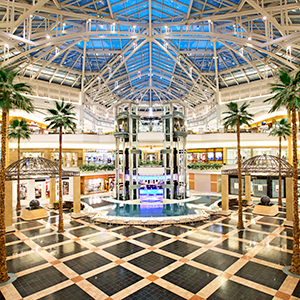
(Photo: Somerset Collection in Troy, Mich.)
- Subscribe to the JCK News Daily
- Subscribe to the JCK Special Report
- Follow JCK on Instagram: @jckmagazine
- Follow JCK on X: @jckmagazine
- Follow JCK on Facebook: @jckmagazine