Pearls carry centuries of history, and to some shoppers, centuries of baggage. The jewelers selling them well right now aren’t fighting that history. They’re explaining it.
Almost every time someone walks into Susan Eisen Fine Jewelry & Watches in El Paso, Texas, to sell jewelry they’ve inherited, there’s a strand or two of pearls in the pile. And almost every time, the seller is sure they’re real.
“Everybody thinks that because they’ve inherited them, and they’re older, that they’re real,” says Susan Eisen, a graduate gemologist and master gemologist appraiser. “I would say 60% of the time they’re imitation.”
Customers are less bothered than you’d expect. “In many cases they really don’t care, because they belong to their great-grandmother. And there might be pictures of her wearing those pearls in her wedding,” Eisen says. “It matters if you’re buying and selling them. But it doesn’t if you’ve inherited them.”
Fake pearls are hardly new. By the late 1600s, bead makers in Paris were lining hollow glass beads with a paste made from fish scales, then filling them with wax. Since then imitations and treatments have continued to improve. “Of course they get better and better, just like they do with colored stone treatments,” Eisen says.
The pearl’s long history is both its greatest asset and its biggest problem: generations of meaning, and to many shoppers, a look straight out of a grandmother’s jewelry box.
Old Pearls, New Gold
“A lot of people think that a strand of pearls is old-fashioned,” Eisen says. “I don’t know why they think that. I guess because they’ve been popular for 100 years.”
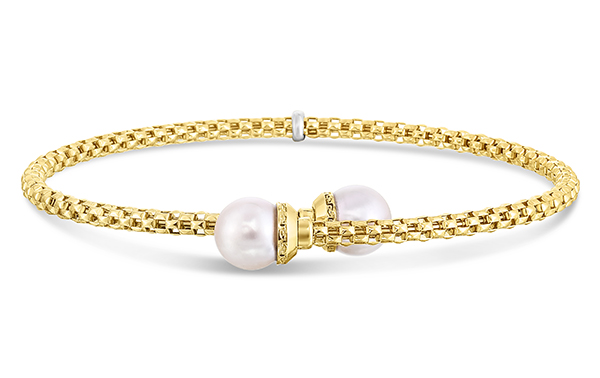
Classic round pearls nevertheless remain her bestsellers. What’s changing for Eisen is the strand of pearls itself: Her team will breaks strands up with gold chain; sometimes, they’ll add beads between the pearls. Redesign, she says, is “a super big part of our pearl business.”
It’s also, increasingly, a gold sale. “When you add gold to the pearls, the gold costs a whole lot more than the pearls,” she says.
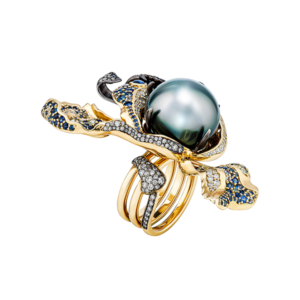
In terms of trends, Eisen sees more yellow gold paired with pearls, colored-stone halos around single pearls, pearl dangles, and layered 16-,18-, and 26-inch strands. Hinged enhancer pendants, which click onto an existing strand, also are steady sellers at her stores.
Every pearl customer gets a lesson in how to take care of them. Hairspray and perfumes are to be avoided. Unlike a chipped diamond, a pearl can’t be recut. “When the nacre of a pearl is damaged, it cannot be fixed,” Eisen says.
Everyday Pearls, Explained
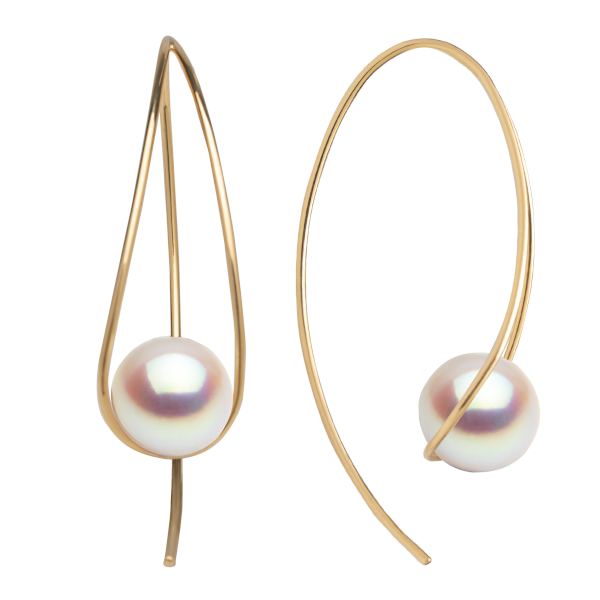
At Miseki Jewelry in San Francisco’s Japantown, founded in 1967, Japanese akoya pearls are “by far our fastest-moving pearl category,” says co-owner and designer Asuka Saito.
Classic akoya strands and single-pearl studs lead, followed by understated pendants, earrings, and a growing number of pearl rings, often set in gold or silver with a touch of diamonds.
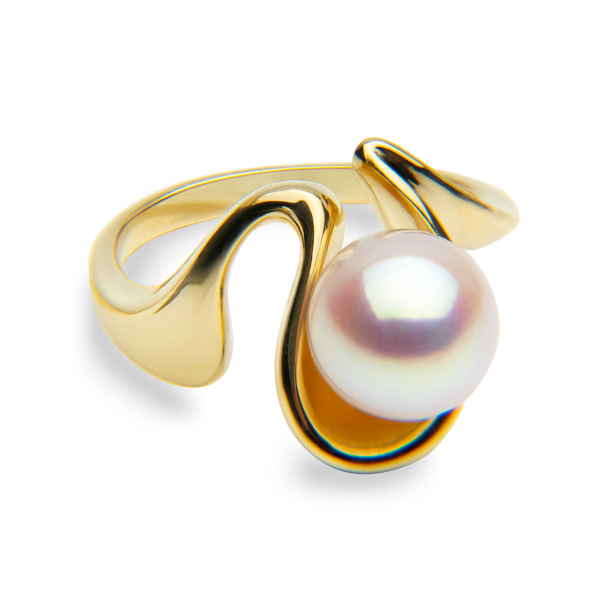
She says customers are shifting when they’re wearing them.
“Pearls are becoming less about saving them for a special occasion and more about using them as a finishing touch,” Saito says.
Inside the store, Miseki plays a video that shows how akoya pearls are cultivated on farms in Japan, which Saito has visited. Once customers see the time and skill involved, she says the conversation shifts away solely from price and moves toward actual value.
Miseki’s buyers are getting younger, and more men are buying pearls for themselves. “What is especially interesting about younger customers is how much they want to learn before they buy,” Saito says.
Younger customers are walking in, asking about origin, quality, the cultivation of pearls, and what makes one pearl different from another.
Her retail price ranges: about $150–$300 for freshwater pieces, $500–$1,500 for akoya gifts such as pendants and earrings, and $2,000–$5,000 for a fine akoya strand.
The Quest for Pearls Fit for High Jewelry
Anne Baker started working with pearls around 2019. Nearly seven years later, the New York City–based designer’s business has shifted toward bespoke work for private clients.
“I’m at a different place than I thought I’d be when I started,” Baker says. “My background is in design, and when I started, I thought perhaps I didn’t have as much experience in gems and high jewelry.”
Her clients, she says, increasingly have been asking for special pieces rather than price-focused pieces.
“It’s kind of the reverse of what I thought, and I’m delighted,” she says.
When designing pearl jewelry, she usually starts with the pearls and designs around them.
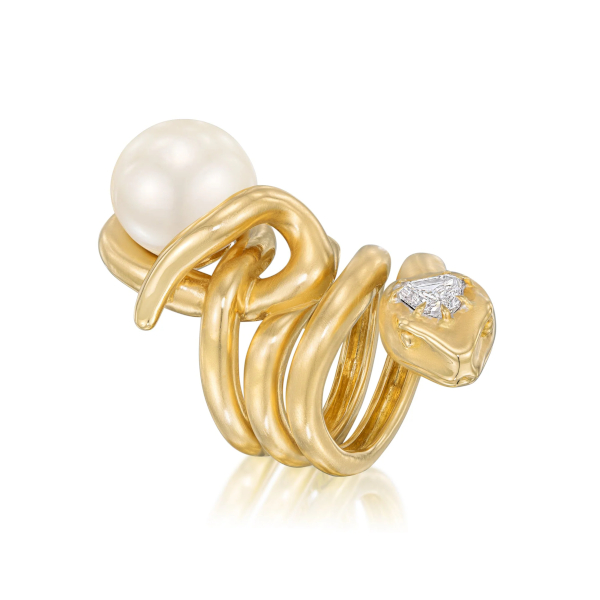
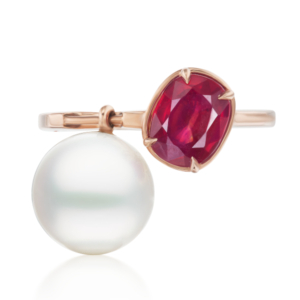
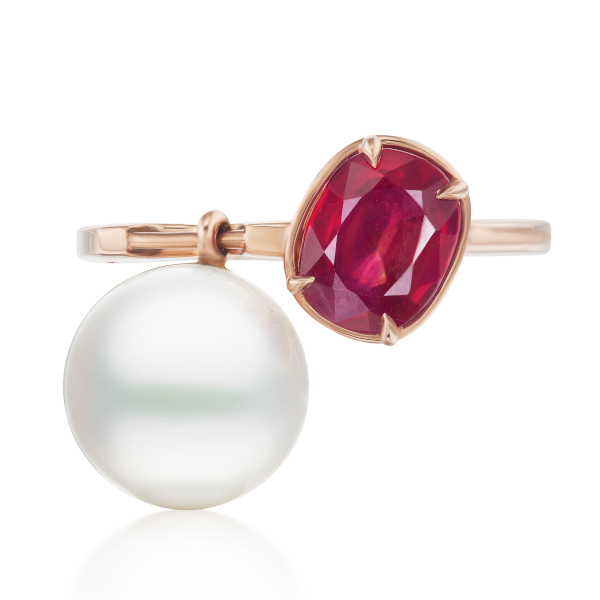
She pairs pearls with diamonds, rubies, and other stones for contrast. “A diamond reflects light; a great pearl seems to hold it.”
“The pearl market may be broad, but the top of the quality pyramid is very narrow,” she says. “Finding one extraordinary pearl is difficult, and finding a twin can be much harder.”
Past a point, Baker says, “the search becomes less about the specifications and more about finding the pearl of character.”
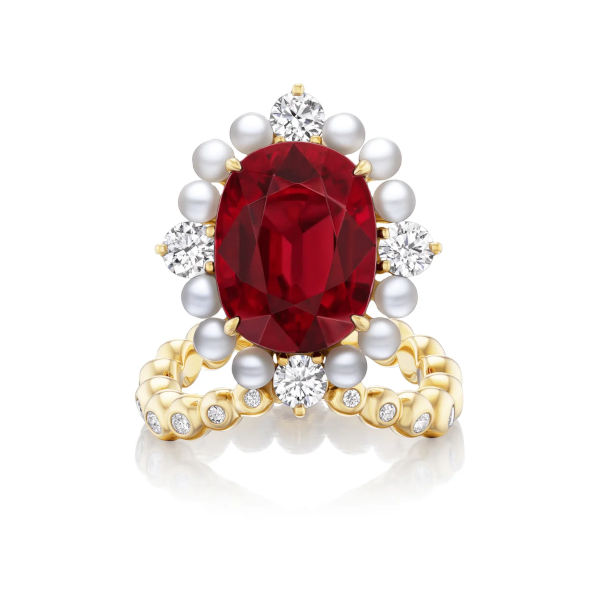
Most of her pieces are made in Manhattan workshops.
She’s candid about the drawbacks. “Pearls are not very durable. It’s not good to sweat in [them],” she says. “I do also think that’s a barrier, with our active modern lives.”
Still, clients are growing comfortable with asymmetry and mixed sizes. “It’s more about personality,” she says.
Pearls as Teaching Tools
At an estate sale, Eisen paid $18 for a small, framed display showing the stages of maturation of a pearl oyster from 1 month to 2 years old. She has used it as a real-life diagram for customers ever since.
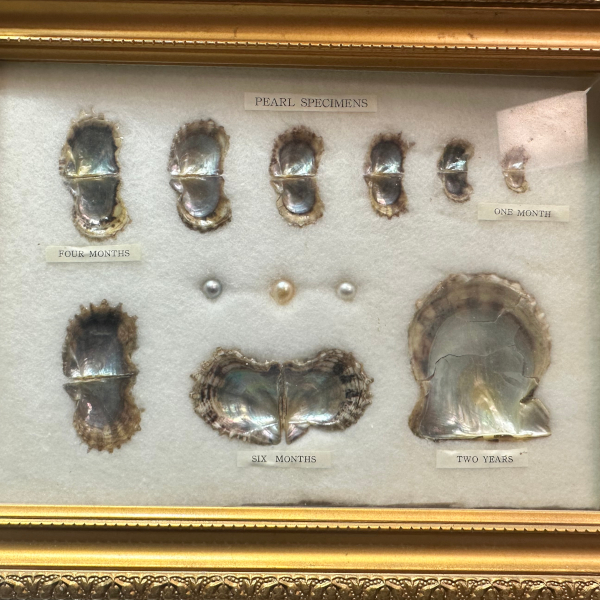
“You have to be able to tell them where it’s made, the color, and all these things,” she says. “If you’re not knowledgeable about it, it’s much more difficult to sell them.”
Top: Anne Baker’s Moi and Toi Rolling Ring sets a 2.8 ct. ruby against an 11.8 mm South Sea pearl ($8,600). Against harder stones, Baker says, a pearl “is so beautifully creamy, and it creates such a nice contrast.”
- Subscribe to the JCK News Daily
- Subscribe to the JCK Special Report
- Follow JCK on Instagram: @jckmagazine
- Follow JCK on X: @jckmagazine
- Follow JCK on Facebook: @jckmagazine