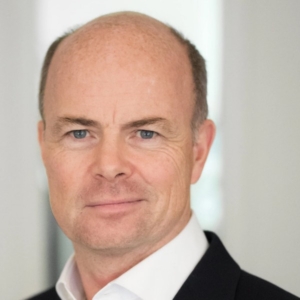
David Kellie stepped down as CEO of the Natural Diamond Council (NDC) at the end of 2025, capping six years helming the group.
In this frank interview, Kellie discusses some of the challenges he encountered during his tenure, including a sudden and dramatic drop in funding, industry “fiefdoms,” lab-grown diamonds, and dealing with a trade where everyone has an opinion. He also gives his view of what the natural diamond industry must do to move forward.
I remember when you took over the NDC. Anything surprise you as far as how things worked out?
When I started at the NDC, we wanted a content and social media strategy [that would be] more editorial in style, with new ways of investing in media—as opposed to a campaign strategy, which is how the industry has done things traditionally.
What we didn’t anticipate was the challenges from within the industry, and the real lack of focus and recognition of what is required to make a successful market. When I joined, I thought there was a clear vision from our member companies. But that became a big disappointment, because I was taking so much time trying to reinforce and convince people of what I thought was an obvious vision.
What were the particular issues?
The prosperity of the industry has always been [tied to] consumer demand for diamonds. I think the industry is aligned on that. But with all the other huge business challenges that have come up, there was just not the focus on the singular challenge of consumer demand that would make this industry prosperous. People became focused on their own fiefdoms and the politics within their stakeholders. And that continues to damage the industry.
What do you mean by “fiefdoms”?
The challenge is [to promote] the whole market. I understand that people compete within the value chain. But the reality is, diamonds are a component part of jewelry. Nobody has really proven that you can brand diamonds in a specific way—meaning in a country-specific way, or any other specific. Diamonds themselves are a brand with their own values. And yet people keep trying to create a brand for their own subset. And that’s holding the market back, sadly.
So you’re saying that diamond “brands” were the problem? And you think origin-specific ones are unproven?
The consumer has never shown any propensity to put a value on the country of origin of a gemstone or any other natural resource. Even though that is fact, people still think they can buck that trend and do something for themselves. It just takes away from the focus on what the industry needs to do.

Let’s go through your years at NDC. Right before you came on board, lab-grown diamonds began to take off. Why do you think that sector grew so much?
My belief is that was initially driven by retailers and the high margins they were making. Consumers weren’t walking into a store in 2020 and 2021 saying, Can I have a lab-grown diamond? Retailers were very much pushing them.
Everyone understood that since synthetics are a technological product, that what would happen in terms of pricing, they would eventually hit rock-bottom. But many retailers weren’t interested in the long-term consequences for the industry and themselves.
It’s not a coincidence that lab-grown diamonds are really only a U.S. market. In other regions of the world, long-term value still appeals to them. But the idea of being showy and wanting to say, “I’ve got a big stone on my finger” without the transparency that the stone is man-made—that is unique to the U.S.
From a trade point of view, a lot of entities were working with lab-grown diamonds as well as natural diamonds. It became a very difficult pitch with the consumer press when so many people in the industry—De Beers, GIA, major manufacturers—were working with lab-grown diamonds. All those entities gave the sense that lab-grown diamonds were now an established product, rather than something sitting outside the true market.
You mentioned the higher retail margins. A lot of people have expected them to go down by now.
The retail margins on lab-growns remain very high. The challenge is that price competitiveness is related to the frequency with which we make purchases. There are commodities that we purchase weekly and we shop around. We know what the good prices are.
With goods that are bought infrequently, it takes much longer for the consumer to be aware of true prices. We all know what’s eventually going to happen and that lab-grown prices will eventually get down to fair retail margins. The big unknown is how long that will take, given the lack of purchase frequency by consumers.
Some have argued the NDC should take a more aggressive approach against lab-growns. How do you feel about that?
When I came in, we changed the group’s name to Natural Diamond Council, before the word natural had gotten into the vernacular. We figured we would need an adjective there.
We have all the research on how consumers react on social media. You can talk honestly about the difference between natural diamonds versus lab-grown diamonds. There’s no negative reaction when it’s data-driven or factual. Those messages land with consumers. They find them interesting and relevant and useful.
So you can compare natural versus lab-grown diamonds, but it’s the tone with which you speak about them. If you become derogatory in any way, people either switch off or they push back at you.
Many lab-grown companies are derogatory toward natural diamonds. What has your research shown you?
My sense, from reading social media, is that maybe in 2021, 2022, 2023, lab-grown diamonds were perceived as more “ethical” than natural diamonds, for all the wrong reasons. That was very much because the American lab-grown diamond producers were pushing that message.
Now, that really doesn’t come up in the research. There’s a much better understanding that lab-grown diamonds aren’t as green as they were once pretending to be, and that natural diamonds have strong arguments as far as their own sustainability values.
But even in 2022, I think that was more of a justification. I don’t think that consumers were buying them for that reason—but having bought a lab-grown diamond, it was a nice narrative to say I bought it for these perceived ethical values.
I also think there’s a much more honest narrative in the consumer press now. There was a time when the press was repeating the line that the lab-grown diamond producers were pushing on them. And we did a lot of work to try and bring awareness to the real values of natural diamonds and what they actually mean. We were actively chasing down journalists and saying, “You are repeating false narratives.”
And I think that’s made an impact. For the last year or two, the consumer is making their own decisions for more honest reasons. And that’s fair enough.
Anything else you want to say about lab-grown?
It still makes me angry and frustrated what was done by the lab-grown diamond industry to falsely position lab-grown diamonds [as more ethical]. Most of those companies are no longer in existence. They were just in it for the short term to make a fast buck on behalf of their shareholders, with no real care for the impact that it had on those less privileged than we are.
When you see the impact on southern Africa from the current market climate, it’s unforgivable, given it was created by people who don’t care about people who are in a far less fortunate position. Their motivation was pure greed.
In 2022, following Russia’s invasion of Ukraine, Alrosa pulled its funding from the NDC. How did that affect the organization?
Clearly, the Natural Diamond Council was stronger when you’ve got more than one key player. We are a council, and we are there to represent the industry, and therefore the more broad the representation, the better.
The combination of Alrosa’s withdrawal and De Beers’ choice to invest more in their own marketing hugely reduced our budgets, by 80%. We couldn’t have anything like the impact we could and should have had with that huge reduction in the budget.
How do you think that affected the industry?
It’s impossible to put a weighting on it. But if we look at the market over the last five or six years, the market was booming when we had a significant budget that was properly spent on content and social media and being in people’s feeds and creating buzz around natural diamonds. And when that was taken away, the market hit much rockier times. Now there were other socioeconomic and cultural things going on, but I can’t believe that the lack of marketing investment in the right ways didn’t have a significant impact on the industry. It could be a coincidence, but I don’t think so.
What do you think of the argument that if De Beers is the primary funder, you don’t need an NDC?
It sounds like semantics, but the voice of the NDC is different from De Beers’. The NDC is a not-for-profit, which means that you have a different relationship with the press and with all sorts of organizations, because you’re seen as a more independent industrywide organization, as opposed to a single commercial entity that is pushing their own specific narrative.
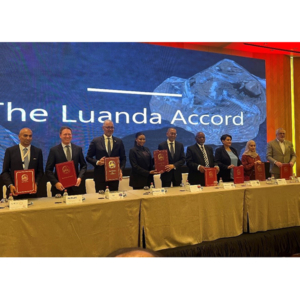
You have tried to diversify funding, with the Luanda Accord.
The Angolan deal should be done soon, and that should bring in far more funding for the NDC this year, as should the deal with Botswana. Now that there is greater representation for a broader part of the industry, the NDC’s in a healthier position than it has been over the last two years.
You have been thinking about diamonds for years. What do people not understand about marketing them?
When I speak at conferences, everyone has an opinion as to how we should be promoting natural diamonds. And I say: Look, even the CEO of the NDC doesn’t make the decision as to what the NDC is promoting. Because it’s all driven by what the consumer is engaging with and relating to.
And that changes much more quickly than people think. It’s not like the days of doing print advertising, when you developed a print ad for six months and then it ran for six months. That was a 12-month cycle. Now these cycles are almost daily.
That’s the reality of what marketing is these days: It’s about staying incredibly close to consumers and understanding what they think is cool and what they think is relevant. It’s about being connected to culture, but culture is constantly changing. Even things like sustainability. Three years ago, it was the hottest topic. That’s massively changed over the last few years. Today, it’s less talked about, less engaged with. As an industry, we have to make sure that our voice is in step with the culture. It’s very nuanced but incredibly critical.
Yet some people do still care about things like sustainability. And you have noted that different messages work with different groups.
That’s the beauty of social media. The algorithms will put into people’s feeds what they want to see. But the idea of anyone suggesting what a campaign should be is, frankly, daft.
So there will be less overarching “A Diamond Is Forever”–type campaigns?
Ten years ago, everybody could have visualized what the big luxury brands’ seasonal campaigns would be, whereas today, none of us see those campaigns. Maybe if we’re going through a major airport, we’ll see a traditional campaign. But that’s just not the way people are consuming media anymore. We’re all on our phones, looking at social media.
That’s not easy to communicate to an industry. You’re not saying: Here’s our image of the new campaign. But even though the NDC’s efforts weren’t visible, the results we were getting were phenomenal. I’m proud of that, but it’s pride mixed with disappointment, because, with Alrosa pulling out, we weren’t able to carry on.
Any final thoughts to share about the diamond business?
What the industry demonstrated in the pandemic was, when forced, it could be incredibly nimble, spontaneous, and make things happen. Everyone was fighting for their own business, and it really became dynamic, in a way that was then out of character.
I don’t know if that dynamism has continued. The industry seems to have fallen back to type since the pandemic. But the markets and consumers remain very dynamic, and the industry has to find a way to be more nimble.
This is an incredible industry. It’s also a very traditional industry. In some cases, that’s its strength, and in some cases, that’s its weakness. Identifying when it’s a good thing to have traditional values and when it’s time to change and be more dynamic will ultimately determine its future destiny.
(Photos courtesy of the Natural Diamond Council)
- Subscribe to the JCK News Daily
- Subscribe to the JCK Special Report
- Follow JCK on Instagram: @jckmagazine
- Follow JCK on X: @jckmagazine
- Follow JCK on Facebook: @jckmagazine