Most American jewelers still picture Chinese freshwater pearls as tabletop goods: off-round, creamy, cheap, and sold by the kilo in heaping piles at trade shows.
In China’s pearl hubs, however, farmers are taking things to a whole new level: growing pearls in sensor-monitored ponds, altering their elevation with water pressure, and bioengineering mussels to produce intense colors.
A new Gems & Gemology study, published this summer by GIA, documents that overhaul, tracing how China rebuilt its freshwater pearl industry after environmental bans cut output by more than 90% between 2006 and 2020. The higher-end goods it describes have barely reached U.S. retail counters, according to Eric Yen, a second-generation pearl wholesaler based in San Francisco, Calif.
“I want people to know, or at least erase, what they have in their mind about freshwater pearls,” Yen says.
“Made in China”
For decades, the “Made In China” label has signaled cheapness to American consumers, whatever the product. Chinese freshwater pearls are no exception, Yen says. They have long been seen as lesser than South Sea or Japanese akoya pearls, and the trade’s own vocabulary reinforced it: Freshwaters were called “potato pearls” or “rice pearls,” he notes, “because they’re not round.”
Adds Yen: “I would say 90% of people haven’t seen the new products yet.”
The study, published by GIA (but conducted by five researchers at China University of Geosciences, Wuhan) traces the industry’s rise, crackdown, and rebuild. Output peaked at 5,265 tonnes in 2006, according to the report, after decades of yield-driven farming that left lakes polluted. In 2007, Chinese provincial governments banned culturing in natural lakes, reservoirs, and drinking-water sources. By 2020, national production of freshwater pearls had fallen to 454 tonnes—just 9% of its peak—before rebounding to about 1,125 tonnes in 2024.
The authors describe an industry stuck in a “volume-driven growth trap,” marked by high output and low profitability—a race to the bottom, as some in the pearl trade would call it.
The comeback, according to the authors, was built on new farming methods. In “smart biocycle” ponds, mussels are fed nutrient solutions via an elaborate piping system, something akin to how medical personnel intravenously administer nutrients to patients in hospitals. Closed greenhouses can grow 9 mm to 13 mm Edison-type pearls in about a year and a half, versus three to five years. (Edison pearls, cultured freshwater pearls pioneered in China, are known for their unusually vivid coloration.)
Yen, who has dealt in these pearls long before the pandemic and visited the Shanxiahu pearl hub in Zhejiang, China, in 2025, says the technology is real. “They drill a hole, they put a feeding tube there, they have chips underwater that monitor the pH level, the water temperature,” he says.
The People’s Pearls
Chinese government support surely has played a role.
“It’s part of their green initiative, because they want to keep the water clean,” Yen says.
During Yen’s visit, Shanxiahu showcased AI grading and drilling systems, and a provincial official pledged better rail links to Zhuji, the city at the center of China’s freshwater pearl trade. Plans for a suburban rail line connecting Zhuji to Hangzhou’s metro have been in the works since at least 2023
“Being the government they are, having the money that they have and the people, they can provide,” Yen says.
Domestic pearl demand can move fast. In a market China’s size, Yen says, “you only need 1% or 2% of the people wanting that certain item” to start a trend. During pandemic lockdowns, much of that buying moved to WeChat livestreams; the study reports that online sales in Shanxiahu rose from 13% of total sales in 2017 to 63% in 2022.
Purple Majesty
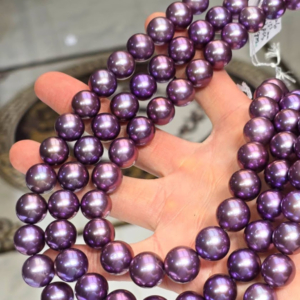
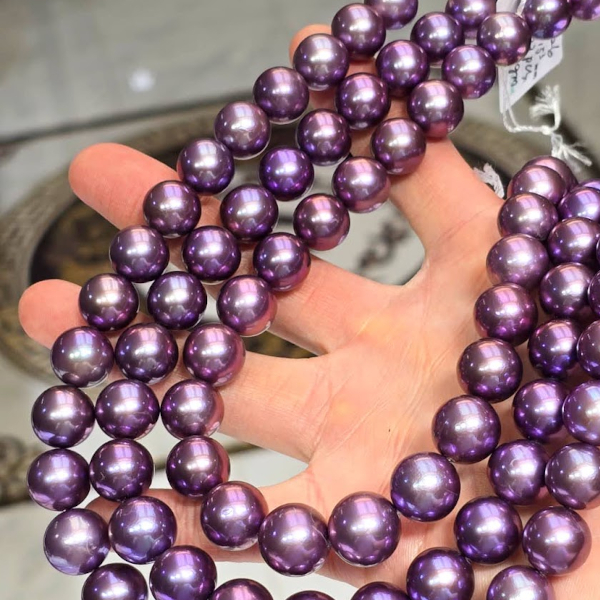
The study describes mussel-breeding programs, including one called “Shen Zi No. 1,” that yields purple pearls at a reported rate of 97.2%.
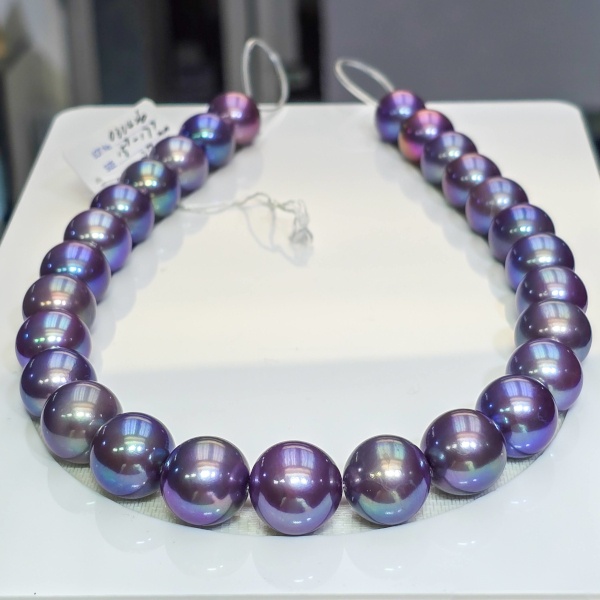
Those are the goods Yen wants U.S. buyers to see. Traditional pastels—such as light pink, peach, orangey tones—are all “old,” he claims.
“The intense purples, the purple with metallic overtones, the purple with bronze, the purple with copper—that’s all new.”
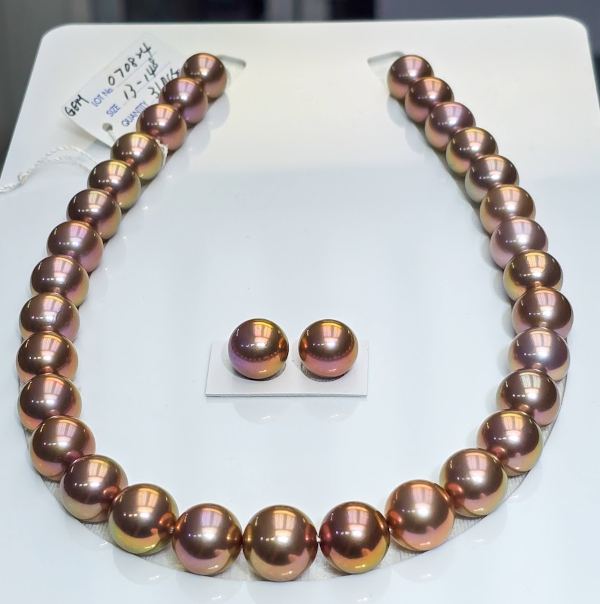
He has carried them since before 2020, but to most consumers and many retailers, they are “very, very new.”
The Pearl Nomenclature War
China’s emerging high-quality freshwater pearls have also spurred a naming and nomenclature war in the pearl industry. It’s similar to what can be seen in the diamond trade, as organizations battle each other in public about rivaling terminologies to describe manmade diamonds: lab-grown or synthetic.
The study flags freshwater akoya as a misnomer used by some producers to describe small, round, high-luster freshwater pearls. True akoya come only from a saltwater oyster, not a mussel.
Yen raised the issue early. In an April 2024 article for AGTA, he warned that “the inherent value of saltwater pearls is a minimum of two-thirds greater than freshwater pearls,” and that such pearls should be properly disclosed to consumers. His company also published a buyer’s guide on terminology.
GIA followed up in January with an article calling the freshwater akoya term misleading: “Using the term akoya for freshwater pearls creates confusion for buyers and undermines transparency in the trade.”
Supply & Demand
After the pandemic, the study reports, ordinary freshwater wholesale prices rose 30% to 50%. Prices on high-quality pearls, it suggests, rose about 80%. But “starting in 2024, the surge in supply coincided with a decline in demand,” the authors write, “placing significant downward pressure on both the volume and price of ordinary pearls.”
Yen sees the same thing as a wholesaler. Commercial goods in recent years have remained “flat or they’re going down,” he says. “There’s more competition, there’s always more production.”
Finer goods—very round, closely matched 13 mm–15 mm Edison strands in intense colors—“are always harder to find.”
Yen says prices follow trends in demand more than farming or production. Policy changes are felt more “at the producer level, not really the wholesaler level.”
He says small Edison pearls were once expensive and hard to produce, until every farmer chased them. The few early players were able to capitalize on the price discrepancy for a short window of time, before the market corrected itself.
“Then you’re going to have overproduction at some point,” he says. “And then the price goes down.”
For the higher-quality products, Yen says there’s a knowledge gap in America. He blames it mostly on presentation and exposure.
“A lot of people don’t display freshwater pearls inside a jewelry case,” Yen says.
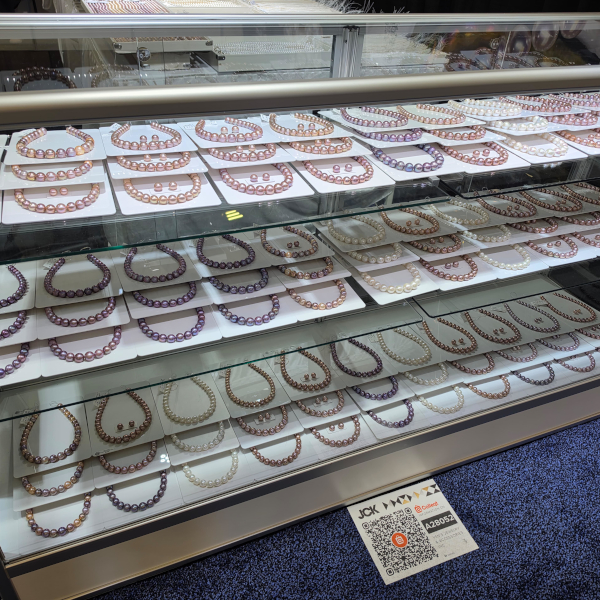
At Tucson and JCK Las Vegas, his company shows quality Edison pearls in a well-lit fine jewelry showcase, while much of the market still treats freshwater pearls as inventory that should be sprawled across a scale and sold by the kilo for a sweetheart keystone deal.
Many independent stores buy once a year at a single U.S. show, he adds, and “have no idea what is going on.”
Chinese gem labs are already writing new color classifications into their gemological certificates. Guild Gem Laboratories, which grades pearls in Zhuji and Los Angeles, issues reports carrying a trade name for top purple freshwaters: Ultra Violet.
One recent Guild report describes a pair of 15.5 mm round freshwater bead-cultured pearls as “Ultra Violet: Vivid Purple,” natural color, with nearly 4.5 mm of nacre, graded “Noble.”
“If you see purple as a base color, they want people to understand that this is freshwater, and this is coming out of China.”
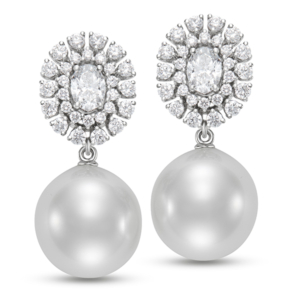
Top: Amethyst Purple freshwater pearl strands farmed in China and made available by wholesalers such as Yen’s Jewelry (photos courtesy of Yen’s Jewelry)
- Subscribe to the JCK News Daily
- Subscribe to the JCK Special Report
- Follow JCK on Instagram: @jckmagazine
- Follow JCK on X: @jckmagazine
- Follow JCK on Facebook: @jckmagazine