
Archaeologists got the best reputation of all time thanks to movie hero Indiana Jones—and Laki Tasatzis knows that’s what most people think of when he tells them that was his first career.
The Enea Studio designer lasted six months in the profession before he made his way back to jewelry. But those lessons from working in the field and finding magic beneath the ground continue to play out in his jewelry business.
He studied classical archaeology at the National and Kapodistrian University of Athens, which is the top university in Greece for archaeology. After graduating in 2012, Tasatzis went to an excavation below the Acropolis.
“Every archaeologist is given a grid square, one piece of ground, and that square is yours. Nothing about it is fast. You remove one centimeter of soil at a time, spread it out in a large frame and go through it by hand for fragments: pottery, coins, anything,” Tasatzis says. “Then the same soil goes through a sieve, and whatever the sieve catches gets sorted and classified. Nothing is thrown away—not even the soil that passed through the sieve. You work as if the archaeologist who comes after you, with better tools than yours, will need to go back and check everything you did.
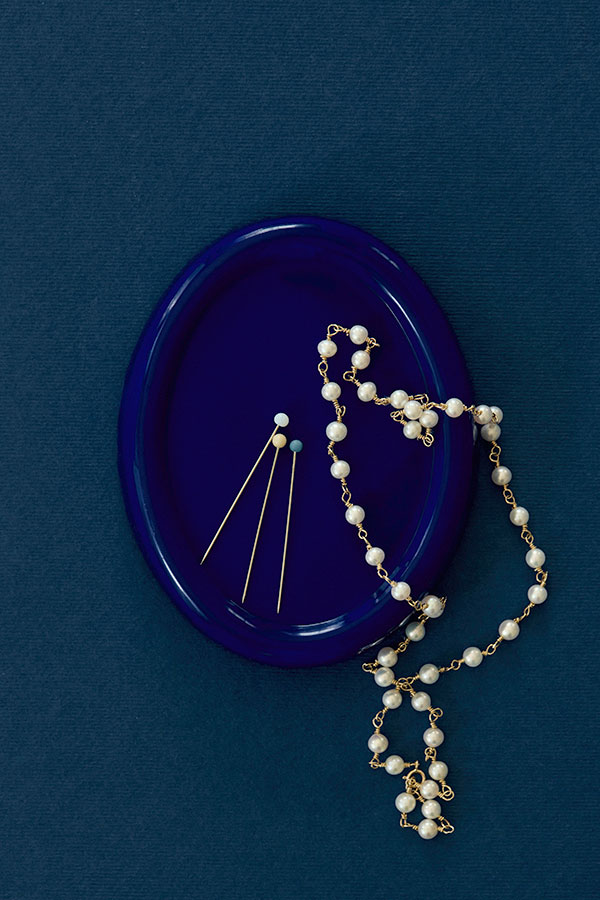
“What it taught me was patience, attention to detail, and to work as if someone in the future is going to depend on what I do today,” he says. “That is exactly what I do now in goldsmithing. A piece we make has to be right for the person who repairs it in 30 years, not just for the person who buys it.”
After the excavation, his family’s workshop needed hands, and he went back to the bench. He learned the trade the way it is learned in a family workshop, one job at a time: design, casting, filing and sanding, polishing, diamond setting, and how to judge a diamond.
“Nobody hands you a title. You do the job until your father stops checking it,” he says.
Tasatzis’ grandfather opened the family’s workshop in 1953 as a chain maker. A chain is one of the hardest things to make by hand, he says. It has hundreds of identical links, each one soldered, and a single bad joint ruins the whole chain. His father took over from him, and now he and his brother Dimitris are the third generation.
“My first jewelry memory is from when I was 4 or 5. The smell of the fire in the workshop, and the tick-tack, tick-tack of the chain machines. And one machine I could not stop watching—we call it the diamantiera, the diamond-cutting lathe,” he says. “The chain is wound onto it and packed in ice so it stays rigid, and a spindle with a diamond at the tip runs along the chain and cuts the facets that make a chain sparkle. A child sees ice, fire, and a diamond cutting gold in the same room. I did not understand what any of it was for, but I knew I wanted to be in that room.”
Tasatzis admits when he left archaeology he thought he would stay with his family’s business for a year. He’s still in jewelry—but in a different way, and that’s because of the pandemic and the birth of his first child.

“For decades the family made pieces for other people, for jewelers and brands who put their own name on our work. Then COVID hit in 2020 and wholesale stopped almost overnight. The shops closed, the orders stopped, and we had a workshop full of skill and nobody to make for,” he says. “That was the turning point. Instead of waiting for the phone to ring, we went online in 2021 and started selling directly to the end customer for the first time in the family’s history, at first under a different name.
His son, Niko, was born on January 9, 2022, at 1:19 in the morning. Nine on the date, nine on the clock. In numerology, 9 stands for completion, universal love, and humanitarianism. His jewelry brand’s name, Enea, comes from ennea, the Greek word for nine.
“So I renamed the brand to carry his number and launched our website. Every piece we make under that name is, in a way, for him,” Tasatzis says.
His jewelry philosophy is simple: He makes pieces to last a lifetime, and then the next one. Everything Enea sells is solid recycled gold, 10k or 14k, made by hand in his workshop in Athens.
“And because we make it, we stand behind it: Any piece we have ever made, we will service and restring for as long as it exists. For a three-generation workshop that is not a slogan, it is the job,” Tasatzis says. “Pan metron ariston. Everything in the right measure. The ancient Greeks built a temple out of a few straight lines and got proportion so right that we are still copying it 2,500 years later. That is what I am after. Simplicity, harmony, good taste, and not one gram of gold more than the piece needs.”
(Photos courtesy of Enea Studio)
- Subscribe to the JCK News Daily
- Subscribe to the JCK Special Report
- Follow JCK on Instagram: @jckmagazine
- Follow JCK on X: @jckmagazine
- Follow JCK on Facebook: @jckmagazine