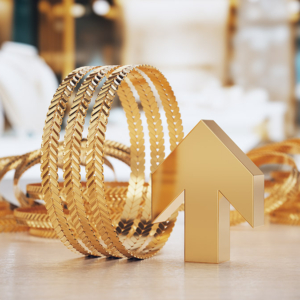
The spot price of gold fell below $4,000 per ounce on Wednesday, dropping to a new low for 2026 and leading at least one firm to lower its price forecast for the second half of the year.
Gold was at $3,965.20—its low for the year—in early trading on Wednesday. At JCK’s press time, it was trading at 4,027.10. The spot price had hit an all-time high of $5,594.82 on Jan. 28.
ING commodities strategist Ewa Manthey shared a report with JCK that said ING now sees gold prices averaging $4,300 per ounce for the third quarter and $4,600 an ounce in the fourth quarter. The financial services firm previously forecast $4,850 for the third quarter and $5,000 for the fourth quarter.
“While we remain constructive on gold over the medium term, the near-term environment has become more challenging. As a result, we are lowering our gold price forecasts,” Manthey wrote on an ING website Wednesday.
She said the main reason gold prices have declined in recent weeks has been “a significant repricing of interest-rate expectations.”
According to Manthey, “Following recent Fed communication, investors have pushed back expectations for monetary easing, driving Treasury yields higher and supporting the U.S. dollar. This has created a less favorable backdrop for gold, which typically struggles when real yields rise and the dollar strengthens.
“At the same time, geopolitical tensions have failed to generate the type of safe-haven inflows seen during previous periods of uncertainty. Instead, markets have focused on the inflationary implications of geopolitical developments and what they could mean for monetary policy.”
Silver prices also fell on Wednesday, to $58.15 as of press time, down 5.39% in trading. Kitco, which reports on the precious metals market, said that gold and silver are both under “heavy pressure” because “a stronger U.S. dollar, renewed Fed-rate repricing and easing oil-supply fears continue to weigh against haven demand.”
ING also lowered its forecast on silver. Manthey said silver will average $68 an ounce in the third quarter and $74 in the fourth quarter, down from ING’s previous forecasts of $79 and $84, respectively.
“While the silver market is expected to remain in deficit, some of the strongest demand drivers are becoming less supportive,” wrote Manthey. “Growth in solar demand is slowing, while continued thrifting and substitution in photovoltaic manufacturing are reducing silver intensity per panel.”
Jewelry marketing strategist Sohail Dewani tells JCK that gold prices have made business exceedingly difficult for jewelry brands in 2026.
Dewani runs Jewelers League, an e-commerce consulting firm, and he says his clients “feel every swing” on gold in real time.
“When gold moves $200 in a week, it changes how they price products, whether customers follow through at checkout, how they quote custom work, and whether their existing inventory is even listed at the right number,” says Dewani. “Gold volatility for an e-commerce jeweler is an operational problem. It hits every product page in the catalog.”
For jewelers, the price swings affect not only their current business but upcoming work and sales, he adds.
“The planning window has collapsed. You used to set prices quarterly. Some of the jewelers I talk to are adjusting weekly now,” Dewani says. “A piece listed on Monday might need repricing by Friday, and most jewelry websites aren’t built for that. You’re either manually updating hundreds of SKUs and missing some or you’re showing visitors a price that no longer reflects what the piece costs to make.”
He is advising jewelry businesses to prepare for continued instability.
“The forces driving gold volatility—geopolitical tension, inflation uncertainty, central bank policy—none of that resolves on a timeline anyone can plan around. And jewelers are about to start Q4 planning,” Dewani says. “Holiday inventory commitments happen over the summer, months before anyone knows where gold will be in November. The jewelers in the strongest position come Q4 will be the ones who built flexibility into pricing now, not the ones who waited for things to settle.”
(Photo courtesy of Getty Images)
- Subscribe to the JCK News Daily
- Subscribe to the JCK Special Report
- Follow JCK on Instagram: @jckmagazine
- Follow JCK on X: @jckmagazine
- Follow JCK on Facebook: @jckmagazine