Hosts Victoria Gomelsky and Rob Bates interview a pair of high jewelry designers who also happen to be sisters: Ofira Sandberg and Lorraine Schwartz. The women share their family’s history going back three generations in the jewelry industry, and tell how they ended up in the business despite their childhood vow not to. Lorraine and Ofira also talk about where they got their keen eye for design and how it helped their star rise as jewelers and led to relationships with several entertainment icons—including Barbra Streisand, Elizabeth Taylor, Beyoncé, and David Bowie. Finally, Ofira reveals what we can look forward to seeing on view during the pair’s first time exhibiting at JCK Luxury.
Watch Now
Title sponsor: De Beers (adiamondisforever.com)
Show Notes
01:50 Lorraine and Ofira’s background
04:10 Lorraine’s entry into the diamond business
08:35 Meeting Barbra Streisand
12:35 Ofira gets encouragement from Pharrell Williams
13:45 What sets them apart in the industry, as women and as designers
15:00 Starting a trend in emerald color
17:50 Lorraine’s first celebrity client
20:25 Working with and befriending Elizabeth Taylor
24:30 A preview of what Ofira will be showing at JCK Luxury
Episode Credits
Hosts: Rob Bates and Victoria Gomelsky
Producer and engineer: Natalie Chomet
Editor: Riley McCaskill
Plugs: @jckmagazine; adiamondisforever.com
Episode Transcript
This transcript has been abridged and edited for clarity.
Victoria:
Hey, everyone, welcome to The Jewelry District…
Rob:
How are you? You seem smiley and good.
Victoria:
I’m smiley and good! We’re thrilled to have Lorraine Schwartz and Ofira Sandberg, some of the best designers in our business. [To Schwartz and Sandberg] One of the reasons we’re talking to you is because we’re going to be seeing you at the Luxury show in Las Vegas in a week.
Ofira:
We’re excited to be here.
Victoria:
First, we want to hear about your origins. Tell us about where you grew up and how you got into jewelry.
Lorraine:
I was born in New York. We’re a third-generation diamond family. Our grandfather started in the business in the ’50s, maybe even earlier, with my great-uncles from Israel. They opened offices together before he moved here. And my mother was born in Israel.
When I was 6 years old, we moved to Israel, and Ofira was born there. My grandfather had separated from my uncles and opened offices around the world. But unfortunately, in the ’80s there was a market downturn because of Japan and the economic bubble, and diamonds dropped from $60,000 to $17,000 for a D flawless. He went through a really hard time.
He was a very respectable man. He was our idol and our role model. Our mother was our biggest idol, but my grandfather was an incredible man. He kept working even though things were hard. His name was everything to him. It wasn’t easy, coming from such a prominent, respected family.
When he went through hard times, you really saw the good and the bad of the industry. We were really young, and we swore that we would never go into this business because of that.
Ofira:
When I was 2, we moved to New York, and we grew up there.
Lorraine:
I was 12 or so when we moved back to New York, and never, ever did we think that we were going to go into this business.
Ofira:
We actually thought the opposite.
Lorraine:
Yes, I was going to go into PR and fine arts. I did a fashion show as a PR project in college and it did really well. So I started doing these fashion shows at clubs in the city and getting paid for them.
It wasn’t until the end of school that my parents said, “Come help us in the office.” It was a hard time. They weren’t the big jewelry company that they used to be, and the industry was rough. They weren’t the nicest to me at the time.
I thought I would help them with clerical work, but the first thing I did was sell a 10 ct. diamond. I gravitated toward that. Then I started to work with diamonds and [was] traveling, selling to stores. I was really a diamond dealer. Ofira was in school still, but she was always around it.
Ofira:
I grew up with diamonds around me.
Lorraine:
Our mom passed away young, at 55. A lot of people in the industry know her. We’re half-Bukharan Jews, from the old-school Bukharans who left their country in the 1920s. Prominent Jewish families were forced to walk to Israel at that time.
Ofira:
So our grandparents at age 3 and 2 walked to Israel.
Victoria:
Put me on the map: Is this Uzbekistan?
Ofira:
Yes, currently it’s Uzbekistan.
Lorraine:
And there’s a lot of people in the industry who are from Uzbekistan. A lot of them left after communism. But our families left when our grandparents were little kids, in 1920. We have that background of that country, of the Middle East, of Israel.
Our mother was such an intellectual—the most elegant woman in the world. Culture was so important to her. She started taking us to museums at 2, 3 years old, and we traveled with her. She was a woman who could wear Armani with wood bangles and diamonds mixed in. She made everything look elegant. We saw her sense of style and her eye.
If anybody asks us what differentiates us, I think it’s an eye. It’s being able to think outside the box, which is really a gift, and we’re so thankful to her for giving that to us because she’s living with us every day through that. Every time we create or somebody wears something of ours…
Ofira:
She’s always in the back of our heads.
Lorraine:
Always—how she would wear it and how she would do it. She really is the reason that we are who we are. She was always the most authentic. So everything we do is about authenticity. Everything we do is about relationships.
And our grandfather, he was like a god to us. Even when he went through a hard time, he kept his stature. I think for me personally, part of my success is being driven by him and rebuilding his name: You made me this strong, you made me realize that I can do anything. But we didn’t think we would do this at first.
Ofira:
I was in television production after college and had a transitional phase in my life where I wasn’t sure where I wanted to go. I started working with Lorraine when she started designing.
Lorraine:
Ofira has always been with me.
Ofira:
That’s how it all grew.
Lorraine:
It was actually Pharrell who pushed Ofira to do her own line.
Ofira:
We met him years ago.
Lorraine:
Yes, I met him 25 years ago. He came up to the office looking for a yellow diamond. He and I were both just starting. I had already started to build a following. Barbra Streisand had just become my client. It was funny—people just found me.
Ofira:
We became very close to him. He bought everything. Lorraine’s so good at education.
Lorraine:
I tell everybody, “Learn, and then come to me. Go see everything.” I educate them because it’s my reputation that’s on the line. It’s very important to us to educate our clients about what we have.
In 2001…I had given Fred Leighton a pink diamond on memo. He [Fred Leighton owner Murray Mondschein] had it for a month, and I said, “Murray, what’s going on with that stone?” He said, “I’m sorry it’s taking so long. The client is coming Thursday, and she wants to meet you.” This was Monday. I thought, “She wants to meet me? I just gave you the stone on memo. Why?”
The next thing I know, I’m going to Barbra’s apartment in the city with Murray, which was so weird. It just happened. My mother or someone was watching over us, and Barbra bought the diamond.
Two weeks later, I got a call: “Hello, Lorraine. It’s Barbra.” I’m thinking, Barbara who? She says, “Barbra Streisand. Murray gave me your number.” She hounded him to get my number and to go to me directly. And then she became our client.
Right after that, Pharrell came. We both grew together. There is a correlation when you are producing music and designing jewelry. There’s something in the frequency, I feel, that really comes together. We learned a lot together. He’s been so important in our lives. Ofira and he became best friends. He really pushed her to do her own line. And he wore her bracelets for years.
Ofira:
He literally took them off my hand one day and said, “I need to buy these. I need to wear them.”
Lorraine:
And he wore seven of them on his hand. They’re documented in so many videos. When Ofira started her line, it was really complementary to mine. I started with bangles and hoops and dangles, but as I grew, I had to elevate my jewelry because I was doing something at a time when nobody did. People were wearing deco jewelry then, and I wanted cooler stuff that I could have made. So that’s what I built. I wanted an “against evil eye” that wasn’t fake. I wanted it made from natural topaz and diamonds. So those are the things, along with my stone knowledge, that got me started.
But as I got to meet more people—royal families who needed sets—I needed to elevate, so my stuff became much higher jewelry, whereas Ofira’s stuff was great for every day. When a client came to me, they’d always end up with three, four pieces from Ofira because it was complementary to my style and it was jewelry they could wear all the time. She really built an incredible business within my business—it’s part of the brand, but her own designs.
Ofira:
The first thing I made was a diamond toe ring.
Lorraine:
Yeah, for Beyoncé.
Ofira:
Then I made anklets and body chains. One thing led to another. And that’s when Lorraine and Pharrell really pushed me to go and do a lot.
Lorraine:
Every one of my celebs wears her jewelry. People don’t know this, but Taylor Swift has worn a lot of her stuff on the carpet into Grammys. Beyoncé’s worn it so many important times. And Blake Lively. It’s just not as known [that celebrities are wearing Ofira’s jewelry] because people right away credit me for it. But she’s been huge.
Ofira:
There’s times when we do things together. We’re collaborative.
Lorraine:
Oh, we have some very famous pieces.
Victoria:
How would you describe your design philosophies? Do you ever clash when it comes to that or feel like you have a different point of view?
Lorraine:
We think very much the same. We’re sisters, we’re best friends. We have the same friends mostly.
Ofira:
We’re together, we work together.
Lorraine:
Her daughter is the love of my life. Our whole family is very close.
Rob:
When you started, I’m assuming there weren’t that many women in the business. Was that something that you had to deal with?
Lorraine:
It was hard. But I liked the challenge. First, I’m tough. And second, I’m American Israeli. It was hard not only being a woman but coming from a family that was so successful that had lost money. People were not the nicest at the time. It’s only something that I can talk about now, because while you’re in it, you don’t want to ever discuss that. You’re going forward.
Ofira:
I think also as a woman, we have an eye for things that most men don’t.
Lorraine:
100%. And not only do we have an eye, but we also make sure that the stones that we use are really beautiful. We won’t buy a deep stone because we don’t want to see all the weight on the bottom. Our clients really appreciate that. Because of our aesthetics, we love certain stones that maybe a regular person wouldn’t like. So we’ve made portrait cuts and rose cuts very popular.
Ofira:
Things that you might consider off-shape.
Lorraine:
I love off-shape. I love a triangle. I love a nude color. We’ve made the nude color popular because all our clients love them; They’re so understated and chic.
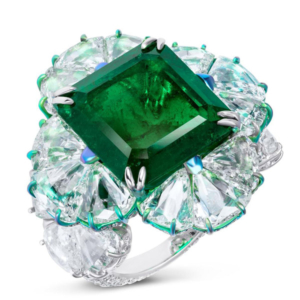
We changed the color of emeralds that people want. In 2009, people were wearing really dark emeralds. We did a fitting with Angelina Jolie and had her try on so many. I said, “No diamonds, just emeralds.” The exact color just pops. It’s so bright. It’s so beautiful. You don’t need diamonds around it. And it makes your face pop when you wear that color. And it changed the market.
Ofira:
I remember going to trade shows afterward and people were saying, “Oh my God, what you did for emeralds, what you did for emeralds for us.”
Victoria:
Side note about those giant pear-shape earrings Angelina Jolie wore: I did a piece for the International Herald Tribune, I think around 2009 or ’10, citing those earrings as a pivot point.
Lorraine:
They changed the color people wanted: the Colombian and the bright. I don’t understand why people were buying darker ones before. You would go out at night and it would look black.
Ofira:
If you didn’t have diamonds, you couldn’t wear it. You wouldn’t see it.
Lorraine:
Two days ago, Isha Ambani wore the ring that Angelina Jolie wore that night, but as a necklace with her own jewelry. She asked me what I would do to add something to it. We made that choker, and it was amazing. That’s a special stone.
We love when people see something unique and it builds momentum. We love paraibas, padparadschas, nude-color diamonds, portrait cuts, unique shapes, because we want our clients to feel like they have something extraordinary. Not what everybody else has. Special.
Sponsor message:
This podcast is brought to you by De Beers. It’s not every day a bridal offering reflects love the way Desert Diamonds do. Both are completely natural. Both take time to form. And no two are ever alike. That’s what makes these rings mean so much more. From sunlit whites to golden-hour champagnes and sunrise blushes, colors as natural as love itself. This year introduce your bridal clients to Desert Diamonds. A diamond is forever. Visit adiamondisforever.com to learn more.
Rob:
Was Barbra Streisand the first celebrity you worked with?
Lorraine:
She wasn’t. Before I had my jewelry in 1994, I had a client who had bought a diamond. She called me one day and said, “I have a really good friend I want to introduce you to. She’s looking for a diamond. Her fiancé wants to buy her one.” And it was David Bowie and Iman.
Iman came to get an idea of what she liked. Then I went to meet David. I had never worked with a celebrity yet. I’m going down the steps to his studio, and of course I trip on the step and fall right on top of him. He’s so charming. He could not have been nicer. We sat in his little salon there for like an hour talking. He bought the diamond and invited us to his concert.
We made all the jewelry for Iman’s wedding [to Bowie]. They invited me to it. At that point, I didn’t understand the celebrity world. I didn’t go. And I didn’t ask for any press. I didn’t want to take the privilege of having made these pieces and use it for my own personal gain at the time. As time passed, like in 2001, when everything really started, I realized that they actually want you to talk about it. But that was my first. Then Barbra was my second celebrity.
Rob:
Those are big names to start with, I’ll tell you.
Lorraine:
We only talk about celebrities who want us to. We’ll never divulge anything they feel is personal. We know when somebody’s getting married, when somebody’s having a baby. We know so many personal details, but we will never share them. I think people trust us. We know what they’re wearing. We know when. And if they are okay with us sharing, then we’ll share it. And if they’re not, then we’ll never. We never say how much something costs, if it’s someone’s personal stuff. People assume, which I find ridiculous.
We started to build a colored diamond collection with Barbra. She loves her stones. She has an incredible collection of white and colored diamonds. We started to go to L.A. more. And through travel, Ofira and I were together all the time.
Another client of mine, [songwriter] Carole Bayer Sager, called us one night if we could come: “We have a friend who wants to buy some jewelry from you.”
She says, “I have to take you to Elizabeth’s.” We had no idea who she was talking about. Next, we’re in a car and the two of us are on our way to Elizabeth Taylor. It was so surreal because our mom loved Elizabeth—
Ofira:
And she had passed away a few years before.
Lorraine:
When we got to Elizabeth’s house, Tim, who is one of our dearest friends today, her chief of staff at the time, opens the door and is very aloof. He put Ofira in Elizabeth’s art room with all the important artists—
Ofira:
Yeah, Picasso, Matisse, Renoir—all amazing, incredible.
Lorraine:
I go up to her bedroom and sit with her for a while. And she buys a whole bunch of bangles and Against Evil Eyes, earrings, dangles. Then Ofira came up.
Ofira:
We passed the test.
Lorraine:
The next morning, I get a call from Tim. “Elizabeth would like you to come over again today.” So we went back, because she wanted some more pieces. She loved to play with jewelry. She became an incredible mentor to us. She was in her late 60s already, but we became very close and spent some very special times together.
We were at the last place she went. We were in L.A. for an award show, and she was going to come to the hotel to eat. We heard she wasn’t feeling well. I had ordered the food that she loved, so I took it down. We spent some time, which was nice, because right after that, she went to the hospital and unfortunately passed away.
But she was so important to me that I bought back a bracelet at the auction. At her 70th birthday in Beverly Hills, I wore a bracelet that I had just made. It had these dangles and diamonds. She saw it on my hand and asked, “What’s that?” She literally took me to her table to show everyone and said, “Who’s going to buy me this?” Elizabeth was amazing. She knew how to sucker you out of jewelry, and she also knew how to give to you. She was so generous.
She’s trying [to get someone to buy the bracelet], but everybody already bought her presents and it was a big piece. So she took it off my hand and wore it all night. The next morning, she calls and says, “Lorraine, darling, I know who’s going to buy me that bracelet. I’m going to buy me that bracelet.” She bought the bracelet, then at the auction I bought it back.
Victoria:
What can we expect to see from you in Las Vegas at Luxury?
Ofira:
I think you’ll be able to see full-on collections. Hopefully it’s all made in time. I’ve always been so small and kept it really private. All of our clients buy my pieces, and it’s been great, but I feel like there’s been more of a demand. People really love it and want to see more of it.
Lorraine:
I’m wearing her earrings today. I only wear me and Ofira. These are her earrings and her bracelets.
Ofira:
I wear the Against Evil Eye bracelets everywhere.
Lorraine:
She has rings with ear cuffs to match. This is a very empowering look that celebrities love. Both men and women gravitate toward it.
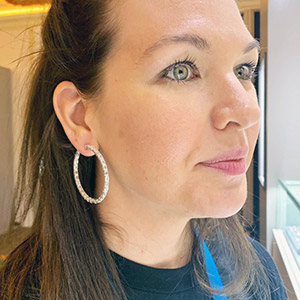
I live in her amazing hoops, and all my clients do too, because they weigh nothing. They’re a cool shape, and they have diamonds inside and out.
Ofira:
We both love hoops. We have a very similar aesthetic, but I make it more of an everyday wearable thing.
Lorraine:
She does a lot of gold and diamonds and other colors.
Rob:
Do you have favorite things to do in Vegas? Do you go to Vegas a lot?
Lorraine:
We don’t go to Vegas a lot. We go for the shows. We love to go to the shows, have dinner with friends, and gamble a little.
Ofira:
We like a little bit of everything. It’s a great time to see people.
Lorraine:
It’s a really big deal. We’ve never done a show. We decided—because of our diamond world, and also because of what we do—to do Luxury for the first time, to try it out and see how that world feels.
Ofira:
We’re used to going to shows, not doing the show ourselves.
Victoria:
Right. Well, this is so thrilling.
Ofira:
We’re excited.
Victoria:
Opening day is May 27th. It’s a Wednesday. I’ll be there in the morning. I’ll come find you ladies.
Ofira:
Can’t wait.
Lorraine:
We’re looking forward.
Victoria:
Can’t wait to see the goods, and to see you in Vegas. Thank you both so much.
Any views expressed in this podcast do not reflect the opinion of JCK, its management, or its advertisers.
- Subscribe to the JCK News Daily
- Subscribe to the JCK Special Report
- Follow JCK on Instagram: @jckmagazine
- Follow JCK on X: @jckmagazine
- Follow JCK on Facebook: @jckmagazine