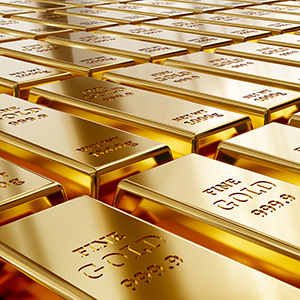
When San Francisco company Marathon Fusion announced last month that it had turned mercury into “real, stable gold,” many scoffed.
The company’s claims have “not been independently verified,” wrote Euronews, “and the material available does not establish how much gold was produced or at what cost.” Others noted that a research paper published by Marathon Fusion has not been peer-reviewed.
However, diamond analyst Paul Zimnisky, who also spent years covering the gold market, says this company’s claims should be taken seriously.
Marathon Fusion’s lead investor is none other than Anglo American, the parent company of De Beers. Marathon Fusion also has received funding from the U.S. Department of Energy.
This is the second time recently that a group claimed it could produce gold in a lab. Last year, scientists at CERN, the European Organization for Nuclear Research, claimed they could produce minute amounts of gold with a supercollider.
In that case, “the economics were nowhere near justified,” Zimnisky says. “It was just an experiment.”
The people at Marathon Fusion are making far grander claims.
CEO Kyle Schiller told the MTS podcast “we are on a pathway to [produce gold] at scale. If things go well, we might double global gold production.”
But when asked if gold might end up losing value like diamonds have, Schiller said that bullion was “an incredibly resilient asset, and it is something that we’re pretty confident will continue to hold a tremendous amount of value even as production scales modestly.”
This new synthetic gold does have one notable similarity to lab-grown diamonds: The early lab-grown players viewed the jewelry business as a way to fund the use of diamonds for technical purposes. Similarly, Marathon Fusion’s stated goal isn’t to create gold, but nuclear fusion, which some think eventually will be a source of cheap, almost limitless energy. Gold will be a by-product of the process. And yet, because it’s gold, it won’t be thrown away.
“The gold wouldn’t be the endgame, more like a side hustle,” wrote The Atlantic. “The millions of dollars made from selling the precious metal could be used to offset the cost of nuclear fusion.”
Zimnisky expects Marathon Fusion to “just produce microscopic amounts of gold,” he says. “But most of the time, that’s what you find in the ground as well. Most commercial mining operations do not produce visible gold.”
Lab-grown gold may also be a huge threat to the bullion market because, unlike lab-grown diamonds, there will likely be no way to tell the synthetic material apart.
“Gold is an element,” Zimnisky says. “Diamond is a mineral. You don’t have the impurities to separate lab-grown from natural, like you do with diamonds. Gold is gold.”
Any metal produced by Marathon Fusion won’t be suitable for jewelry use—at least not right away. Since it will have traces of radioactivity, it may have to be stored for close to 18 years, the company has said.
“But eventually it will be cleared,” says Zimnisky. “And if you’re holding gold as an investment, who cares where it’s held, especially since it will probably be priced at an attractive discount.”
What does all this mean for the gold market, which lately has seen an unprecedented run? The price of gold is still trading at historically high levels—it’s currently around $4,000—but that’s lower than the $5,500 it hit in January.
Zimnisky believes nervousness about lab-grown gold could be dragging the yellow metal down.
“Gold has always been very sentiment-driven,” he says. Yet it’s also generally been looked at as a conservative hedge. It’s only lately, he says, that the metal’s big gains have turned it into a “highly speculative” commodity that makes “exaggerated moves reflecting whatever the latest story is.”
In any case, it’s generally agreed that lab-grown gold is expensive to produce and potentially hazardous. It’s also not available commercially. No one expects it to be coming to a jewelry counter in the near future.
Commodity market expert G Chandrashekhar told India’s ET Now that “it is possible” to create very small amount of lab-grown gold.
“However, the cost associated with producing gold in a laboratory is going to be astronomical,” he said. “For it to be commercially viable is not on the horizon anytime soon.
“But we also remember, technology keeps advancing all the time. So, who knows? Five years, 10 years, it may become possible. For the moment, physics and economics may be limiting factors for lab-grown gold to compete with natural gold.”
Zimnisky mostly agrees, though he points out that the original lab-grown diamonds were also costly and difficult to produce.
“It’s just a question of how quickly the tech advances,” he says. “I think lab-grown gold will probably happen a lot quicker than it did with diamonds. Diamonds were first produced in the 1950s, and it was decades before they became commercial.
“With the AI build-out, companies need an enormous amount of energy, so there’s a lot of money going into fusion technology. I think it’s just a matter of time for lab-grown gold. The cat is already out of the bag.”
(Photo: Getty Images)
- Subscribe to the JCK News Daily
- Subscribe to the JCK Special Report
- Follow JCK on Instagram: @jckmagazine
- Follow JCK on X: @jckmagazine
- Follow JCK on Facebook: @jckmagazine