The American Watch Association and the Jewelers Vigilance Committee (JVC) have asked the U.S. Supreme Court to strike down President Trump’s tariffs on Swiss and Japanese watch imports, saying they will “unequivocally harm U.S. businesses, workers, and consumers.”
In an amicus brief filed with the court Oct. 24, the two groups said their members “depend on specialized precision components available exclusively abroad, primarily in Switzerland and Japan. There exist no domestic substitutes for these Swiss and Japanese watch components at the necessary commercial scale in the United States, nor is there any realistic prospect of generating the capabilities necessary to manufacture them in America.”
The brief asserted that watch movement factories require “purpose-built machinery, sophisticated tools for precise measurement and control of product dimensions, clean-room assembly, and a highly trained workforce. Simply manufacturing the tools necessary for making watches (such as molds, dies, cutting and forming tools, jigs, and fixtures) alone requires prohibitively large capital investments.
“And even assuming some manufacturers were otherwise willing to undertake the billions of dollars in investment necessary to generate industrial watchmaking capacity, it would likely take a decade or more (from site selection to production part approval) before any sort of manufacturing capability could exist.”
The associations further claimed that rather than create U.S. jobs, as intended, the tariffs will eliminate them, explaining that Swiss manufacturers increased shipments to the U.S. before the tariffs went into effect, but some small jewelers lack the financial resources to hold excess stock, they noted.
“Without an assortment that includes much, if any, new inventory, independent jewelers cannot stock display cases, which drive foot traffic and service volume,” according to the brief. “This decreased supply generates less demand, forcing reductions in staff hours, benefits, and head count.”
Trump has offered “no cogent rationale” for the tariffs on watches, the groups said, noting that while the tariffs are billed as “reciprocal,” neither Japan nor Switzerland has duties on watch components.
“Any perceived imbalance in the bilateral trade relationship [with Switzerland] is not the result of the watch industry,” the brief said, “but instead of other industries, including pharmaceuticals—which, unusually, the president exempted from the tariffs.”
JVC and the watch association filed their amicus brief in Learning Resources v. Trump and Trump v. V.O.S. Selections, a consolidated lawsuit that argues that Trump improperly used the International Emergency Economic Powers Act to impose tariffs on virtually all U.S. trading partners.
The Court of International Trade, the U.S. District Court for the District of Columbia, and the U.S. Court of Appeals for the Federal Circuit have all ruled that Trump lacked the constitutional authority to impose the levies. However, the Court of Appeals declined to enjoin the tariffs until the Supreme Court ruled on the issue. The nation’s highest court agreed on Sept. 9 to take up the case, with hearings set to begin Nov. 3.
During a panel Monday at the CIBJO Congress in Paris, JVC president and CEO Sara Yood said she was unsure what the outcome would likely be.
“It is possible that the Supreme Court could say that all of these tariffs are illegal and [all the importers will] get refunds,” she said. “It is also possible that they will say they’re okay and we will continue along this pathway.”
In August, the United States imposed a 39% tariff on Swiss imports, spurring what the Federation of the Swiss Watch Industry called an “extraordinary” 56% drop in Swiss watch exports to the U.S. in September.
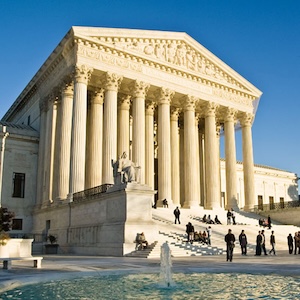
(Photo courtesy of the U.S. Supreme Court)
- Subscribe to the JCK News Daily
- Subscribe to the JCK Special Report
- Follow JCK on Instagram: @jckmagazine
- Follow JCK on X: @jckmagazine
- Follow JCK on Facebook: @jckmagazine