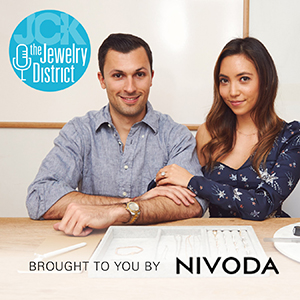
In the latest episode of The Jewelry District, JCK news director Rob Bates and JCK editor-in-chief Victoria Gomelsky talk to the husband-and-wife cofounders of The Clear Cut, a New York City–based brand that creates custom engagement rings and other jewelry with the option to do so completely virtually. Olivia, the Clear Cut’s CEO, and Kyle, its chief operating officer, talk about their company’s origin story, from Instagram DMs to a full-time tech-enabled operation; how they fill the niche between an in-store experience and an overwhelming online marketplace; their unapologetic focus on natural diamonds; trends in the engagement ring space; and their ideas about the importance of storytelling around diamonds.
Listen Now
Title sponsor: Nivoda (nivoda.com)
Sponsor: De Beers (adiamondisforever.com)
Show Notes
04:00 Olivia and Kyle’s backgrounds
07:00 The Clear Cut is born
09:00 The direct-to-consumer landscape
11:55 Filling a niche in the market
15:00 Natural diamonds and The Clear Cut’s recent growth
18:30 The lab-grown vs. natural diamond conversation
22:00 How can the natural diamond industry better promote itself?
Episode Credits
Hosts: Rob Bates and Victoria Gomelsky
Producer and engineer: Natalie Chomet
Editor: Riley McCaskill
Plugs: @jckmagazine; nivoda.com; adiamondisforever.com
Show Recap
Olivia and Kyle’s backgrounds
Olivia is the fourth generation of her family in the diamond business. Her dad’s side of the family were diamond cutters and dealers in Antwerp, and her parents had an independent antique jewelry business. Growing up around the industry, Olivia didn’t think she would pursue jewelry as a career, but after college, she wasn’t sure what direction to take, so she got a Graduate Gemologist degree at GIA. “While I was there, I fell in love with diamonds, gemstones. It was in my blood all along,” she says. That was also where she met Kyle.
The path that Kyle took to GIA looked quite different than Olivia’s: He moved to Sierra Leone after studying countries with a wealth of natural resources that hadn’t translated into economic prosperity. “Sierra Leone, unfortunately, is a strong example of that,” Kyle explains. After doing research there as a student, Kyle was hired by a Sierra Leonean politician Momodu Maligie.
After Maligie’s campaign, Kyle got the opportunity to start a fair trade diamond-mining venture. Since he didn’t have experience with diamonds, his investors sent him to GIA, where he met Olivia. He returned to West Africa to work at the mining venture until the Ebola crisis set the country back. He then returned to New York and attended Columbia Business School.
While Kyle was in West Africa, Olivia got her first job at Tiffany’s flagship store. She worked on the engagement floor, where she fell in love with bridal jewelry, especially diamonds. She wanted to have more of a hands-on role with clients, so she moved to a large wholesaler in the Diamond District. During that time, Kyle was in business school, and many of his friends were getting engaged. Since they knew Kyle had ties to the industry, he was constantly being asked if he knew someone who could get a good deal on engagement rings. “So, I was the go-to ‘guy’ for everyone at Columbia Business School that year,” Olivia says.
The Clear Cut is born
As Olivia taught all Kyle’s friends about the four C’s, helped them pick out diamonds, and create custom rings, she got the idea to start an education blog. The Clear Cut began as a blog in 2016, so their friends and Kyle’s classmates could read about the basic do’s and don’ts of buying diamonds.
After Olivia started posting some of the engagement rings she was designing on social media, people started following her account and requesting their own custom rings. “It kind of snowballed and turned into this accidental side business where I was selling almost $1 million of engagement rings on my lunch breaks, and before and after work.”
Kyle, who was in business school, decided they should make into a real company. In 2018, The Clear Cut got into a tech accelerator called Techstars. The couple officially quit their day jobs and started working on The Clear Cut full time. “We always had a vision of scaling this ‘lunch break private jewelry business’ into something more meaningful,” Kyle says.
After their first year, they debuted a collection of jewelry—necklaces, earrings, and bracelets. By 2020, they had built proprietary software, which helps with purchasing engagement rings remotely. This timing was fortuitous, since during the pandemic, remote selling of engagement rings became a lot more common. The company saw enormous growth over its first few years as a result.
The direct-to-consumer landscape
Victoria takes a moment to zoom out and ask Olivia and Kyle to paint a picture of the direct-to-consumer (DTC) landscape in 2017–2018, at the time The Clear Cut launched. Many brands were DTC, raising venture capital money and spending a lot on social media ads. “It was that high time where everyone was growing and not being profitable,” Olivia remembers. In the jewelry space, specifically, the big players were Blue Nile, Brilliant Earth, and James Allen, which was acquired by Signet.
Though many companies were trying to get into custom jewelry, most of the founders didn’t have Olivia and Kyle’s diamond background, and their understanding of the sales process and potential pain points. “At that time, there was very much a DTC playbook,” Kyle recalls, pointing to Away luggage and Warby Parker. But they understood that it was important to make some key departures from that formula in order for online jewelry sales to be successful.
They disagreed with some conventional selling strategies, such as sending models with CZ to customers. “People care about the diamond,” Olivia insists.
Kyle says that “selling expensive items that are one of a kind and not just a marketplace seemed unscalable. All the things we doubled down on turned out to work.”
Filling a niche in the market
When they started The Clear Cut, Olivia and Kyle saw two main ways to buy a diamond engagement ring. One was online marketplaces with unlimited options. The other was at a local jewelry store with limited inventory that could be purchased in person from the glass case. Consumers educated themselves about engagement rings through social media, and they came with a specific vision.
Olivia and Kyle positioned The Clear Cut to fill the niche in the market for people who want custom jewelry, but don’t have access to a private jeweler. “
But how do they create this experience when the process is virtual? Every person who wants to create a custom ring must schedule a 10- to 30-minute phone call with a gemologist to understand what they’re looking for. This builds a connection to the gemologist, while also weeding out anyone who isn’t serious. Each customer gets their own personalized portal. The gemologist handpicks each diamond and provides photos, videos, and side-by-side comparisons, so the customer can feel comfortable moving forward. “It’s a real blend between technology, but also the human touch and expertise,” Olivia explains.
Natural diamonds and The Clear Cut’s recent growth
With The Clear Cut’s November sales up about 200% year-over-year, Rob and Victoria ask what the cofounders attribute their recent success to. Kyle notes that last year was a presidential election, which could have affected consumer decisions.
He also underlines The Clear Cut’s strong pro–natural diamond stance. The Clear Cut has had their highest average order value in the history of their company this year, and bridal sales are strong. “Competition allows you to help define your own voice,” Kyle says. “And I think The Clear Cut has a really strong voice and customers are aware of that, and come to us for increasingly more products.”
Rob asks why they think their consumers like natural diamonds, given all the talk about lab-growns. Kyle credits their travel ring program, which includes a free lab-grown diamond along with the custom natural diamond ring. If someone is deciding between The Clear Cut and a competitor offering a lab-grown diamond ring, “that ends that comparison pretty quickly,” Kyle says.
The lab-grown vs. natural diamond conversation
Victoria asks how they tackle the conversation when a customer is leaning toward lab-grown, because they want a larger-size diamond, but don’t have the budget to get one. Kyle explains that the goal is having the conversation, rather than talking the customer out of or into something.
Olivia notes that they have had some customers recently who got a lab-grown diamond ring that they’ve decided to trade up for a natural diamond. “And it’s not for a bigger natural or even a higher quality,” she notes. They have been asking for a similar size, but in a natural diamond.”
Kyle explains that, at the end of the day, people tend to have a set budget that they can spend on an engagement ring. He thinks there will be two separate markets for lab-grown and natural diamonds, and that they will be budget-dependent. “There was a period of time when there was a lot of confusion in the market,” Kyle says. “I think those days are ending.”
How can the natural diamond industry better promote itself?
Rob asks what Olivia and Kyle think the natural diamond industry should be doing to promote itself. In an effort not to be disparaging, Olivia thinks the natural diamond industry has failed to take a crucial marketing step: “Acknowledge the competition and say why you’re different.”
“There’s no lack of desire for diamonds, whether lab-grown or natural, but we need to know: Why should a consumer spend more money on a natural diamond?” Olivia says.
Olivia and Kyle have noticed the percentage of their color grade assortment has shifted: Since 2023, their K through O color grades has increased over 115%. Clients are opting for lower and lower color grades. They point to this as a response to lab-grown diamonds. Their theory is the warmer tones signal that the diamond is natural.
Victoria asks about how countries that depend on diamond mining are doing. Kyle talks about newer programs like GemFair that empower artisanal miners and bring new transparency to that part of the process. But he also stresses the need for storytelling about places that have done so much with diamond mining.
The Clear Cut has come full circle and is working with Columbia Business School to write a case study on the diamond industry with a focus on Botswana. The country’s minister of minerals and energy recently came to the school and took unscripted live questions from students. They had hard questions, but she was poised and inspiring. “Her story is uniquely shaped by diamonds,” says Kyle. Olivia and Kyle believe that telling those stories are what will bring a new generation on board.
Any views expressed in this podcast do not reflect the opinion of JCK, its management, or its advertisers.
- Subscribe to the JCK News Daily
- Subscribe to the JCK Special Report
- Follow JCK on Instagram: @jckmagazine
- Follow JCK on X: @jckmagazine
- Follow JCK on Facebook: @jckmagazine