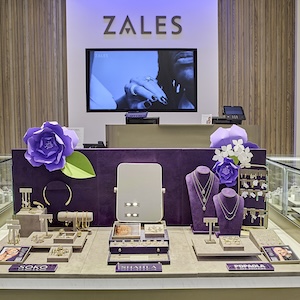
Signet’s third-quarter comps rose 3% over last year, with comps at its three “core banners”—Kay, Zales, and Jared—up 6%.
It was the third quarter in a row that Signet’s comps increased, and comes on the heels of two years of falling same-store sales.
Overall sales improved 3.1% to $1.4 billion during the quarter ended Nov. 1, up $42.4 million from the same period last year.
On a conference call this morning, Signet executives noted the difficult retail climate, with consumer confidence down while tariffs and the price of gold have been heading up.
That uncertainty was reflected in Signet’s updated fourth-quarter guidance, predicting that comps will come in anywhere from 0.5% up to 5% down—which executives admitted was a conservative forecast.
“At the start of November, we saw everything from [low] consumer confidence to issues with the government shutdown, SNAP,” said CEO J.K. Symancyk on the call. “Our consumers are dealing with a lot.”
But he added: “We really believe the holiday is going to happen per normal and we’ve got confidence in our plan moving forward.”
Following the call, Signet’s chief financial officer and operating officer Joan Hilson talked with JCK about how the jewelry giant has been affected by tariffs and other issues, what’s happening with lab-grown and natural diamonds, and why traffic is down in some stores but not others.
Obviously, the current 50% tariffs on Indian imports are having some effect. How have you been coping with that?
Our teams have done a terrific job overcoming the incremental tariffs that we saw over the last several months. We’ve been working to offset them either through [relocating to a different] country of origin or through assortment architecture or through product innovation, as well as negotiating with our vendors.
We were able to do that with mid-single-digit price increases in the assortment, selectively done. Most of the pricing work was done through reduced promotions and reduced discounting.
On the earnings call, you mentioned Signet stores have had lower traffic throughout the quarter.
What we’re seeing is the brands that have a higher concentration of lower- to middle-income households have seen a more pronounced impact over the last five weeks. The brands like Jared have seen some impact, but not nearly as what, for example, Kay and Zales have seen.
How did you find Black Friday?
We haven’t talked about our performance over the weekend. What we would say is that in our business, Black Friday is not as material as it may be in other retail businesses. We have 70% of our business to go coming out of Black Friday. So really the next several weeks are what are most critical to us.
Speaking of Jared, you reported that its comps were up 10% in fashion.
Jared is a really great story of the traction that we’re getting with our “Grow Brand Love” strategy. We’ve launched Storied Diamonds and have launched a new modern marketing campaign with that brand. We’ve upscaled [Jared] product with a beautiful offering of gold and diamond jewelry, and the customers are responding. They have also been furthest along on the reduction in promotions and discounting, and in fact they are down 25% from last year. So we’re seeing the brand positioning, the product assortment, and the modernized marketing strategy is working together to deliver that positive comp.
You have said the company is increasing the use of lab-grown diamonds in fashion.
Lab is, we believe, an expander for us in fashion. It’s performing quite nicely, and we’ve increased our penetration of lab-grown in fashion. We’ve doubled it from 7% to 14% of the merchandise assortment in the quarter, and we’ll continue to do that. That’s largely in price points below $1,000.
On the call, you said that lab is 40% of your bridal business and 15% of your fashion sales. How about natural diamonds?
We continue to see a nice acceptance of both natural and lab within the bridal business and within Jared, where we’re beginning to see the new programs and the new marketing take hold. It’s early days, but we’re seeing some improvement to prior run rates with natural diamonds with that campaign.
When you talk about lab-grown under $1,000, what kind of product is that?
It would be rings with diamonds on them, or bracelets with more diamonds, necklaces with more diamonds, earrings that the customer could not afford with a natural stone and so they’re able to get diamond fashion jewelry with a lab-grown stone.
It’s very interesting because the gold content and the lab-grown content is really a nice balance for us. [Lab-grown diamond jewelry delivers] three times the value of a piece without a lab-grown diamond in the piece. So it drives up the average transaction value, but it also gives the customer something affordable under $1,000.
And how about gold prices?
We’ve value-engineered our products to target key price points within our assortment, while taking selective price increases where necessary. While customers do understand the value of gold as a commodity, there have been pockets of demand weakness, as the costs have gone up largely at price points most sensitive to lower-end consumer demand. And I would note Banter as an example of that.
It’s been nearly a year of the Grow Brand Love strategy. What are Signet’s priorities in the coming quarter?
[We’re instituting] the modern playbook in marketing. You’re going to see more of a mix in digital video rather than traditional TV, and you’ll see more marketing with social. So we’ve mixed that up going into the holiday season.
(Photo courtesy of Signet Jewelers)
- Subscribe to the JCK News Daily
- Subscribe to the JCK Special Report
- Follow JCK on Instagram: @jckmagazine
- Follow JCK on X: @jckmagazine
- Follow JCK on Facebook: @jckmagazine