The Saks Global bankruptcy should serve as a reminder to jewelry companies that they should always file the appropriate uniform commercial code (UCC) forms when providing merchandise on consignment, a lawyer involved in the case tells JCK.
“A lot of people still don’t do it,” says Sidney Scheinberg, an attorney with Dallas-based Godwin Bowman, who represents several jewelry companies involved in the Saks bankruptcy. “If you’re giving goods on consignment, have a written agreement and, for God’s sake, get a UCC on file. It’s not going to cost you a fortune. It’s a good insurance policy for the future. Otherwise, you have nothing to go on. Without the UCC, you have no proof that you had the consignment.”
Regardless, Scheinberg says UCCs will likely not be an issue in this particular case. “They probably won’t question the consignment vendors that hard,” he says. “They have been making deals: If you sold them goods pre-petition and you continue to supply them, they will pay you for the merchandise plus the money that they owed. The people that are taking over realize that if they don’t have a relationship with their vendors, they will have no merchandise coming in.”
Scheinberg believes Saks Global—which includes Saks Fifth Avenue, Neiman Marcus, and Bergdorf Goodman—has already made agreements with most of its big vendors, though some of the smaller ones may have a tougher time getting money back.
Geoffroy van Raemdonck, the Neiman Marcus veteran who became Saks Global’s CEO following the Chapter 11 filing, told Bloomberg this week that just about all the company’s major vendors are continuing to ship merchandise.
He later wrote on LinkedIn that Saks Global has “secured access to an additional $325 million under our committed $1.75 billion financing package, bringing total liquidity to approximately $825 million since mid-January, with access to another $300 million tranche expected in the coming weeks.”
Scheinberg expects that Saks Global “is going to survive, based on what I’ve read. They’ve shut their outlets. Filing for bankruptcy lets them get out of some bad leases.”
But he doesn’t think much of the Saks-Neiman merger engineered by former chair Richard Baker, which occurred only a year before Saks Global filed for Chapter 11.
“That was a house of cards,” Scheinberg says. “When Saks bought out Neiman, they didn’t have the resources to do it. They ended up borrowing from Neiman to pay for what was wrong with Saks.”
In Monday’s New York Times, Baker said he shouldn’t be blamed for the Saks bankruptcy—as well as the liquidations of Lord & Taylor, Fortunoff, and Hudson’s Bay, all of which he presided over.
“I kept each one of these businesses going longer than anyone on Earth ever could have,” he said. Though he added: “I’m happy to be out of the department store business.”
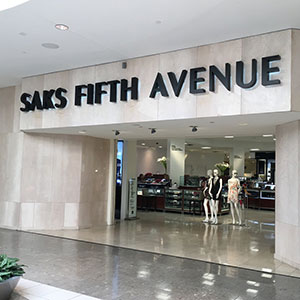
(Photo courtesy of Saks)
- Subscribe to the JCK News Daily
- Subscribe to the JCK Special Report
- Follow JCK on Instagram: @jckmagazine
- Follow JCK on X: @jckmagazine
- Follow JCK on Facebook: @jckmagazine