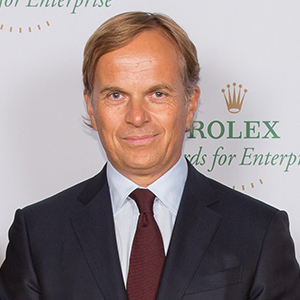
Despite Rolex’s 2023 purchase of retail chain Bucherer, the watch giant will keep selling its products through traditional channels, Rolex CEO Jean-Frédéric Dufour said in a wide-ranging (and rare) interview during a Dubai Watch Week panel last month.
Bucherer “is a small part of our distribution network,” Dufour said. “We don’t have any intention to grow further than that. It was [a purchase] opportunity we had to do. And now we are better understanding the retail business.”
The traditional model is “the way Rolex built our success,” he said.
“We always found the best partner locally, to be sure that we were able to spread [our] message the right way.”
As far as Rolex’s other major move in the last few years, Dufour said the decision to launch a certified secondhand program stemmed from what company officials had observed in the United States.
“We noticed that at some point of sales, the number one brand is Rolex and the number two brand is Rolex secondhand,” he said. “So we said, Okay, maybe there’s something which is wrong there, by having such a level of business without being sure there won’t be any issue.…
“While you are buying a watch, we can say, ‘Don’t worry. We will take care of you.’ It’s very important. People need to trust.… There’s nothing worse than feeling betrayed when you bought something expensive.”
On the topic of technology, Dufour said that Rolex is using artificial intelligence (AI) “to program” and “maintain” machine parts and for quality control.
“AI can also help you, for example, with the final quality test, because you can replace the human eyes with AI and instead of controlling maybe just the samples of what you do, you can control 100% of what you do,” he said.
But Rolex would never use AI for customer service, unlike “when you call banks or insurance,” Dufour maintained.
“If you call the after-sale service at Rolex, it won’t be an AI answering you,” he said. “We still need this human connection. I think it’s very important that we keep that in our industry.
“The final consumer, they want to be connected to something that is real. When you call Rolex, it has to be a real connection, something which is not just AI.”
Dufour said he wasn’t surprised by the failure of the luxury Apple Watch, though he does think smartwatches got people used to having something on their arm.
“They don’t produce a watch, they call it a phone that you put it on your wrist,” he added. “They tried to [sell] the Apple Watch in gold.… They were advertising in Vogue, and they put a lot of money in[to it]. But we’re lucky—Americans, they’re not so patient. They thought that after six months they have to try something else.”
Room for innovation remains in the market, according to Dufour. Some young, upstart brands “are pushing us” to think different, he noted.
“It’s good for an industry to have newcomers. An industry without newcomers is a little bit of a dying industry.”
In response to a question, Dufour said Rolex respected the role of industry journalists, even though company executives rarely speak with them.
“We are a very silent brand, but we love journalists,” he said. “You cannot imagine a world without journalists. We love them.”
The Dubai Watch Week panel with Dufour was moderated by Wei Koh, founder of watch-culture magazine Revolution, and also featured Abdul Hamied Seddiqi, chairman of United Arab Emirates-based luxury retailer Seddiqi Holding.
(Photo courtesy of Rolex)
- Subscribe to the JCK News Daily
- Subscribe to the JCK Special Report
- Follow JCK on Instagram: @jckmagazine
- Follow JCK on X: @jckmagazine
- Follow JCK on Facebook: @jckmagazine