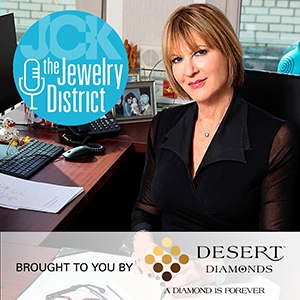
Appearing in a new video format, JCK’s Victoria Gomelsky and Rob Bates interview Rebecca Foerster, Hearts on Fire’s president for North America. Rebecca, who recently won JVC’s Stanley Schecter Award, shares how her experiences growing up in New York City, working in cosmetics and fragrances, and entering the jewelry industry on the manufacturing side shaped her view of and affection for the business. She also lends her perspective on what successful retailers are doing right, as well as how lab-grown diamonds have changed the market.
Watch Now
Title sponsor: De Beers (adiamondisforever.com)
Show Notes
03:55 Rebecca’s background and introduction to the industry
05:30 Her time in cosmetics and fragrance
12:00 Working at Alrosa
15:20 Being part of a global industry
17:30 Rebecca’s priorities at Hearts on Fire
20:50 What retailers need to do
24:00 Lab-grown diamonds’ place in the market
26:15 Women in leadership roles in the jewelry industry
Episode Credits
Hosts: Rob Bates and Victoria Gomelsky
Producer and engineer: Natalie Chomet
Editor: Riley McCaskill
Plugs: @jckmagazine; adiamondisforever.com
Episode Transcript
This transcript has been abridged and edited for clarity.
Victoria:
Hey, everyone, welcome to The Jewelry District. I’m calling in from my garage in Los Angeles, where the magic happens.
Rob:
I’m currently at the JCK world headquarters in New York City.
Victoria:
We’re very pleased to welcome Rebecca Foerster, president and CEO, North America, of Hearts on Fire, an industry veteran. We’re really thrilled to have you, and we’re excited to start this video format.
Rebecca:
Thank you for having me. We’re having a lot of fun behind the scenes, and I look forward to our conversation.
Victoria:
Well, we can dive in. We just saw each other at all the industry events: 24 Karat, the Gem Awards, and the JVC luncheon, where you were honored with the Stanley Schechter Award, which we will get to.
We typically begin with background. Tell us a little about where you grew up, where you went to school, and what led you to your first major industry—then eventually to jewelry.
Rebecca:
I grew up in Jackson Heights, Queens, where I lived until I moved to New Jersey after getting married. I attended Bronx High School of Science, which was a rigorous school that gave me a strong foundation. I then went to Pace University in Manhattan, studying premed. My goal was to become a doctor.
After graduating, I applied to medical school but realized that if I want to balance life, that wasn’t what I wanted to do. So I earned a master’s degree in marketing and began a career in the cosmetics and fragrance industry, working for Revlon, Estée Lauder, Elizabeth Arden, and Lancaster Group.
Rob:
How long did you do that?
Rebecca:
I was in that industry about 15 years.
Rob:
Was it similar to what you do now, or different?
Rebecca:
Very different. The corporate life was different. People had a lot of money. We were celebrating luxury in a different way. In cosmetics and fragrances, there are very healthy margins, which supported a robust marketing role or a leadership role. There was lots of money to spend to promote your brand, to gain recognition for your brand. That industry continues to excel at marketing, because the money was there to do that.
After many years, I was recruited into the jewelry industry by Jonathan Goldman, my first mentor in this industry, the CEO and owner of Frederick Goldman. And I have to say it was a big change. I think when you look from the outside, diamonds and jewelry seem glamorous and luxurious. But the reality is when you work for a manufacturing company, which is in the middle of the supply chain, it’s a different story.
But I quickly fell in love with jewelry, diamonds, and the industry and the relationships. It took me a while to get used to, but I realized that there were a lot of the same skills that could be applied.
We created many brands during the very beginning of jewelry branding, many of which remain in the marketplace and have been with Frederick Goldman for a long time.
Later, I was recruited into the mining industry by Rio Tinto, which gave me experience across the supply chain, which is highly unusual. I was there for seven years. Rio Tinto introduced champagne diamonds and silver mist diamonds, adding storytelling and value to these unique gems that were coming out of the ground.
Sponsor message:
This podcast is brought to you by De Beers. It’s not every day you get to talk about a truly new idea on natural diamonds, one that gives customers a way to celebrate their person with diamond jewelry as unique as they are. Desert-toned diamonds come in unexpected shades of pale, sunlit whites to deep, smoky whiskeys—natural colors unlike anything else, for people unlike anyone else. This year, introduce your clients to Desert Diamonds. A diamond is forever. Visit adiamondisforever.com to learn more.
Victoria:
I know you spent time at Alrosa…. I’m curious what that was like.
I was born in Russia, in what was then Leningrad, and then we emigrated in the late ’70s. I went back for the very first time in 2004, to do a writing program in my hometown, which had been renamed back to its original St. Petersburg. I had convinced my then boss, Whitney Sielaff, at National Jeweler—yes, we’re going way back—to let me continue to write from Russia. I had made a big deal of trying to connect with Alrosa while I was in St. Petersburg. I reached out to Alrosa and made an appointment to come to Moscow, which is no small feat.
I’d emailed maybe 10 times to confirm [the appointment]. And the morning of, I call his office and they’re like, “He’s not here.” And he had totally bailed. It was a story in its own. I was disappointed and maybe not entirely surprised, knowing that Russians can be a little unpredictable. I wondered what your experiences were.
Rebecca:
The experience at Alrosa was one of the best I’ve had in this industry. Obviously, the way it ended was another story. The interview process lasted a year and a half, with several meetings in New York by different people each time. I never really knew who was going to show up or where we were going to meet. Sounds like a movie. But always very professional, very mindful.
My supervisor there became one of my strongest mentors and was very respectful and supportive.
I was a woman running the North American division of their mining company, which they never really had. It was a startup of sorts. I went to Moscow quite a few times—a beautiful city, really alluring. The company itself was fantastic, very professional. It was a mix of the old and the new, but it was very efficient. And it was a great three years of my career. I learned even more about diamonds because they have some of the most beautiful diamonds in the world. We did rough tenders and polished auctions. They trusted me, and we had really great camaraderie and great transparency and dialogue.
They were very ethical and very responsible. The amount of revenue that they gave back to their community in Yakutia, which is where the 12 mines were, was more than any company. It was incredible—the wildlife, the children, health care, culture, education. It was really something. I was very proud to represent them here in the United States.
Rob:
You’ve worked for companies based in Israel, Russia, China, Australia, and the United States. Any differences you’ve noticed?
Rebecca:
We live in a global world, but each culture has nuances. Working across cultures has helped me grow and become a better businessperson and learn how to navigate those nuances.
A former boss at Estée Lauder taught me the motto “Win wars, lose battles.” If you try to change everything or convince people of everything, it often doesn’t pay off. It’s a big waste of energy, and it doesn’t often give you a big change. So you deal with the big things that are going to make a difference. And that’s very important with different companies around the world, because you don’t always see eye to eye on everything. I think it’s really helped me build an interesting perspective.
Victoria:
You arrived at Hearts on Fire in 2022, correct? What were your top priorities in your first year, and how has the company evolved during your tenure?
Rebecca:
This year marks Hearts on Fire’s 30th anniversary. About nine years ago, Chow Tai Fook acquired the brand from Glenn and Susan Rothman. When I arrived, the company had a broad distribution base and was very diamond-centric, focused on “the world’s most perfectly cut diamond.” That was the tagline at the time.
But the rise of lab-grown diamonds signaled the need for change. We transformed the brand from a diamond brand to a modern diamond jewelry brand. Why is that different? Because of the value proposition you’re offering to the retailer and end consumer. If you’re a diamond brand, everything’s about the price of the diamond and its cost. And having a well-cut, beautiful diamond comes at a premium. Now, competing with lab-grown, it was clear we had to make a change.
We evolved our designs and created signature collections that were designed to allow the diamond to perform at its best, with mountings and settings that allowed the diamond to breathe and show its soul, light performance, color, and fire.
This elevated us to a new level of luxury. And our global team created visual assets, elevating us out of that middle tier, competing with generic and lab-grown, and now competing up there with brands that were more luxury.
Of course it takes years. We have many new signature collections that have done very well. For them to become iconic, like some of the other luxury brands, takes time. But we’re on our way, and I’m proud to say that the strategy has been very successful.
Victoria:
Tell us about retailers, like Just One Eye, which you’ve partnered with. What are they doing right? What is their secret?
Rebecca:
It’s all about the customer journey and experience: creating that 360-degree experience, from looking at a website to walking into the store and working with a salesperson. The stores in our portfolio that do this best create an experience and therefore become a destination. Many incorporate coffee or cocktail bars or redesign their stores to an incredible level.
Just One Eye is especially unique—more like a museum than a store, with high ceilings and curated merchandise. When you walk in, you immediately know that the owner has done a serious job of picking what she believes is the best of each category to share. So being part of a store like that is amazing for Hearts on Fire because we’re there with these unique designers. We were there with a Cartier collection. That was a huge vote of confidence in what we were doing.
They also have incredible art. Damien Hirst is there, and a new sculptural collection. When you visit, there’s always something different. The events they do are known throughout Los Angeles. It’s a big deal to get invited. Similar stores like CD Peacock and Thomas Markle and others have done similar things, but more jewelry-focused.
Victoria:
What role do you see lab-grown diamonds playing in the industry?
Rebecca:
Lab-grown diamonds are here to stay, and consumers demand them. I don’t negative-sell the category; it has its place. We need to come together as an industry and be very clear and consistent in our messaging to the consumer so they understand exactly what they’re buying, what makes a lab-grown different than a natural diamond, why the pricing is different. In the end, consumers are going to make the decision, but I at least want to make sure it’s based on the right information.
At VicenzaOro, Martin Rapaport said something interesting: Natural diamonds should go where the money is. And I think that’s true. That’s why Hearts on Fire’s elevation strategy was spot-on, because the people that appreciate natural diamonds have the money to spend on it. And they’re buying more and more. Our average sale price almost doubled since we’ve taken on this strategy. So I think there’s a place for it in that upper part of the market. And I think lab-grown has its place.
This happens in every industry. It’s our job to figure it out and shift. I don’t think we can live in a world where there isn’t long-term thinking, strategy, and being able to shift and pivot. There’s always going to be a consumer for natural diamonds. The market share might be different or smaller, but we have to capitalize on that.
Victoria:
Let’s talk about women in the industry. You were just honored with the Stanley Schechter Award, which is incredible. So many of the people who we see honored in the business—because they’re the executives—are and continue to be men. Was it difficult rising through the ranks of this business? What can the industry do to welcome more women into leadership roles?
Rebecca:
I was fortunate to have many opportunities. I was often in the right place at the right time. But I see more women rising into significant roles today. They may not always be C-suite positions, but they’re head of merchandising, head of marketing. How you show up matters—confidence, fairness, listening, and bringing value all make a difference. In any industry there needs to be a good balance between a female perspective and a male perspective.
There are still challenges, as in any industry, but many of the leaders I’ve worked with have respected and welcomed women’s perspectives. I’ve been lucky in that regard.
Any views expressed in this podcast do not reflect the opinion of JCK, its management, or its advertisers.
- Subscribe to the JCK News Daily
- Subscribe to the JCK Special Report
- Follow JCK on Instagram: @jckmagazine
- Follow JCK on X: @jckmagazine
- Follow JCK on Facebook: @jckmagazine